Foreword from the editors
As members of the Contemplative Practice Faculty Interest Group (CP FIG), staff and faculty at Concordia University gathered monthly to create a space for stillness and reflection, interrupting the bounded layers of teaching and learning within a large urban higher education institution. This resource reflects the generative possibilities that emerged through our communal and yearlong cycle of inhaling and exhaling together; moments of playful resistance where empathy, belonging, and curiosity surfaced.
This publication arose from a scan of existing open-access resources on contemplative practices and pedagogies (CP&P). It is not meant as a recipe book or an exhaustive introduction to CP&P, but instead a reflection of the knowledge and experiences of our faculty interest group. Rather than reading it linearly like a traditional book, we invite you to engage with this online resource as a network of reflections, practices, and tools. Like a tree root system, it is somewhat entangled, always in communication with itself, and has the potential for new content and practices to grow.
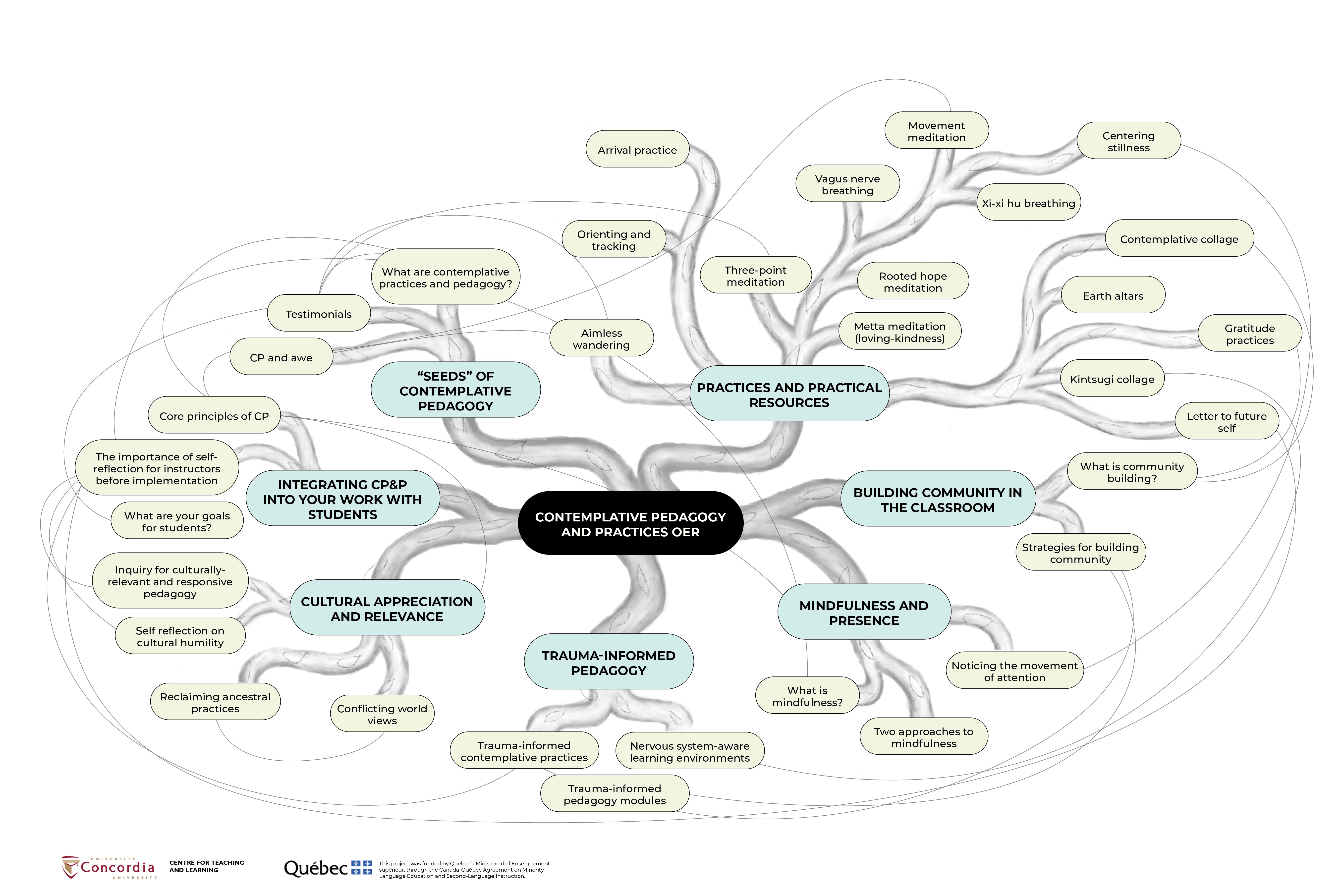
The phrase “Contemplative practices and pedagogy” can mean two distinct but related things. The first meaning names an approach to pedagogy that prioritizes the development of student skills in contemplation. Regardless of discipline, subject matter, or approach, every teacher can develop approaches to teaching that benefit the whole person–mind, body, and spirit. In this resource you will find high-level design principles and practical tips for bringing CP&P to your learning objectives and classroom activities, towards goals like community building, practicing cultural humility, and engaging with awe.
Second, “CP&P” can name an entry point into being contemplative about your teaching, reshaping how you relate to and approach your course goals, materials, and lesson design. CP&P in this sense was what inspired us to include intentional pauses throughout the resource, as reminders for how CP&P is as much about instructors as it is about students. Notably, this research features pedagogical considerations that emerged during our monthly gatherings, including honouring the cultural and historical roots of various practices; recognizing the interconnections between the nervous system and the importance of trauma-informed approaches; prioritizing classroom community; and integrating mindfulness and presence.
We are very pleased to share this resource with you, and we feel honoured to have been participants and learners in the many sessions hosted by the Centre for Teaching and Learning over the last year. We have much to praise and feel grateful for from all of our collaborators, but we still wish to single out Cristina Galofre Gomez, Josephine Guan, and Erika O’Hara for bringing everything together with their vision, generosity, and joy. We are so pleased to have helped bring this resource for teachers into the world, and we hope to learn about how CP&P shapes your teaching in the years to come.
– Amy Cooper and Stephen Yeager