Practices and practical resources
Kintsugi collage
Amy Cooper
Category / branch (in the tree of contemplative practices): Creative – contemplative arts
Kintsugi – the art of/and repair
This practice was initially designed as an arts-based method folded into my doctoral research exploring critical forms of human rights education (HRE). It was used during a three-day participatory HRE workshop for community workers on how to advance racial justice within their youth-serving organizations. Specifically, the practice aimed to explore resistances faced by community workers in their anti-racism efforts and provide space for repair, learning and transformation. Given the diverse group of IBPOC community workers participating in the workshop, each with their own complex stories of racism and discrimination, it was important that the activity support reflection, care, and restoration.
Cultural & historical origins
The practice is inspired from the Japanese art of golden joinery called kintsugi (金継ぎ), where broken pottery is put back together with lacquer and gold dust. The art of kintsugi acknowledges that a broken pottery, such as a bowl or plate, can never return to its original state; instead, by showcasing the breaks, it is made anew. Drawing from the aesthetic philosophy of wabi-sabi (侘び寂び), where perfection lies in the imperfect, the golden fissures are the in-between spaces of beauty and possibility.
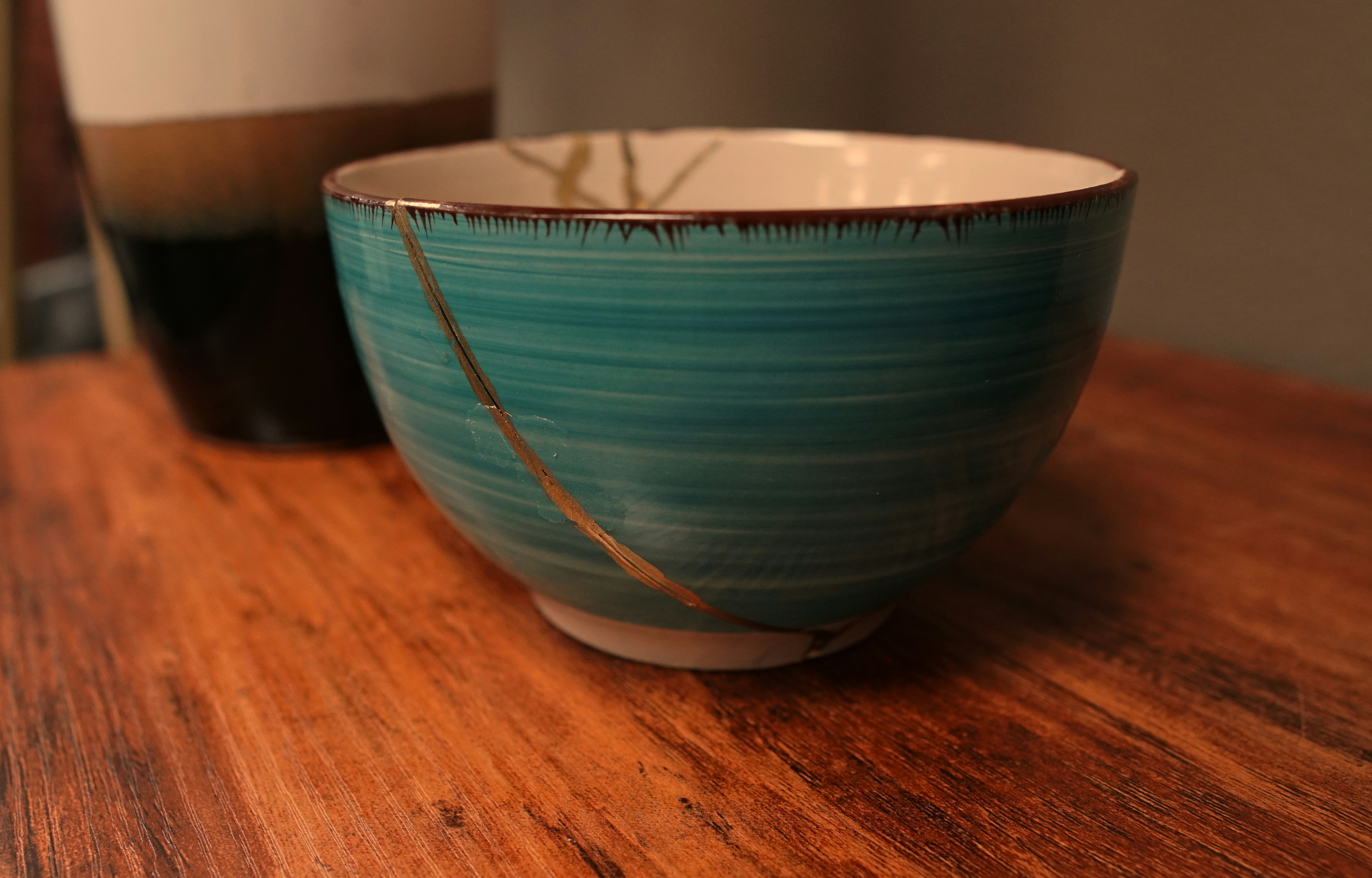
This practice is also tethered to my Japanese mother, an avid potter, who was born during WW2 and settled in Canada in the early 1970s. It honours her experiences with racism, as well as my own, and comes from a place that recognizes that we are all a bit broken but where transformation can emerge from the fissures.
What to be aware of
Given this process calls for a prompt that invites an exploration of a negative experience for renewal and transformation, be mindful of how this may be triggering for participants as well as yourself. Ensuring a trauma-informed lens will help support people’s safety and meaningful participation. For example, consider who is in your class/group, what experiences may emerge, and their relationship with each other. Consider also what processes or spaces participants can have access should they need a break during and/or after the activity. Please be sure to consult our section on trauma-informed pedagogy.
Ways to use this in the classroom
The practice aims to reorient a previous negative experience towards growth and transformation. It is important to identify a prompt that is related to class objectives and to situate the activity and its facilitation in a way that allows for thoughtful exploration.
It requires at least 45 minutes, but the time depends on the number of students/participants and the breadth and depth of the associated group discussions. Be mindful of the timing of the activity and how you close the reflection.
Before you begin, remind students that participation comes in different forms and is voluntary. It is also important encourage participants to shake off any inhibitions or fears they may have regarding art-based practices. The art is in the process of individual creation, not the final product. Further, finished pieces are for the students themselves to keep and do what they want with.
Materials: White and coloured paper (preferably card stock), markers, gold-coloured art supplies such as paint, markers, glitter glue, etc.
Instructions
The process described below is a modified version from the activity I led during a longer three-day workshop. Participants had established a trusting relationship with each other and were used to sharing their stories and experiences for discussion.
This practice is divided into three parts:
Part 1: Setting the stage (5-10 min)
- Explain to participants that you will be doing an arts-based practice to explore resistance and transformation. Encourage students to set aside any concerns or inhibitions that come with the term art, as the art here is focused on the individual process of making and creating, and not the finished product.
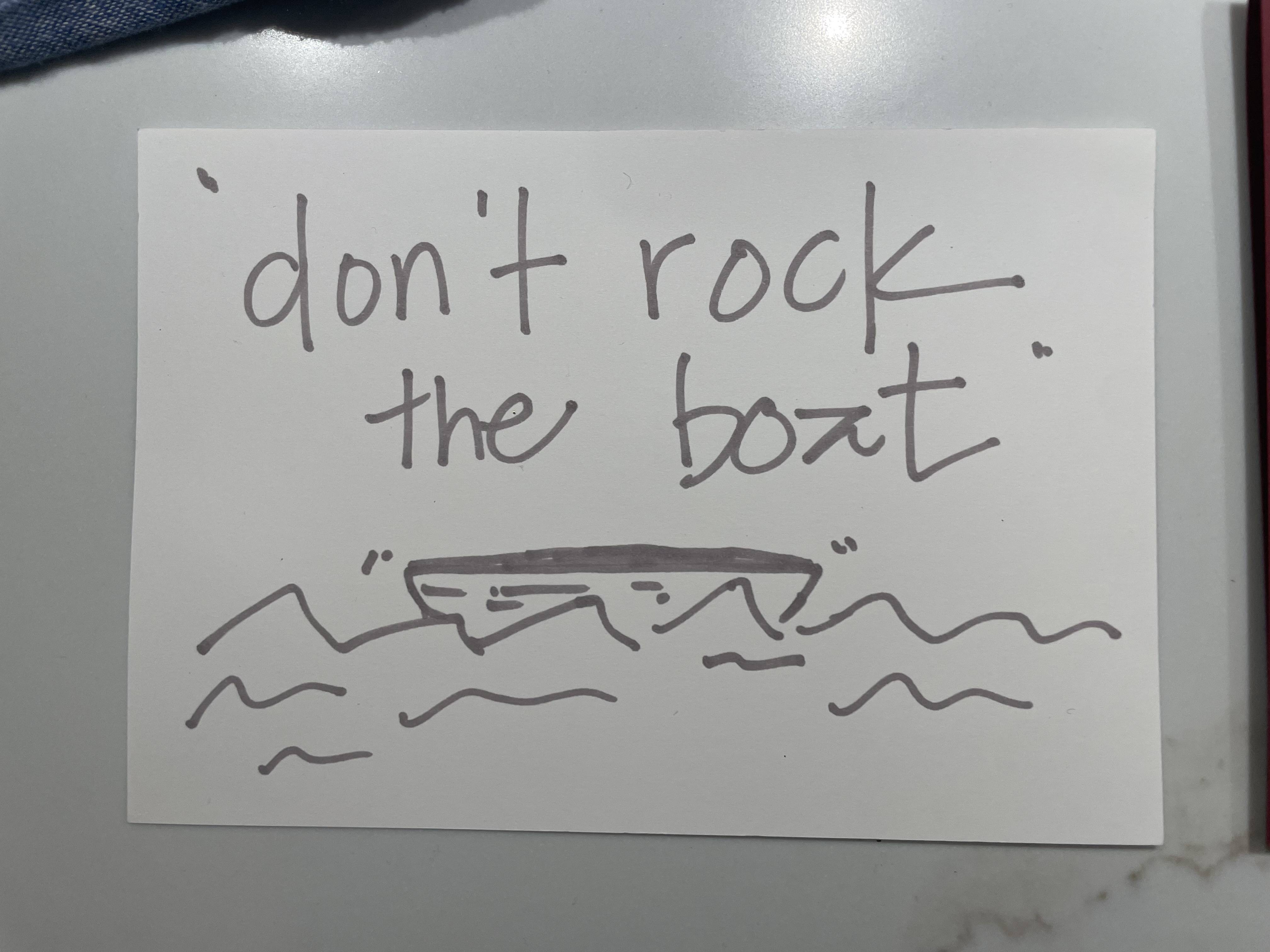
- Ask students to individually reflect on their ordinary moments of resistance in their anti-racism work (or topic of your choice), such as being told to “stop rocking the boat” or “we’re not ready to do this work”.
- After a few minutes, ask students to capture their resistances in 3-5 key words or images (e.g. doodles) on a piece of card stock (see Fig. 2)
- Invite volunteers to read and simply show their words and/or images to the group.
Part 2: Destruction and Repair (15 min)
- Explain the art of kintsugi – where broken pottery is put back together with lacquer and gold dust. The bowl or plate never returns to its original state; instead, by showcasing the breaks, it is made anew. These fissures are where the beauty and possibility lie, the in-between space where faults and failures help us learn, repair, and transform.
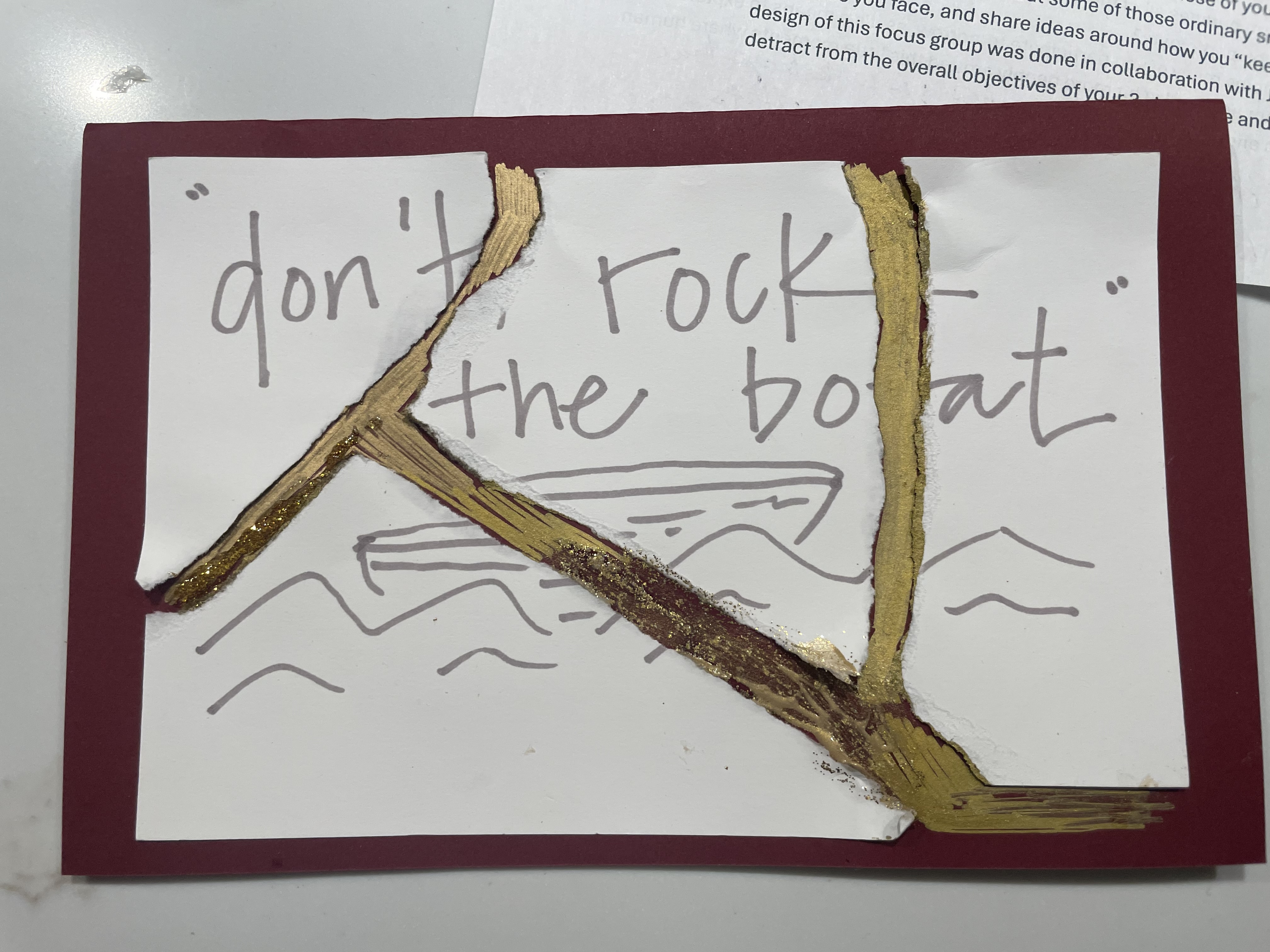
- Tell participants to tear the card stock into 4-5 pieces and invite everyone to start their repair work by putting back their pieces using the gold paint, glitter and gold, or other materials at each table (see Fig 3).
- Provide some guiding questions for students to consider as they repair their pieces in silence, such as: Where do you find strength when faced by a challenge? Where do / can you find joy as you move forward?
Part 3: Sharing learnings (10-15 min)
- Invite students to share discussion based on the following questions. Ensure you allow space for silence and do not force people to respond. If a large group discussion doesn’t seem appropriate, invite students to discuss with their neighbour or write in a reflection journal instead.
- How do you feel about your resistance now?
- What have you learned about yourself in these moments?
- How do you work through these resistances? What do you do to sustain yourself in these more challenging moments? Where do you find hope and renewal?
- Close the discussion by thanking participants and summarizing and/or suggesting strategies for hope and renewal. For example, you could share breathing techniques that promote grounding, reduce anxiety, and balance the nervous system.
Related content
- Naj Sumar’s self reflection on cultural humility can help you situate yourself in relation to the cultural roots of this practice
- Check out the piece by Ridge Shukrun on the importance of self-reflection in the implementation of contemplative pedagogies
- Consider reading more about trauma-informed pedagogical strategies to help be address any trauma that may surface in the practice of breaking and repairing
Additional resources
Princer, M. K. (2022). Putting the pieces back together: Using a kintsugi-influenced directive to promote self-forgiveness and resiliency in young adults with shame and guilt [Master of Arts in Marriage and Family Therapy, Dominican University of California]. https://doi.org/10.33015/dominican.edu/2022.AT.03