Practices and practical resources
Earth altars
LeeRay Costa
Category / branch (in the tree of contemplative practices): Creative, ritual/cyclical, and stillness
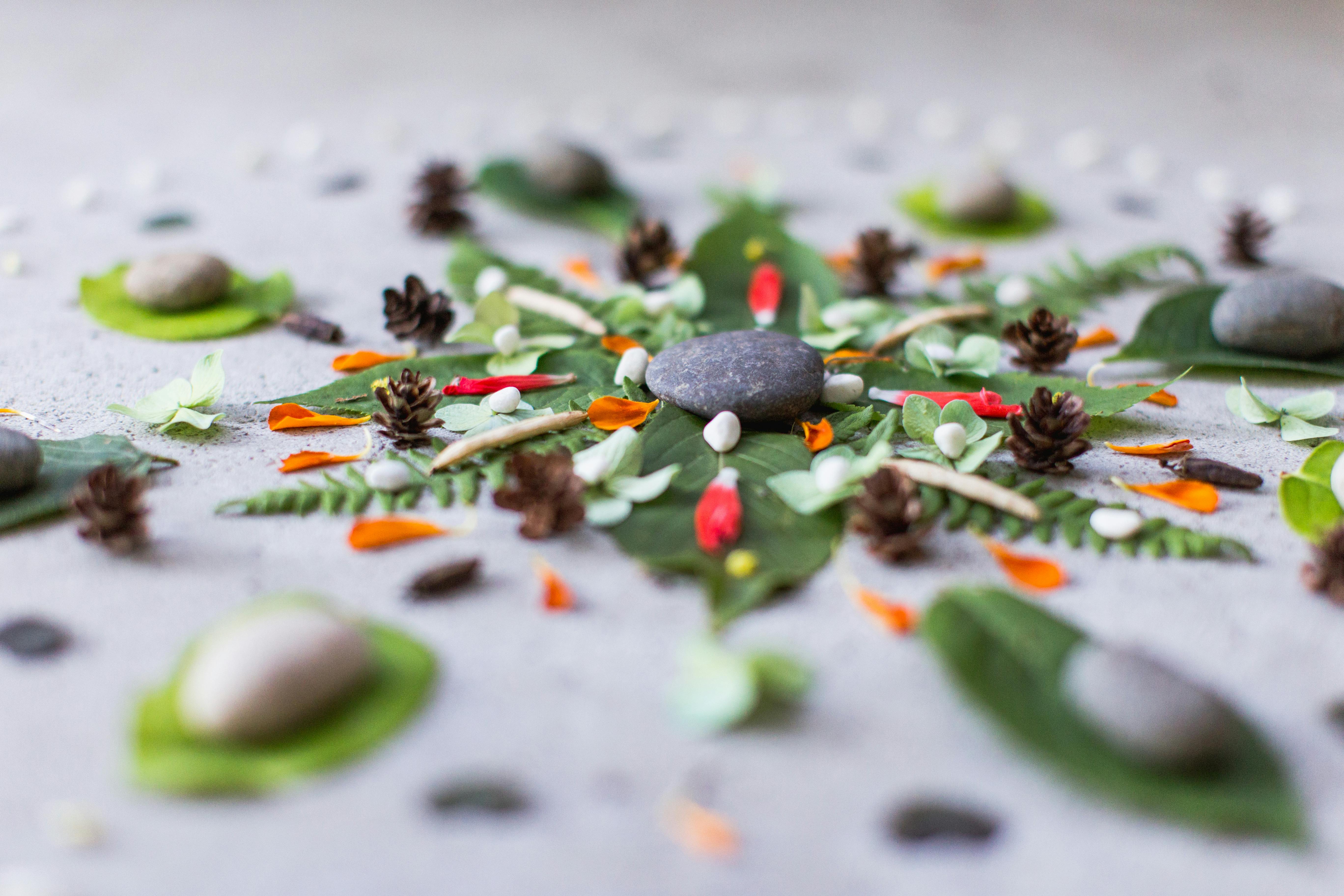
“It is the return to nature that allows us to return to our true selves.” – Lucia Pec, @my.creative.nature
I began making earth altars on the beach many years ago, as a form of quiet, creative expression. This included altars made out of natural materials and objects, as well as plastic and trash. I have always been a creative person but I did not readily connect my personal art-making to my other contemplative practices. It wasn’t until I discovered the work of Day Schildkret that I began to more intentionally merge these practices. After attending a retreat on “Morning Altars” (as he calls them) with Day, I began to make earth altars on my forest hikes in the Blue Ridge Mountains where I live, and post photos of them to my social media accounts. Personally, I find the creation of earth altars to be a profoundly moving practice that reminds me of my interconnectedness with the natural world. I had long been integrating other contemplative practices into my work with students (e.g., breathing, meditation, yoga, forest bathing, etc…). But it was while co-teaching a course called Naturing Community, Nurturing Connection that I led my first earth altar workshop – bridging my interests and training in cultural anthropology, spirituality, contemplative practice, and environmental studies/activism. Since then, I have been invited to share my earth altar practice in other university venues, with students, alumni, faculty, and staff.
Cultural or historical origins
People across time, cultures, and nations have practiced making a diversity of forms that we might include under the umbrella term of “earth altars.” Nature-based art and the creation of sacred altars or sites reflect a wide range of spiritual, religious, and secular traditions and values (e.g., Indigenous spiritual traditions, Buddhism, Hinduism, and more). Altars can be made by individuals as part of personal contemplative practices, or by groups as part of collective rituals and/or celebrations and offerings. They may honor relationships to the ancestors, spirits, diving beings, mother earth, and human and non-human relatives. Or they may reflect ceremonies for healing and transformation. Some examples include the medicine wheels or sacred hoops created by Native American (Indigenous) communities, Navajo (Diné) sand paintings, stone circles made by the Celts and Vikings, Indian rangoli, and Tibetan Buddhist sand paintings.
What to be aware of
Students have varying levels of experience and comfort with being in natural/outdoors spaces. Letting students know a few weeks ahead of time about the activity and inviting them to share any relevant information with you can be helpful in supporting students. It may be useful to talk one on one with concerned students to provide more detail about the activity and what to expect.
Note that for students raised in some Christian traditions, the creation of earth-based altars might be interpreted as “pagan,” or “sinful,” and feel contrary to their faith. Thus, developing alternatives or modifications to the activity to accommodate a range of student needs is advised. Emphasizing the focus on presence, stillness, and reflection (which are meaningful practices across spiritual traditions) is important. Making the sharing of experiences during the debrief optional also allows students to have more control over what and when they share. This can be followed up with a written or audio-recorded reflection shared only with the instructor.
Ways to use this in the classroom
Explain how the contemplative practice will enhance students learning and/or support learning objectives. Include important considerations that educators leading the practice must be aware of, such as duration of the practice, timing, class size, materials needed, classroom set-up, etc.
Contemplative pedagogy and the use of contemplative practice focuses on the whole student – mind, body, and spirit. As Daniel Barbezat and Mirabai Bush write: The use of contemplative and introspective practices in teaching and learning “promote the exploration of meaning, purpose, and values and seek to serve our common human future. Personal introspection and contemplation reveal our inextricable connection to each other, opening the heart and mind to true community, deeper insight, sustainable living, and a more just society” (2014, p. xv). Such practices help students to cultivate humility, patience, compassion (for self and others), presence, and accountability. They support focused attention on both self and course content, engagement with complexity and contradiction, enhanced critical thinking, and the easing of anxiety, depression, and stress.
Like any contemplative practice, the creation of earth altars helps students to slow down and tune in to present-moment awareness. While stillness and meditation can be challenging for some students, adding the activity of creativity and play (through earth altar making) can help students ease into this contemplative practice in a more familiar way. This practice can be used in a variety of ways, and creatively paired with course themes and questions – whether focused on the environment or not.
The instructor should cultivate familiarity with the practice on their own before introducing it to students. Dedicating sufficient class time for preparation, practice, and debrief of the activity is essential. This is not an activity to be rushed (and would be contradictory to the spirit of the practice). Think carefully about where you will conduct the activity – are there appropriate places on campus to gather natural elements for the altars? And to build the altars? Ensure enough time to get to these spaces before releasing the students to wander and create their altars.
I recommend providing students with a bag to collect items for their altars, and small scissors IF you decide it’s ok to cut leaves/flowers from living plants (you may decide to use only what you can find on the ground). If you plan to make the altars with materials provided by you in the classroom, then you will have to gather all the elements ahead of time and set them up on a table before class for students to forage from.
Instructions
There are no rules for making an earth altar – just open yourself to observation, creativity, intuition, play, and presence. Earth altars can be as diverse as the humans who make them – any shape or design, in any location, made of a wide variety of materials that appeal to the creator. (However, it may be prudent to offer warnings about poison ivy and other dangerous plants if relevant to your context. Students should also be mindful not to take any plants/flowers that have been intentionally, and painstakingly planted by campus grounds crews).
For those who would like a guide, consider these steps offered by Day Schildkret in his beautiful book Morning Altars (2018, page 16-17 – modified here):
- Wander & Wonder: forage for treasures to use in your altar. Remember to ask for permission when removing items from their home place. Follow the 1/3 – 2/3 rule – never take more than 1/3.
- Place: listen for a place that calls you, to locate your altar.
- Clear: use your hand or a brush to clear the space to create a blank canvas for your altar.
- Create: use your collected items to design patterns and shapes, crafting your altar.
- Gift: set an intention or devote your altar (to a person, group, or idea) as a ritual or form of gratitude.
- Share: photograph and share your creation with others.
- Let Go: practice releasing your creation to the earth and elements, bearing witness to impermanence and change.
Alternatives
Students who do not wish to create earth altars can be invited to spend quiet time in nature, the woods, the beach, and/or the classroom as an alternative. Invite them to practice stillness, breathing, meditation, movement, observation, and/or reflection on aspects of nature. This is more akin to forest bathing (Shinrin-yoku; see resource below). For students with mobility issues, instructors may consider providing natural materials for students to make an earth altar on a desk in the classroom, or in an area outside the classroom that is easily accessible (sidewalk, nearby grass area or flower bed).
Related content
- Earth altars can be a way to reclaim ancestral practices and reflect on the questions posed by Emil Briones about our connection to the land
- The sharing of earth altars can be one strategy to help build community in the classroom
- While outside, you can also try a sitting on the earth practice shared by Kariwentha Lee Scott
Additional resources
Click to expand additional resource list
Barbezat, D. P., & Bush, M. (2014). Contemplative practices in higher education: Powerful methods to transform teaching and learning. Jossey-Bass.
Goldsworthy, A. (1990). Andy Goldsworthy: A collaboration with nature. Abrams.
Journal of Contemplative and Holistic Education
Journal of Contemplative Inquiry
Journal of Contemplative Studies
Kimmerer, R. W. (2015). Braiding sweetgrass: Indigenous wisdom, scientific knowledge, and the teachings of plants. Milkweed Editions.
Li, Q. (2022). Effects of forest environment (shinrin-yoku/forest bathing) on health promotion and disease prevention—The establishment of “forest medicine.” Environmental Health and Preventive Medicine, 27, 43. https://doi.org/10.1265/ehpm.22-00160.
McGrady, M. L. (2018). Contemplative pedagogy in the classroom: Engaging students’ self-awareness to enhance learning. Academic Leadership Academy, 93, 1.
Mortali, M. (2019). Rewilding: Meditations, practices, and skills for awakening in nature. Sounds True.
Penguin Books UK (Director). (2018, April 24). The art and science of forest bathing with Dr Qing Li [YouTube Video].
Schildkret, D. (2018). Morning altars: A 7-step practice to nourish your spirit through nature, art, and ritual. WW Norton.
Community & inspiration
- Instagram accounts: @morningaltars, @my.creative.nature, @earth_altarscapes, @lauraloescher.art, @jamesbruntartist
- Participant submissions for the earth altars workshop during Concordia Contemplative Practices Summit 2025 https://padlet.com/leeraycosta/earth-altars-concordia-contemplative-practices-summit-l45f7fobvkbncnvg
Evidence of benefits for students and educators
- Increased sense of well-being (integration of mind, body, spirit)
- Improved academic performance
- Development of healthy life skills
- The development of deep concentration
- The development of increased respect, empathy, and compassion (for self and others)
- The development of humility, patience, presence, and accountability.
- Improvement in communication skills
- Enhancement of creativity & leadership skills
- The development of connectedness and a stronger sense of community
- Recognition that all knowledge is culturally constructed and partial
- Affirmation of diverse cultural and spiritual traditions, ways of knowing, and dignity and worth of all people
- Increased sense of agency and making a difference in the world
- An easing of anxiety and depression, and reduction in stress
- Strengthening immune system function, and decreasing effects of trauma (Berila p. 13 additional citations)
Citations: Owen-Smith 2018; Berila 2016; Snowber 2016; Sable 2014; Barbezat and Bush 2014; Rendón 2014; Zajonc 2008; Goleman 1994).
References
Click to expand reference list
Barbezat, D. P., & Bush, M. (2014). Contemplative practices in higher education: Powerful methods to transform teaching and learning. Jossey-Bass.
Berila, B. (2015). Integrating mindfulness into anti-oppression pedagogy: Social justice in higher education (1st ed.). Routledge.
Goleman, D. (1995). Emotional intelligence: Why it can matter more than IQ. Bantam Books.
Owen-Smith, P. (2018). The contemplative mind in the scholarship of teaching and learning. Indiana University Press. https://doi.org/10.2307/j.ctt200616w
Rendón, L. I. (2023). Sentipensante (sensing / thinking) pedagogy: Educating for wholeness, social justice, and liberation (2nd ed.). Routledge. https://doi.org/10.4324/9781003446941
Sable, D. (2023). Reason in the service of the heart: The impacts of contemplative practices on critical thinking. Journal of Contemplative Inquiry, 1(1), 1–22.
Snowber, C. (2016). Embodied inquiry: Writing, living and being through the body. SensePublishers. https://doi.org/10.1007/978-94-6300-755-9
Zajonc, A. (2008). Meditation as contemplative inquiry: When knowing becomes love. Lindisfarne Books.