Seeds of contemplative practices and pedagogy
What are contemplative practices and pedagogy?
Donetta Hines and Erika O’Hara
Contemplative practices and pedagogy (CP&P) encompass a variety of course design approaches, teaching practices, and learning activities that provide the time and space for individuals to identify, access, and satisfy their own needs and intentions for learning, in line with your learning goals for students.
On this page…
Contemplative practices
Contemplative practices come from all over the world, rooted in the rich histories of a variety of cultures and peoples. Barbezat and Bush in their 2014 book Contemplative Practices in Higher Education provide the following definition for contemplation:
The word contemplation derives from contemplari, to “gaze attentively,” but the word was originally linked to the act of cutting out or creating a space, as in “to mark out a space for observation.” The word temple comes from this definition: a place reserved or cut out for observance. In many ways, the practices we are discussing provide this space for students to allow them to observe and gain insight.
Contemplative practices have varied origins and purposes tied to them, including:
- spiritual/religious – e.g., The Ignatian Pedagogical Paradigm (Chien, 2020),
- secular (e.g., secular instrumental music (MisirHiralall, 2016),
- or a blend – e.g., Mindfulness Based Stress Reduction (MBSR) but its roots come from Zen, Theravada, Tibetan, and Vietnamese Mahayana Buddhist meditation (Romano & Chang, 2022)
These practices are diverse, varied, and perhaps even contradictory, but some of the shared qualities that exist across contemplative practices are that they:
- are additional ways of knowing the world which complement the traditional (rational, sensory) ways of knowing, teaching, and learning (Hart, 2004).
- make space for discomfort by cultivating curiosity, rather than mastery.
- can foster transformative – rather than transactional – and integrative learning that nourishes the well-being of the whole person. This includes not only the cognitive domain of learning, but extends to the emotional, the physical, the spiritual, and more.
- reorient us to ourselves, what we are actively doing, those we are in relation with and the effect of our actions, and the community we are fostering together.
- aid in cultivating a sense of meaning by using a first-person perspective with either the direct experiences of the self, or complex ideas or situations as the object of focus (Barbezat & Pingree, 2012).
- are more than meditation. Contemplative practices include forms of movement and dance, ritual, focused thought, time in nature, reflective writing, deep listening, dialogue, storytelling, and arts, from traditions around the world.
The Tree of Contemplative Practices
In the video below, Rosemary Reilly, a founding faculty member of the faculty interest group on contemplative pedagogy gives a brief overview of the “Tree of Contemplative Practices”. This tree, developed by Maia Duerr and Carrie Bergman for Contemplative Mind in Society in 2004 provides an overview of practices that were used by folks in sectors such as healthcare, education, business, government, and social justice. The practices are group by common themes, which serve as the larger “branches” of the tree.
Click to download a transcript of the video (pdf)
Contemplative pedagogy
Contemplative pedagogy can be defined as approaches to teaching and learning that intentionally integrate contemplative practices, or the philosophies behind them. The general aim is to encourage deep learning and character development by cultivating students’ focused attention, reflection, and introspection. Contemplative pedagogy can range from integrating practice in the classroom all the way to designing a course or curriculum that centres contemplation.
From a scan on the literature, contemplative pedagogy can be summarized as:
Ways of teaching and learning that exist in the spaces between.
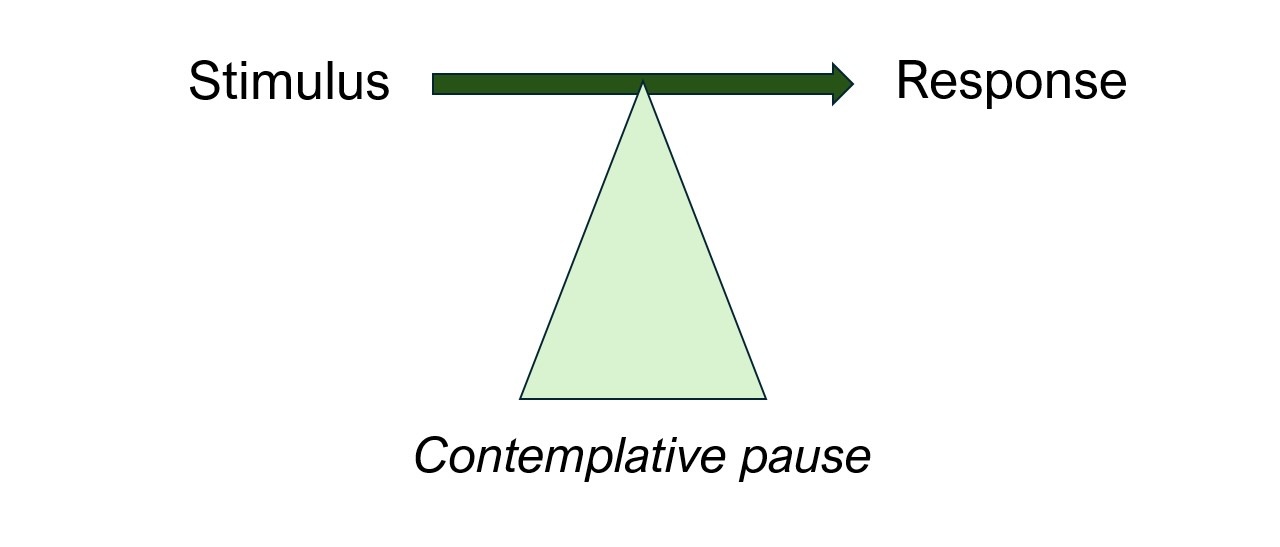
“The spaces between” is intentionally worded ambiguously – it can be applied to the physical spaces between the body and its surrounding environment, stimulus and response; the metaphysical spaces between mind, body, and spirit; self and other; self and environment; self and object or subject of study; the educator and student, student and student…
This is building on the “contemplative pause” in which Karolyn Kinane (University of Virginia, contemplative guide & educator) talks about in her introductory video on contemplative pedagogy (2022).
An aside on the term “pedagogy” versus “andragogy”
During a co-writing meeting held by the OER co-writing group, there had been some discussion over what we intended “pedagogy” to mean in the context of this resource. Given that we are aiming to reach educators in the university setting, there was question of whether we are actually engaging in contemplative andragogy.
Three points of note regarding this:
- “Contemplative pedagogy” is the contemporary keyword/subject term for this topic which, if searched in literature databases, will yield relevant texts, regardless of the age of the learners in question.
- Andragogy and pedagogy have a tenuous, highly contextual relationship ranging from being in opposition, to one growing from the other, to being unattached fields of study (Loeng, 2018).
- Even within andragogy, there are variant understandings of the concept including a spectrum of individualized motivation and progress, to a social and relational lifelong learning process (Loeng, 2018).
With that in mind, the pedagogy vs. andragogy question is not one to be answered in the scope of this resource. Rather, our aim is to highlight the “why”s and “how”s of bringing contemplation into one’s teaching practice.
From a scan of the literature on contemplative pedagogy, the following key themes and characteristics were found:
A variety and versatility of approaches, attitudes, and practices
Not only does the variety of contemplative practices allow educators to pursue the best fit for themselves and their courses, it also creates the opportunity for students and teachers to learn about diverse cultures and situate themselves in relation to these histories and peoples (Fort, 2016). Haberlin (2026) has developed a framework for implementing meditation in the classroom that is flexible enough to work for any discipline. What matters, in the case of bringing contemplative pedagogy into the classroom, is knowing oneself as an educator and knowing the students.
Because contemplative practices can be rooted in spiritual or cultural practices, they must be chosen and integrated with care. This is a key addition that arose from our co-writing sessions with the contributors of this resource that developed into many chapters that you will find here. Ridge Shukrun provides a starting point for instructors who are considering or have already implemented contemplative pedagogy in their work with students in his chapter on the importance of self reflection. Furthermore, you will find an entire section in this resource focusing on how the implementation of a contemplative pedagogy can be done in a culturally appreciative and culturally-relevant manner, beginning with a self-reflection exercise from Naj Sumar on cultural humility.
Educator as practitioner
Educators do not need to be masters of a given practice in order to share it, but it is important to commit to something that they connect with and works for them and their classroom (Laliberte, 2025a; 2025b; 2025c; 2025d). If the educator is not a practitioner, it becomes harder for students to develop their own practice (Barbezat & Bush, 2014). In many practices, the educator needs to have the intrapersonal competence and readiness to guide a practice with students. For more on what this means see Ridge Shukrun’s chapter on the importance of self-reflection for instructors and Joseph Siddiqi’s testimonial as an instructor integrating a contemplative pedagogy into his classroom.
When educators are themselves practitioners and have spent time rehearsing practices, it can increase confidence to teach using a contemplative approach (Laliberte, 2025b; 2025d). For those who are new to contemplative pedagogy, connecting with groups like Centres for Teaching and Learning can help acquaint them with like-minded peers and build community among faculty members within an institution (Laliberte, 2024b; 2025c).
Fostering intra- and inter-connectedness
Contemplative pedagogy can foster connectedness within different parts of the self, with a variety of knowledge disciplines, and with the world as shared by all (Brucker & Chapple, 2017; Papenfuss et al., 2019; Alimah, 2020). Practices can cultivate a sense of judgement based on multiple perspectives which helps both educators and students to think with an open mind that is aware of the interconnectedness of the world (MisirHiralall, 2021).
Students are often encouraged to connect with their own values and meaning making, with course material and to broader issues like social justice (Wilson, 2021). Unlike the banking model of education, where students are seen as “empty vessels” into which information is deposited, contemplative pedagogy bring students and educators together to co-create knowledge in a participatory manner (Wilson, 2021).
See more about this in our section on building community in the classroom and specifically how arts practices can deepen a sense of belonging.
Lifelong growth and learning
Rather than focusing on external materialisms and knowledge acquisition, contemplative pedagogy cultivates students’ insight and wisdom through ongoing awareness (Romano & Chang, 2022).
The transformative learning of contemplative pedagogy stems from the shift away from knowledge and skill acquisition towards a “journey of enacted wisdom” (Gunnlaugson et al., 2023, p. 88).
By adopting a mindset of lifelong growth beyond the power and status acquired with graduation, students who experience education embedded with contemplative pedagogy see their time at university as just the beginning, where they will continue to help the world throughout life. Competition is discouraged in Buddhist universities, who prefer to transform this energy into cooperation (Storch, 2013). Britton et al. (2013) also found that contemplative practices in science education and research helped to foster prosocial behaviour, decrease competition, and improve scientific integrity.
Beyond simple momentary “stress reduction”
In addition to helping students cope with adjusting to university, life stressors, and global crises (Wilson, 2021; MirsirHiralall, 2021; Reeve et al., 2021), contemplative practices can also help educators cope with the stresses involved in teaching, thereby preventing burnout (Muneer & Batool, 2021). They can also help to prevent stress in the future by developing resilience and tolerance to failure (Henriksen et al., 2022), as well as provide physical benefits such as silence or slow breathing (box breathing, centering stillness).
While a common motivator to educators incorporating these practices into their work with students is often stress (Alimah, 2020; Wilson, 2021), it is important to not limit their use to only being a stress-reduction tool. Contemplative pedagogy contains much more nuance and complexity that, when brought into the classroom in a culturally appreciative manner, can allow students to use course material as the object of contemplative focus (Delfita et al., 2020). We will discuss this more in the following chapter on your goals for students.
Building on top of this discussion of stress reduction, our contributors note that some practices may even increase stress for students, especially when asking students to connect with their emotions or engaging with unfamiliar practices in the classroom setting. It is important, therefore, to approach contemplative pedagogy in a trauma-informed manner. Our contributors have developed a section focusing on trauma-informed practices and pedagogy, and going deeper into the reasoning of how activated nervous systems contribute to the classroom environment.
Slowing down to resist the “rush”
Contemplative pedagogy helps to break the habits of mind of “perfectionism, urgency, instrumentalism, and purely transactional relationships” (Kinane, n.d.c.). In contrast to the “fast knowledge” culture we currently live in, contemplative pedagogy aims to slow the classroom pace to allow the time for the knowledge to sink in deeply, which allows them to better understand the full complexities of knowledge and the world (Orr, 1996; Hall & Keator, 2019; Simmer-Brown, 2019).
See Joseph’s section on mindfulness and presence to hear his approach to slowing down and noticing. Also, see the aimless wandering, three-point meditation, orienting, gratitude, and arrival practices shared in this resource.
Decolonial action in education
Engaging in CP&P in good faith, with appreciation, challenges and resists the commodification of mindful and contemplative practices as mere “tools” (Kinane, n.d.b.). Additionally, honouring wisdom – ancestral and contemporary – as equal to intellect is to teach and learn in ways outside the western and colonial habitus (Reilly, 2023). Resisting the rush and recentering values is crucial to ensuring the sustainability of our natural world.
Contemplative pedagogy supports the inner work required to unlearn colonial habits of mind. For example, racial biases can be uncovered, examined, and transformed (Romano & Chang, 2022). Contemplative practices can offer hope and imaginative resistance for more just futures, as in Dr. Robinson-Morris’ rooted hope practice shared in this resource.
Related content
- In the following chapter, we will dive deeper into how contemplative pedagogy can align with your goals for students
- Donetta Hines summarizes five core dimensions of contemplative pedagogy
- A crucial step before implementing CP&P is reflection on what approach you are taking, how to frame this with students, and the implications of incorporating practices. Read Ridge Shukrun’s piece on the importance of self-reflection here.
- Similarily, care must be taken to ensure cultural appropriation. Naj Sumar provides some critical questions for self-reflection here.
- Watch Joseph Siddiqi’s video introducing mindfulness, one entry point to contemplative practices and pedagogy
References
Click to expand reference list
Alerby, E. (2020). Silence within and beyond pedagogical settings. Springer International Publishing. https://doi.org/10.1007/978-3-030-51060-2
Alimah, A. (2020). Contemplative and transformative learning for character development in islamic higher education. Ulumuna: Journal of Islamic Studies, 24(1), 1–23.https://doi.org/10.20414/ujis.v24i1.384
Barbezat, D. P., & Bush, M. (2014). Contemplative practices in higher education: Powerful methods to transform teaching and learning. Jossey-Bass.https://psycnet.apa.org/record/2014-06440-000
Barbezat, D., & Pingree, A. (2012). Contemplative pedagogy: The special role of teaching and learning centers. To Improve the Academy, 31(1), 177–191.https://doi.org/10.1002/j.2334-4822.2012.tb00681.x
Britton, W. B., Brown, A-C., Kaplan, C. T., Goldman, R. E., DeLuca, M., Rojiani, R., Reis, H., Xi, M., Chou, J. C., McKenna, F., Hitchcock, P., Rocha, T. A., Himmelfarb, J., Margolis, D. M., Niles, H. F., Eckert, A. M., & Frank, T. (2013). Contemplative science: An insider prospectus. New Directions for Teaching and Learning (134), 13-29. https://doi.org/10.1002/tl.20051
Brucker, J., & Chapple, C. K. (2017). Contemplative pedagogy: A descriptive account of two approaches to student engagement at Loyola Marymount University. International Journal of Dharma Studies, 5(1), 1–18. https://doi.org/10.1186/s40613-017-0046-z
Chien, G. I.-L. (2020). Integrating contemplative and ignatian pedagogies in a buddhist studies classroom. Religions, 2020(11), 567. https://doi.org/10.3390/rel11110567
Delfita, R., Trisoni, R., Andrizal, A., Putra, A. I., & Adripen, A. (2020). Contemplation-based learning: An effective learning model for serving science and self-knowledge integration. Al-Ta Lim Journal, 27(1), 1–15. https://doi.org/10.15548/jt.v27i1.586
Fort, A. O. (2016). Creating contemplative studies in the southwest: Theory and practice. International Journal of Dharma Studies, 4(1), 13. https://doi.org/10.1186/s40613-016-0039-3
Gunnlaugson, O., Cueto De Souza, R., Zhao, S., Yee, A., Scott, C., & Bai, H. (2023).Revisiting the nature of transformative learning experiences in contemplative higher education. Journal of Transformative Education, 21(1), 84–101. https://doi.org/10.1177/15413446211067285
Haberlin, S. 2026. Facilitating meditation practice in the higher education classroom: A conceptual framework. College Teaching, 74(1), p. 52-61.
Hall, M. P., & Keator, M. (2019). Stitching together east and west: A tale of two professors. Dev Sanskriti Interdisciplinary International Journal, 14, 08–21. https://doi.org/10.36018/dsiij.v14i.132
Hart, T. (2004). Opening the contemplative mind in the classroom. Journal of Transformative Education, 2(1). https://doi.org/10.1177/154134460325931
Henriksen, D., Heywood, W., & Gruber, N. (2022). Meditate to create: Mindfulness and creativity in an arts and design learning context. Creativity Studies, 15(1), 147–168.https://doi.org/10.3846/cs.2022.13206
Karolyn Kinane (Director). (2022, April 20). 18 min intro to contemplative pedagogy w/ Karolyn Kinane [YouTube Video]. https://www.youtube.com/watch?v=L3j8–VUO34
Kinane, K. (n.d.-a). Is contemplation just meditation? [Wordpress]. Contemplative Lab Curriculum.
Kinane, K. (n.d.-b). What are we doing? [Wordpress]. Contemplative Lab Curriculum.
Laliberte, A. (2025a, February 5). Contemplative pedagogy and practices spotlight: Joseph Siddiqi. Centre for Teaching and Learning (CTL).
Laliberte, A. (2025b, February 26). Contemplative pedagogy and practices spotlight: Anne Archambault. Centre for Teaching and Learning (CTL).
Laliberte, A. (2025c, April 3). Contemplative pedagogy and practices spotlight: Megan Fitzgibbons. Centre for Teaching and Learning (CTL).
Laliberte, A. (2025d, April 4). Contemplative pedagogy and practices spotlight: Theodore Klein. Centre for Teaching and Learning (CTL).
Loeng, S. (2018). Various ways of understanding the concept of andragogy. Cogent Education, 5(1), 1496643. https://doi.org/10.1080/2331186X.2018.1496643
MisirHiralall, S. D. (2016). Re-envisioning contemplative pedagogy through self-study. Teacher Learning and Professional Development, 1(2), 84–96.
MisirHiralall, S. D. (2021). Developing a body scan meditation for contemplative pedagogy through self-study. Teacher Learning and Professional Development, 6(1), 48–63.
Muneer, R., & Batool, R. B. (2021). A qualitative study on mindfulness and teacher’s well being. International Journal of Education and Humanities, 1(2), 79–89.https://doi.org/10.58557/ijeh.v1i2.19
Orr, D. W. (1996). Slow knowledge. Conservation Biology, 10(3), 699–702. https://doi.org/10.1046/j.1523-1739.1996.10030699.x
Papenfuss, J., Merritt, E., Manuel-Navarrete, D., Cloutier, S., & Eckard, B. (2019). Interacting pedagogies: A review and framework for sustainability education. Journal of Sustainability Education, 20(April 2019).
Reeve, J., Jindal, R., Bartle, C., & Stokes, N. (2021). Using creative and contemplative pedagogy to promote learning efficacy and wellbeing within first-year, undergraduate students. Gateway Papers, 2(1), 1–12. https://doi.org/10.3943/gp.34
Reilly, R. C. (2023). Workshop: Exploring the tree of contemplative practices: What can I actually do in my classroom? [Yuja].
Romano, L. E., & Chang, D. F. (2022). Right mindfulness in teacher education: Integrating Buddhist teachings with secular mindfulness to promote racial equity. Education Sciences, 12(11), 778. https://doi.org/10.3390/educsci12110778
Simmer-Brown, J. (2019). Contemplative teaching and learning: Opportunities for Asian studies. ASIANetwork Exchange A Journal for Asian Studies in the Liberal Arts, 26(1). https://doi.org/10.16995/ane.291
Storch, T. (2013). Buddhist universities in the United States of America. International Journal of Dharma Studies, 1(4), 1–16. https://doi.org/10.1186/2196-8802-1-4
Wilson, C. (2021). A contemplative pedagogy: The practice of presence when the present is overwhelming. Journal of Transformative Learning, 8(1), 52–62.