Planning Appendix
Planning an
Open Textbook Project
Each project led by a Concordia professor will have its own pathway toward adopting, customizing, or creating an open textbook for an undergraduate course. We plan for these projects to be for undergraduate students by working with undergrads. The Planning Appendix provides an overview of the types of open textbook grant projects, along with the time, work, and steps involved in the process.
Applying for an Open Textbook Grant
Supported by the Library Service Fund, the Open Textbook Grant applications are open every October during Open Access Month and every March during Open Education Month. We encourage Concordia professors across all departments to apply and to adopt, customize, or create an open textbook.
These grants are designed to assist professors in hiring undergraduate students to assist with research, editing, and formatting the open textbook for publication on the Pressbooks platform. Often, students who have taken the course in question make for excellent research assistants in these projects. During open application periods, professors can apply using the application form on our open textbooks grants page (Eng and Fr).
Decide on which open-textbook grant is best for your project based on available grant types.
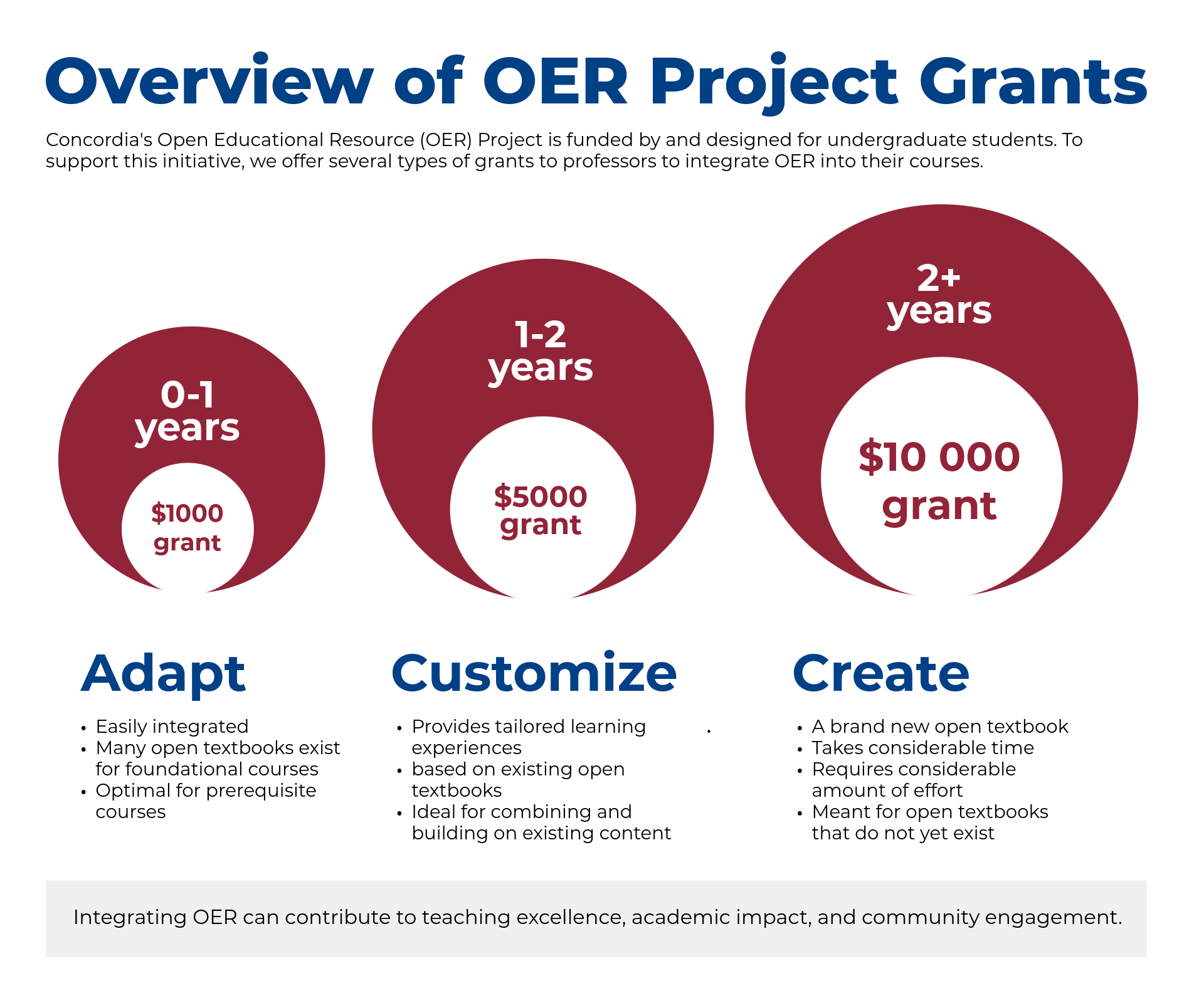
Grant applications are evaluated based on cost savings for students, improvements to teaching and learning, the feasibility of the scope and timeline, and alignment with grant-recipient expectations.
Summary of Onboarding
Successful open-textbook grant applicants will go through an onboarding process in consultation with the Scholarly Publishing Librarian, with assistance from the students on the Library’s OER Team.
Project Plan
The project plan elaborates on the open textbook grant application. It provides an overview of the course, the team and the roles of the members, the allocated budget, a brief sketch of the textbook sections and work to be done, alongside a high-level timeline with check-in points.
As you move along the process, you may choose to develop a more detailed sketch (for your own purposes) and project management documents (again, for your own purposes). You may choose to develop a project tracking strategy that accounts for the tasks involved in the front matter, body, and back matter of your project’s organization. Depending upon the timeframe and scope of your project, you may also decide to integrate a design plan for consistency in the functional components of your open textbook.
Signing OER Agreement
The project plan informs the OER Agreement between the grant holder, as the project lead, and Concordia University Library, as the publisher. A realistic deadline for piloting the project and receiving the final report is set for the purposes of the agreement.
Training
The OER team will assist you in your open-textbook project using Pressbooks. We provide project plan consultation and training on Creative Commons licensing, accessibility basics, as well as a walk-through tutorial on using the platform. We additionally share resources to help inspire, plan, and design your open textbook project.
Working with Pressbooks
This Guide to Pressbooks at Concordia University provides an overview of Pressbooks projects gained from our insights with grant recipients over the years.
It includes samples from inspiring projects alongside technical information on 1) how to add interactive learning components (see Interactive Content with H5P), 2) how to enhance accessibility, and 3) how to add multimedia. We additionally have a section on integrating custom HTML and CSS to further customize textbooks (see Complex CSS), as well as a Design Appendix page.
Students hired your open-textbook project team
Funding is primarily directed towards hiring Concordia undergraduate students to assist with the adoption, customization, or creation processes. This work may include identifying and evaluating resources, developing and adding content in Pressbooks, implementing accessibility standards, implementing interactive content, and providing teaching support with the open textbook in class. Concordia University HR policies and protocols must be followed. Grants cannot be used for travel or equipment. We recommend hiring students who have taken your course in the past.
Ideas as to what your student assistants could be tasked with
In an ‘Adopt’ project, only minor changes are made to an existing open textbook. Student assistants may share responsibilities as outlined in a ‘Customize’ project, but on a smaller scale.
In a ‘Customize’ project, you can change the content of existing open textbooks, merge open educational resources together, add new chapters, or enhance the book with multimedia or interactive learning. Student assistants may be responsible for reviewing or editing existing text, conducting research to add local examples specific to Canada, Quebec, or Montreal OR examples that show current shifts in the field of study. Students might add images or diagrams to illustrate an idea, remove excerpts that are not relevant to the syllabus, or explore adding interactive learning.
In a ‘Create’ project, you must create the content of the open textbooks entirely from scratch. Student assistants may be responsible for research, gathering texts and images from other open-source materials, and planning and organizing the textbook’s content.
In all three project types, we recommend that student assistants share their perspectives on the course materials from their vantage point as learners in your field.
Implementation
Working on an open textbook can be a daunting endeavour. To manage the workload effectively for yourself and the students working on your project, it is essential to clearly outline responsibilities for each collaborator and break those responsibilities down into manageable tasks. Make time for the work involved in each section, including editing, testing, implementing a consistent design, and reviewing our Accessibility Checklist. While building on your initial project planning document, we recommend creating a project tracking strategy that works for you.
Pilot and Feedback from Students
One benefit of an open textbook is the ability to iteratively update it with new information as needed. After developing the content in Pressbooks, the first version is ready to use and test in your course. It does not need to be perfect for students to begin benefitting especially if they know that their feedback will enhance the textbook for the course.
During this stage, the book will be set to “Public,” allowing anyone with the link to access the open textbook. Remember, you can choose to make any specific chapter “private” if not yet ready. Testing the book in a classroom setting lets you see what works well and what needs tweaking. You and the Library’s OER team benefit from collecting student feedback in your course.
During the ‘Pilot’ stage, part of the process is to gather feedback from students on how your open textbook can improve. See our Open Textbook Student Feedback form.
Your own experience with the book, your notes, and feedback from your students can help you add the final touches to your book or develop a second version.
Major changes should be well documented in your ‘Versioning’ section.
Final Report and Deadline
Your student assistants will have completed all assigned hours for the project. As your experience developing an open textbook is valuable to us, we appreciate and learn from your feedback, as well as from your students.
Launch
Congratulations are in order! Your textbook is ready for launch. At this final stage, the content, organization, and layout of your book are finalized (knowing that future versions are possible). The open textbook can be promoted, shared and celebrated at Concordia University and in the wider OER community. Your open textbook will be added to the catalogue of open textbooks on our Concordia Open Textbook website, the Pressbooks Directory, and Sofia, and will be provided with an ISBN.