Digital Marketing Strategy by Pierre-Yann Dolbec is licensed under a Creative Commons Attribution-NonCommercial-ShareAlike 4.0 International License, except where otherwise noted.
Digital Marketing Strategy by Pierre-Yann Dolbec is licensed under a Creative Commons Attribution-NonCommercial-ShareAlike 4.0 International License, except where otherwise noted.
The internet has digitalized our lives: we now create and meet others in online communities on websites such as Reddit, Imgur, Facebook, or NikeTalk. Our relationships with our friends and families have expanded to digital channels such as WhatsApp, Facebook Messenger, and Instagram. We forge new relationships through dating apps such as OkCupid and Tinder. We become microcelebrities on Twitch and YouTube. We consume other people’s lives, we talk to strangers, and we project public personas on social media platforms.
The internet has also transformed how businesses conduct their activities and how consumers go about buying products. Whole industries, such as music and travel, have been radically reshaped. In order to be successful digital marketers, we need to go beyond simply translating the methods and processes that used to be successful for traditional media. We need a drastically different way of thinking about approaching consumers and selling products.
The objective of this textbook is to provide a way of conceptualizing how to do marketing online and a strategic framework to do so. Throughout, real-life examples, learning exercises, videos, and additional resources are offered to cement and expand your learning experience.
The first section of this textbook explains how the internet has transformed the ways firms create value and how consumers experience brands and products. In this first section, we focus on understanding a shift in how firms communicate with consumers: they have moved away from talking about themselves, which was predominant in a pre-internet era, towards often offering free resources to create value for consumers. We then explore how the consumer experience has been radically altered and what the implications are for firms’ strategies.
More precisely, Chapter 1: Introduction to Digital Marketing discusses how digitalization is changing the ecosystem in which we conduct marketing activities. In this chapter, we explore what marketing is and how value is created online, and briefly touch on consumer journeys.
Chapter 2: Understanding the Digital Consumer explores how digitalization is transforming the journey of consumers. We learn about marketing tools (persona, consumer journey, and journey mapping) to help us understand consumer behavior and craft digital marketing campaigns.
In Chapter 3: Planning For a Digital Marketing Campaign, we cover basic notions of search engine optimization and then discuss how, when creating content, keywords can be used to respond to consumers’ needs and goals. We also discuss how keywords can help us understand how our competitors are positioned online.
Chapter 4: Introduction to Digital Strategy presents some key vocabulary associated with digital marketing and the framework we are going to cover for the rest of the semester, the RACE framework. We explain its relationship to persona, journey, and strategy and how it can be used to perform competitive analyses.
The second section of this textbook provides an in-depth presentation of a digital marketing framework centered on conversion-based marketing. This framework echoes the work of many digital marketing agencies. It is composed of four stages through which firms can attract visitors, create leads, transform leads into customers, and foster customer loyalty.
Chapter 5: Reach: Generating Awareness and Attracting Visitors discusses paid media activities. We first emphasize the necessity of building landing pages and describe what landing pages are. We then turn our attention to the online ecosystem, discussing elements such as types of paid media activities and expand on payment models and types of targeting that are available online.
Chapter 6: Act: Creating Content covers some central activities associated with content creation. We discuss how content creation can be informed by the RACE framework, the difference between gated and ungated content, how to build topical relevance, and how pillar pages can help us do so. The chapter ends with a short presentation of content calendars.
Chapter 7: Act: Lead Generation and Lead Nurturing looks at the basics of lead generation and lead nurturing activities. We define leads and lead stages, present a few ways to generate leads and different types of opt-ins, explain how to score leads, and discuss email marketing.
Chapter 8: Convert: Conversion Optimization examines what conversion is and how to optimize web pages to convert better. To do so, we discuss conversion rate optimization, how to identify what to optimize as people move from one web page to another, some conversion-centered principles, A/B testing, and retargeting.
Chapter 9: Engage: Building Loyalty and Co-Creating With Customers deals with how to evaluate and encourage customer engagement and loyalty and foster co-creation by engaged customers. More precisely, we delve into customer engagement, customer lifetime value, ways to measure engagement, consumption communities, and co-creation activities.
Pierre thanks Alexandre Bustamante for the book illustrations, Kelly-Anne Lemay for formatting and editing, and Chloe Lei for academic support, as well as the financial support of Concordia University and the Open Educational Resources initiative.
Figure 1.1 The Evolution of WOM Theory
Figure 2.1 Persona
Figure 2.2 Types of Segmentation / From University of Minnesota’s Principles of Marketing / Text Description
Figure 2.3 RV Betty / Credit: BBH Singapore (@bbh_singapore) / Text Description
Figure 2.4 Consumer Journey: The Funnel Model
Figure 2.5 Consumer Journey: The Circular Model
Figure 2.6 ZMOT
Figure 2.7 Four Types of ZMOT
Figure 2.8 Journey Mapping / Adapted from nngroup.com
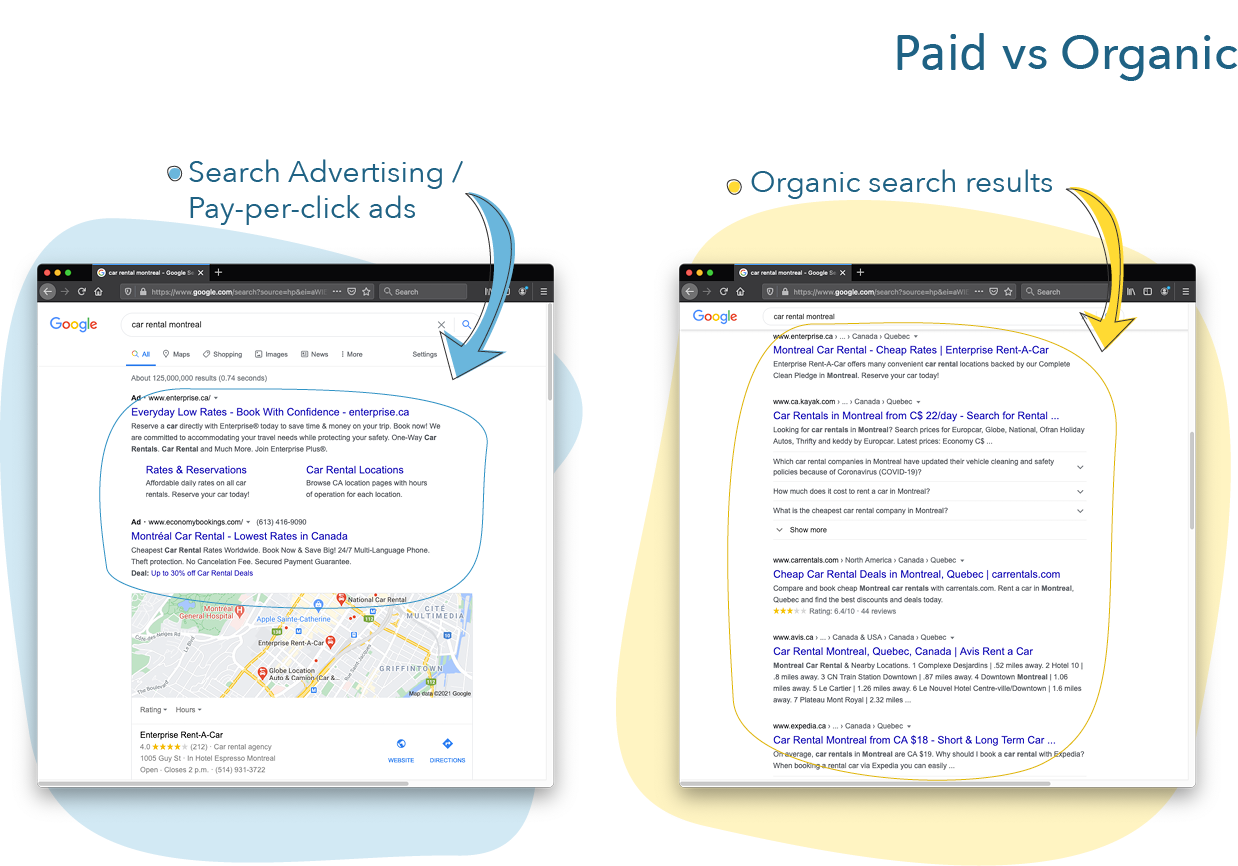
Figure 3.1 Paid vs Organic Search
Figure 3.2 Top Ranking Factors
Figure 3.3 How Meta Tags Are Displayed on Google SERPs
Figure 3.4 Cross-Linking Example
Figure 3.5 Top On-Page Factors
Figure 3.6 Types of Search
Figure 3.7 Journey and Searches
Figure 4.1 Objective / Goal / KPI
Figure 4.2 KPIs Example / Text Description
Figure 4.3 AARRR / Text Description
Figure 4.4 RACE Ojbectives / Text Description
Figure 4.5 Journey and Searches
Figure 4.6 Conversion Path
Figure 4.7 Conversion Path – 1st Example
Figure 4.8 Conversion Path – 2nd Example / Text Description
Figure 4.9 RACE / Text Description
Figure 5.1 Examples of a Clickthrough Landing Page – Fit for Life
Figure 5.2 Examples of a Clickthrough Landing Page – Spotify
Figure 5.3 Examples of a Lead Generation Landing Page – Fit for Life
Figure 5.4 Examples of a Lead Generation Landing Page – Uber
Figure 5.5 Shopify Ad
Figure 5.6 Shopify Homepage
Figure 5.7 AR Conversion
Figure 5.8 Shopify Landing Page
Figure 5.9 Landing Page – Attention Ratio
Figure 5.10 Basic Elements of a Landing Page – Shopify Example
Figure 5.11 Banner Ad
Figure 5.12 Interstitial
Figure 5.13 Pop-Up Ad
Figure 5.14 Floating Ad
Figure 5.15 Wallpaper
Figure 5.16 Map
Figure 5.17 Native
Figure 5.18 Longtail Keywords and Conversion Rate / Text Description
Figure 5.19 Facebook Ad Objectives / Text Description
Figure 5.20 Affiliate Marketing Example
Figure 6.1 Content Marketing
Figure 6.2 Exemplar and Prototype
Figure 6.3 Gated Content Example
Figure 6.4 Ungated Content to Gated Content
Figure 6.5 Topics
Figure 6.6 Funnel
Figure 6.7 Pillar Page Example
Figure 6.8 Traditional Approach
Figure 6.9 Pillar Approach
Figure 6.10 Pillar Page and Gated Content
Figure 6.11 Pillar Page and Gated Content
Figure 6.12 Pillar Strategy
Figure 6.13 Content Calendar / Text Description
Figure 7.1 Lead Generation Facebook
Figure 7.2 Marketo Form Fields
Figure 7.3Scroll-Down Pop-Up Opt-In on Zoella.co.uk
Figure 7.4 Bottom of Content Opt-In on fastcompany.com
Figure 7.5 Double Opt-In on Instagram – Part 1
Figure 7.6 Double Opt-In on Instagram – Part 2
Figure 7.7 Double Opt-In on Instagram – Part 3
Figure 7.8 Drip Email Sequence Example
Figure 7.9 Drip Sequence
Figure 7.10 Email Automation / Text Description
Figure 8.1 Conversion Rate
Figure 8.2 Funnel / Text Description
Figure 8.3 Google’s Conversion Funnel Example
Figure 8.4 A/B Test
Figure 8.5 A/B Differences
Figure 8.6 Attention Ratio Works
Figure 8.7 Encapsulation Example
Figure 8.8 Encapsulation
Figure 8.9 Color Contrast
Figure 8.10 Directional Cues
Figure 8.11 Reading Flow
Figure 8.12 White Space
Figure 8.13 Information Hierarchy
Figure 8.14 Continuity
Figure 8.15 Message Match Failure
Figure 8.16 Message Match Success
Figure 8.17 Design Match Failure
Figure 8.18 Design Match Success
Figure 8.19 Congruence Example
Figure 8.20 Landing Page Evaluation / Text Version
Figure 8.21 Retargeting
Figure 8.22 Retargeting Example
Figure 9.1 Net Promoter Score
Figure 9.2 Value Chain / Text Description
In this chapter, we discuss how digitalization is changing the ecosystem in which we conduct marketing activities. We start by defining marketing, value, and how value is created. We then go on to see how the media ecosystem and digital channels are transforming the logic we use to create value, moving away from representing the company to representing the customer. To set up the next chapter, we conclude by briefly discussing the consumer journey.
Learning Objectives
Understand that the main goal of marketing is to create value and how the changing ecosystem is transforming the ways we can achieve this goal.
According to the American Marketing Association—marketing’s top association—marketing is “the activity, set of institutions, and processes for creating, communicating, delivering, and exchanging offerings that have value for customers, clients, partners, and society at large” (American Marketing Association 2013).
Our goal is to better understand how the consumer experience has been transformed and why it has become necessary to adopt a drastically different perspective on how to perform marketing online. Thus, as we reconceptualize the ecosystem in which consumers and firms operate, we concentrate on the following elements of that definition: “processes for creating, communicating, delivering, and exchanging offerings that have value.”
In other words, the role of marketing is to create value for a broad range of stakeholders. In this textbook, we concentrate on value creation for consumers. We concentrate on value creation because consumers “do not buy products or services, they buy offerings which … create value” in their lives (Gummesson 1995, p. 250). Hence, our focus will be on understanding how firms can create value in consumers’ lives—and how they can do so online.
Firms create value for consumers in many different ways. If we rewind back a few decades, we find that our understanding of value creation was tainted by the work of economists, and value was mostly thought of as being based on products’ utility. Utilitarian value, therefore, denotes the value that a customer receives based on a task-related and rational consumption behavior (Babin et al. 1994). Since then, our understanding of value has vastly broadened to include other types of value, such as hedonic value—value based on the customer’s experience of fun and playfulness (Babin et al. 1994)—or linking value, which is based on the creation of interpersonal links between consumers (Cova 1997). This is important for digital marketers because it means that there are numerous avenues to contribute to consumers’ lives through value creation that expand beyond the use of a product by a consumer to achieve a specific task.
Another important transformation of our understanding of value creation over the last decade is the idea that value is always co-created (Vargo and Lusch 2004). Value is co-created through the meeting of consumers, with their own resources such as skills, expertise, and existing possessions, with that of firms and their resources, such as brand campaigns, service delivery models, and the products they sell.
Let’s see these notions concretized through an example: Before, we would have conceptualized a consumer as buying a car because they wanted to extract the utilitarian value associated with the product (i.e., moving from point A to point B). Value resided in the car and was transferred to a consumer when they put that product into use. Nowadays, we understand the purchase of a car as conceptually very different. First, consumers can buy a car for reasons other than going from point A to point B. Maybe they want to belong to a community of other consumers, or what is referred to as a consumption community, and buying this car allows them to do so. This community-oriented strategy is employed by iconic brands such as Harley-Davidson. Or maybe the consumers see the car as a recreational object, where the end is not important (i.e., where they are going), but how they get there is. This has led to many ads that emphasize the pleasure of driving, rather than more utilitarian characteristics such as fuel economy. And we now understand the value created by a car as emerging from the interaction of a consumer and the car. For example, creating value by consuming a sports car can be limited by the skills of the driver. The car has a set of characteristics from which consumers can create value, but they can only maximize value co-creation if they possess the expertise to do so. Similarly, a consumer can co-create value when buying a Harley-Davidson while riding it, but they might leave undeveloped value when they do not participate in the worldwide community of Harley-Davidson drivers.
To sum up, value exists in many different ways, and it is always the result of the interaction between a consumer and a firm (and its products and services). This has important implications for digital marketing, one of them being the creation of content. Many firms participate in creating value in consumers’ lives by offering free content. This content can have hedonic value, such as a humorous YouTube video. It can also help consumers better their skills and knowledge, such as online tutorials. By increasing consumers’ expertise, firms allow consumers to expand their resources, which can lead them to create more value when consuming products. We will come back to this idea in the conclusion of this chapter.
How do firms create value? For the last 30 years, the dominant paradigm for understanding how firms create value for consumers has been market orientation. Market orientation refers to the “the organization-wide generation of market intelligence, dissemination of the intelligence across departments and organization-wide responsiveness to it” (Kohli and Jaworski 1990, p. 3). By this, we mean that organizations create value by generating information and disseminating this information throughout the firm in order to properly respond to it. This is done by generating and responding to information about customers, or what is referred to as customer orientation, and generating and responding to information about competitors, or what is referred to as competitor orientation. For this reason, marketing academics and practitioners typically aim to identify and respond to customer needs as well as examining and responding to their competitors’ efforts. Being market-oriented has been found to be necessary for a firm to compete in markets effectively (Kumar et al. 2011). For this reason, we will cover both customers and competitors in the first few chapters, and the strategic framework offered in this textbook is centered around answering customers’ needs, goals, and desires, ideally more effectively than the competition does.
Now that we have defined the bases of marketing, we turn our attention to change brought about by the internet and how it transformed the ways that firms create value for consumers.
Canadian media scholar Marshall McLuhan famously wrote that “the medium is the message” (McLuhan 1964). By this, he meant to emphasize that the characteristics of a medium (e.g., TV vs. print vs. internet) played an important role in communications, in addition to the message. We conclude this chapter by showing how the internet, as a medium, has played a transformative role in shaping the message and what this means for marketing.
The ways messages are diffused to consumers have been vastly transformed since the 1950s. In reviewing word-of-mouth (WOM) models (Figure 1.1), Kozinets and co-authors (2010) identify three periods that are useful in conceptualizing how the diffusion of messages from firms to consumers has evolved.

In the 1950s, the diffusion of messages echoed a view found in the very successful series Mad Men: advertising firms would create what they believed to be a message that could sell products and would use mass media such as TV, newspapers, magazines, and the radio to diffuse these messages. Word of mouth was organic, in the sense that it happened between consumers without interventions from firms. This is known as the organic interconsumer influence model.
In the 1970s, theories started to recognize that some individuals held more power than others to influence other consumers. Increasingly, these influential consumers and celebrities were leveraged by firms to diffuse their messages. This is known as the linear marketer influence model because in these earlier efforts, such influencers were believed to faithfully diffuse the message created by firms and their advertising agencies.
The emergence of the internet led to a third transformation in how we understand message diffusion and word of mouth and a movement toward a network co-production model. In this last model, consumers like you and me, online communities, and other types of networked forms of communication (such as publics created through hashtags, see Arvidsson and Caliandro 2015), have an increasing role to play not only in diffusing messages but also in transforming them.
Marketers have capitalized on this new mode of diffusion for messages by directly targeting influencers who are part of consumer networks and communities, which has resulted in the explosion of influencer marketing and the rising influence of micro-influencers. They have also developed capacities, such as social media monitoring, to identify emergent discourses on and around their brands, which sometimes completely reinterpret brand meanings.
The increased power of consumers in creating, modifying, and diffusing messages on and around brands has led, for example, to the creation of doppelgänger brand images, “a family of disparaging images and meanings about a brand that circulate throughout popular culture” (Thompson, Rindfleisch, and Arsel 2006). Or, to simplify, consumers now create alternative campaigns that tarnish the intended image initially created by brands. Consumers using Twitter to diffuse alternative brand meanings or groups of consumers such as 4chan co-opting advertising campaigns are examples of this. For firms, the increased role of consumers in the creation and diffusion of messages has important implications for value creation: firms now have to consider not only how their messages can be amplified by consumers but also how they could be co-opted, reshaped, and resisted.
Another transformation brought about by the internet is media and audience fragmentation. In the 1970s, All in the Family was for a few years the top-watched TV show in the US. At its peak, it was watched by a fifth of the population. The 1980 finale of the hit series Dallas was watched by 90 million viewers, or more than 75% of the US television audience, while the last episode of M*A*S*H was watched by 105 million people. The last finale to make the top 10 list was Friends, in 2004, as the adoption of broadband internet accelerated.
Consumers have an increasing number of options for media-based entertainment. Traditional media companies are now competing against user-generated content found on social media websites such as Instagram, Facebook, and TikTok. Younger consumers have moved en masse to these new media, complicating the creation of advertising campaigns. Media fragmentation and the rise of internet in the lives of consumers has led to the emergence of the concept of the attention economy.
This is not a new concept. In 1971, Simon was already discussing how “information consumes … the attention of its recipients,” and Bill Gates was stating in 1996 that “content is king.” The implications for digital marketing had been recognized as early as the mid-1990s, when Mandel and Van der Leun mentioned in their book Rules of the Net how “attention is the hard currency of the cyberspace.” Goldhaber (1997) would add that “as the Net becomes an increasingly strong presence in the overall economy, the flow of attention will not only anticipate the flow of money but eventually replace it altogether.” This has led to a drastic rethinking of how to do marketing online and is intrinsically tied to the rise of inbound marketing and content marketing.
To recap, a few decades back, information was rather scarce; people, for the most part, consumed information from only a few sources, and companies could rather easily target consumers to diffuse their advertising messages. Nowadays, information is plentiful, consumers are diffused over a largely fragmented media ecosystem, and it has become more difficult for companies to diffuse their advertising messages to a mass of consumers, which can work against them. That difficulty, and the development of targeting technologies that have transformed how we can send messages to consumers, have led to two important transformations for marketers and how we understand value creation for consumers.
The first transformation was a movement away from finding consumers toward being found by consumers.
What does this mean?
If we rewind history, it used to be that marketers would “find” consumers: They would use market research reports in order to understand where consumers hung out so as to place advertising there, what they watched so that they could run ads during their favorite shows, and understand their movements in a city so as to put ads and billboards in the right places. Although this still functions online—you can “find” consumers through online targeting by placing your ads on relevant websites—there has been an important switch toward consumers finding companies.
Consumers find companies through their normal everyday searches. In the chapter on consumers and their journey, we are going to see how finding companies expands the sets of brands that consumers consider before making a purchase.
How does this work?
Think of a need or a problem you might have. How do you usually go about answering this need or resolving this problem? Maybe you will ask a friend. Maybe you will go to a store and trust the salesperson. Or perhaps, as millions of consumers do every day, you will turn to the internet to do a search about your need or your problem. This is how thousands of consumers discover new brands and products every day! This has strong implications for digital marketers, one of the most important being content creation: In order to be found by consumers, you need to create content that addresses their problems. This is a topic we will explore in more detail when discussing content creation.
In short, it used to be that companies would find consumers and try to attract them to their stores or choose their brands through traditional media and advertising. Nowadays, our job has moved to creating content that informs, educates, and entertains consumers so that they can find us when they are searching for solutions to the needs they have or issues they are facing.
The second transformation has been a move from representing yourself as a company to representing the customer.
What does this mean?
It used to be that, when finding consumers, companies would talk about themselves. Take, for example, this ad from Home Depot, which emphasizes how “Home Depot is more than a store … it is everything under the sun … all at a guaranteed low price” where you can save on flooring and where they have everything for your needs. In short, the ad is presenting the company and explaining why the company and its product are the best choice for the consumer. The ad represents the company.
Representing the customer means switching the focus to consumers’ needs and goals and the problems they are experiencing—and helping consumers address those problems. There are numerous ways to do so. Companies often create resources, such as tutorials and infographics, to help consumers solve their problems or achieve their goals. For example, Nike has developed an extensive set of videos to help consumers work out at home, train for running, or eat better (all of which can be found on their YouTube channel). This obviously represents opportunities for Nike to talk about their brand in every tutorial and connect with consumers, but the main goal is not to talk about how great Nike and its products are: It is to help consumers achieve their goals of training, running, and eating. It still serves the company well, though. When a consumer is searching for at-home exercises, they might come across Nike, consume their tutorials, and then, when it is time to purchase a new pair of sneakers or a tee to exercise in, be more likely to buy from Nike rather than a competitor.
Some brands have taken this a step further by offering tutorials tied with products they sell in-store, with a readily available shopping list for do-it-yourself projects. Home Depot, for example, offers tens of tutorials on their YouTube channel: This makes sense since the home improvement store sells products for such projects. By going a step further and representing the needs of the consumer, Home Depot can bring potential customers to their website when they want, for example, to build a fire pit. Within these tutorials, Home Depot presents a list of “Materials You Will Need,” which directly brings consumers to sections of their websites where they sell such products. The tutorial has thus become a great resource to create sales!
What is a consumer journey? It is the experience of a consumer across the different stages of their buying process, which then extends to phases of relationships with a company. For example, let’s imagine you want a new pair of sneakers. You might have an existing pair. How satisfied were you with that pair? If you were highly satisfied and you still love the brand, you might go buy the same pair. This is partly why companies try to build loyal customers: to foster repeat sales. If you were unsatisfied, this model is not available anymore, or you want some variety, you might go and look for another pair of sneakers. You will then go through different stages: Having recognized a need you want to answer, you will move to discover options to answer that need, evaluate these options, make a choice and buy a new pair of sneakers, and then evaluate how much you like or dislike this pair.
As we will explore in the next chapter, these transformations and the new digital ecosystem in which consumers evolve have led to a drastically different way to enter in relationships with brands: Consumers now discover brands, rather than being discovered by them, and they start their relationships with those brands with online searches aligned with their needs, goals, and problems. The objective of companies doing marketing online is thus to be there when consumers need them. We will talk in the next chapter about how we can conceptualize such changes in transformations in the journey consumers take when buying products they want.
In this chapter, we discuss how digitalization is transforming the journey of consumers. To better understand how to do marketing online, we also cover basic marketing tools (i.e., persona and consumer journey) to help us create digital marketing campaigns. We conclude the section by discussing journey maps.
Learning Objectives
Understand the concepts of personas, journeys, and maps, how to calculate customer lifetime value, and why it is important.
There are two broad approaches to conducting marketing: mass marketing (i.e., an undifferentiated approach where products are simply sold to the masses) or targeted marketing (click here for more information on these approaches). In the latter approach, firms practice segmentation and tailor marketing communications and products to segments. The digital ecosystem makes it quite easy to address segments, even segments of one. Although it is possible to practice mass marketing online, many processes unique to digital marketing, such as web analytics, A/B testing, or the use of online targeting platforms, work best when firms have defined segments. For this reason, we are going to emphasize a targeted approach in this course.
To practice targeted marketing, firms use segmentation to create groups of consumers that are homogeneous (i.e., they have similar characteristics to each other) but are heterogeneous from the rest of the population (i.e., they are differentiated by their shared characteristics).
A useful tool to help create and represent segments is personas. Personas are semi-fictional, generalized representations of a customer segment. They help you better understand your customers (and prospective customers) and make it easier for you to tailor content to the specific needs, behaviors, and concerns of different segments.
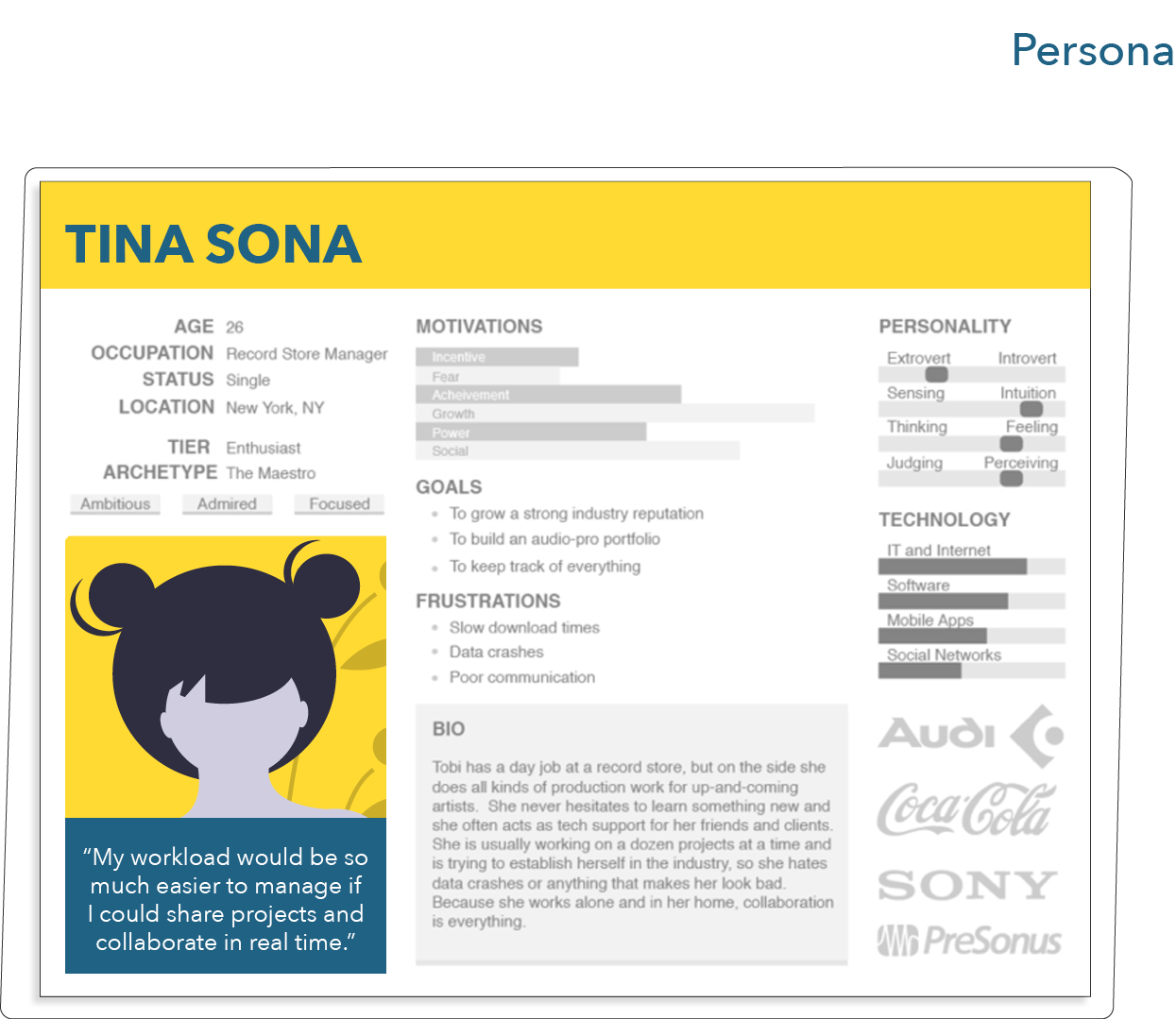
Personas are important because they help you understand who your ideal consumers are, what their characteristics are, and how to talk to them. The needs, desires, and problems of your personas (or segments more generally) should be the starting point of any marketing strategy. As a reminder from chapter 1, our goal as marketers is to create value, and in digital marketing campaigns, we create value by representing the customer. The only possible way to do so is to understand who this customer is and what they need. Personas can assist in a wide variety of marketing activities, from creating campaigns and ads to guiding product and service development to helping with customer support. We will see how shortly.
Firms develop personas the same way they develop segments: through market research and the use of internal data. Firms typically segment consumers based on their behaviors (which are also now trackable online!), demographics, lifestyles, or psychographics (see Figure 2.2 for a brief summary or, for a text description of the figure contents, click here).
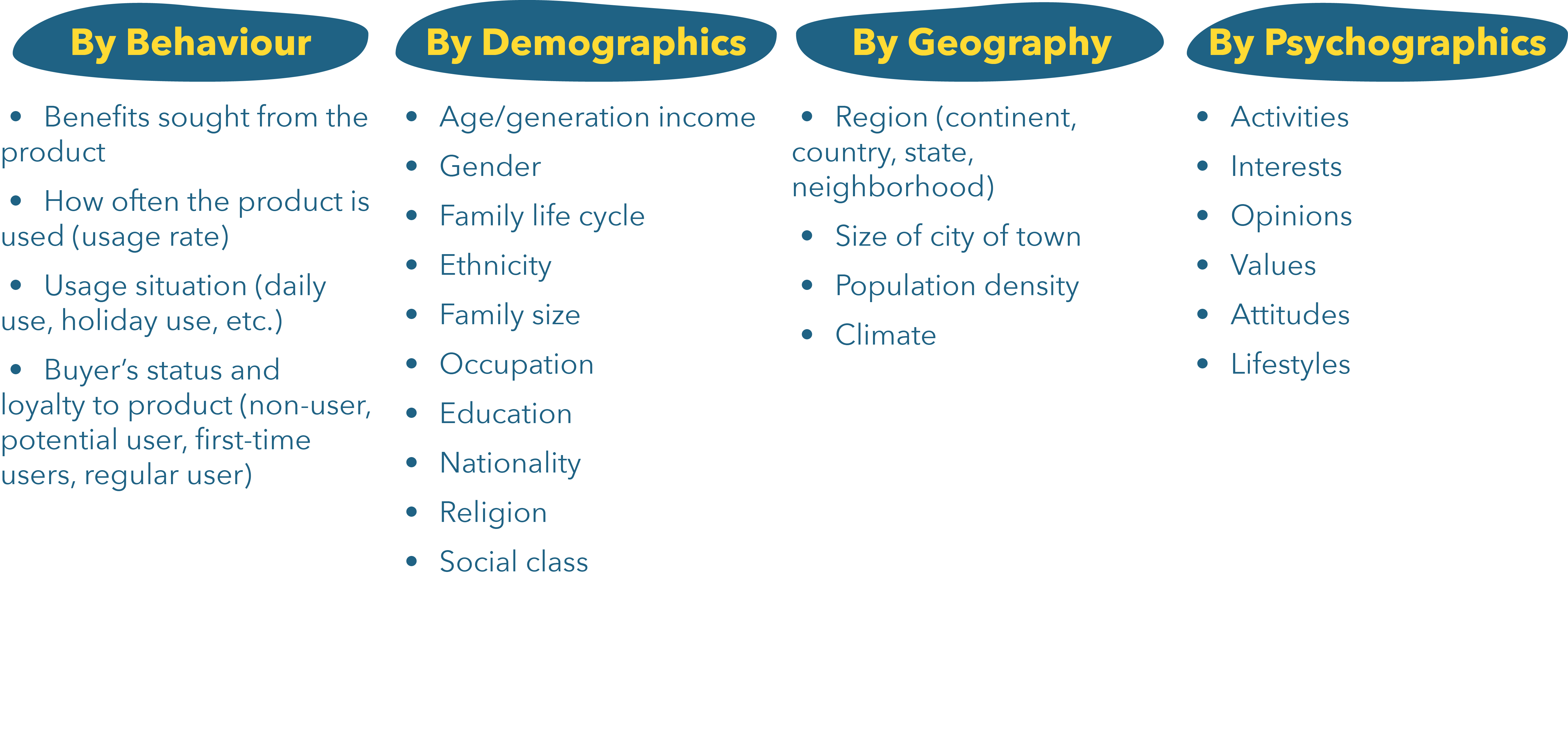
Segmenting based on these variables is highly useful for informing online targeting strategies. For example, on the Facebook Ads platform, you can easily select to deliver an ad to people aged between 18 and 25 years old living within a kilometer of Mile End who like cycling.
However, these variables are less informative concerning how to talk to these consumers. For this reason, we emphasize the importance of intersecting segments with their goals, wants, needs and motivators and the challenges they face.
In her book Introduction to Consumer Behaviour, Andrea Niosi explains these as follows:
A goal is the cognitive representation of a desired state, or, in other words, our mental idea of how we’d like things to turn out (Fishbach & Ferguson 2007; Kruglanski, 1996). This desired end state of a goal can be clearly defined (e.g., stepping on the surface of Mars), or it can be more abstract and represent a state that is never fully completed (e.g., eating healthy). Underlying all of these goals, though, is motivation, or the psychological driving force that enables action in the pursuit of that goal (Lewin, 1935).
Motivation can stem from two places. First, it can come from the benefits associated with the process of pursuing a goal (intrinsic motivation). For example, you might be driven by the desire to have a fulfilling experience while working on your Mars mission. Second, motivation can also come from the benefits associated with achieving a goal (extrinsic motivation), such as the fame and fortune that come with being the first person on Mars (Deci & Ryan, 1985). One easy way to consider intrinsic and extrinsic motivation is through the eyes of a student. Does the student work hard on assignments because the act of learning is pleasing (intrinsic motivation)? Or does the student work hard to get good grades, which will help land a good job (extrinsic motivation)?
Consumer behavior can be thought of as the combination of efforts and results related to the consumer’s need to solve problems. Consumer problem solving is triggered by the identification of some unmet need. A family consumes all of the milk in the house; or the tires on the family car wear out; or the bowling team is planning an end-of-the-season picnic: these present consumers with a problem which must be solved. Problems can be viewed in terms of two types of needs: physical (such as a need for food) or psychological (for example, the need to be accepted by others).
Although the difference is a subtle one, there is some benefit in distinguishing between needs and wants. A need is a basic deficiency given a particular essential item. You need food, water, air, security, and so forth. A want is placing certain personal criteria as to how that need must be fulfilled. Therefore, when we are hungry, we often have a specific food item in mind. Consequently, a teenager will lament to a frustrated parent that there is nothing to eat, standing in front of a full refrigerator.
Most of marketing is in the want-fulfilling business, not the need-fulfilling business. Apple does not want you to buy just any watch; they want you to want to buy an Apple Watch. Likewise, Ralph Lauren wants you to want Polo when you shop for clothes. On the other hand, a non-profit such as the American Cancer Association would like you to feel a need for a check-up and does not care about which doctor you go to. In the end, however, marketing is mostly interested in creating and satisfying wants.
Often discussion around needs will separate them into those which are utilitarian (practical and useful in nature) and hedonic (luxurious or desirable in nature).
To this list, we add the notion of challenges, by which we mean an obstacle faced by a consumer in resolving a need or fulfilling a want. This is important because consumers turn to the internet every day to help them answer challenges they face in their everyday lives, whether it is how to change a tire, how to have the perfect Friday night makeup, or how to paint a room. Resolving challenges drives the consumption of online content.
Hence, when creating a persona, you create a semi-fictional representation of a segment by bringing together the following information:
Take the example of RV Betty (Figure 2.3, text here).

Can you find the information mentioned above in this short persona?
A consumer journey is the trajectory of experiences through which a consumer goes: from not knowing they want something, to buying this something, to performing post-purchase activities (the most obvious being consuming the product). Put more theoretically, the consumer journey is “an iterative process through which the consumer begins to consider alternatives to satisfy a want or a need, evaluates and chooses among them, and then engages in consumption” (Hamilton et al. 2019). The journey is composed of pre-purchase activities, that is, activities consumers engage in prior to buying a product; purchase activities, or what people do to acquire a product; and post-purchase activities, or what consumers do once they have bought a product (Lemon and Verhoef 2016).
As a side note, we make a distinction in this course between customer journey, which would focus on the journey of a customer with a specific firm and would include, for example, touchpoints solely associated with that firm, and consumer journey, which is a broader perspective on consumers who “undertake [a journey] in pursuit of large and small life goals and in response to various opportunities, obstacles, and challenges” (Hamilton and Price 2019, p. 187). By touchpoint, I mean “any way a consumer can interact with a business, whether it be person-to-person, through a website, an app or any form of communication” (Wikipedia).
Understanding the consumer journey is important because doing so strongly contributes to firm performance. For example, a survey by the Association of National Advertisers in 2015 found that top performers in a market understood the journey better than their peers and had better processes to capture journey-related insights and use them in their marketing efforts (McKinsey 2015).
The journey varies greatly depending on which market a firm evolves in. It also varies depending on personas and their specific goals. For example, a survey by Google found that some markets, such as banking, voting, and finding a credit card, will typically have a longer journey than others, such as groceries or personal care products. Variation also exists within markets. For example. Google found three types of journeys for restaurants: one where consumers pick a restaurant within the hour, one where consumers pick a restaurant a day before going, and a last one where consumers pick restaurants two to three months before going.
Can you think of what these relate to?
We can hypothesize: If you’re at work and looking for a place to have lunch, chances are, you won’t dedicate much time to it and will pick a restaurant within the hour before going. If you are going out with friends or a Tinder date, you might be a bit more involved in the process and pick the restaurant one or two days before. Lastly, if you are going to travel (and are a foodie!) or you want to make a marriage proposal, this will require more planning, and you might start your journey much, much earlier. This also has implications for restaurants! Some restaurants who cater to downtown lunchers might be better off pushing Instagram ads with the menu of the day, or some daily sale, around 11 a.m. or just before lunch. Restaurants catering to groups or dates might want to start campaigns on Wednesdays to capture Friday and Saturday restaurant-goers. And restaurants that target the marriage proposal or foodie crowds might need longer, “always-on” continuous marketing activities to bring in patrons.
Our understanding of consumer journeys has greatly evolved over the last two decades, and there exist a number of ways to conceptualize journeys. It is important to understand that these are not perfect representations of reality. Rather, they are thinking tools that help us create marketing campaigns. In real life, people tend not to be so linear in their decisions.
A common conceptualization found in marketing textbooks is one where consumers move between different stages, initially being aware of a large number of brands and then slowly refining their understanding of the options in the market to make their purchase. McKinsey represents such a typical model here (Figure 2.4). In this model, the consumer goes through five stages:
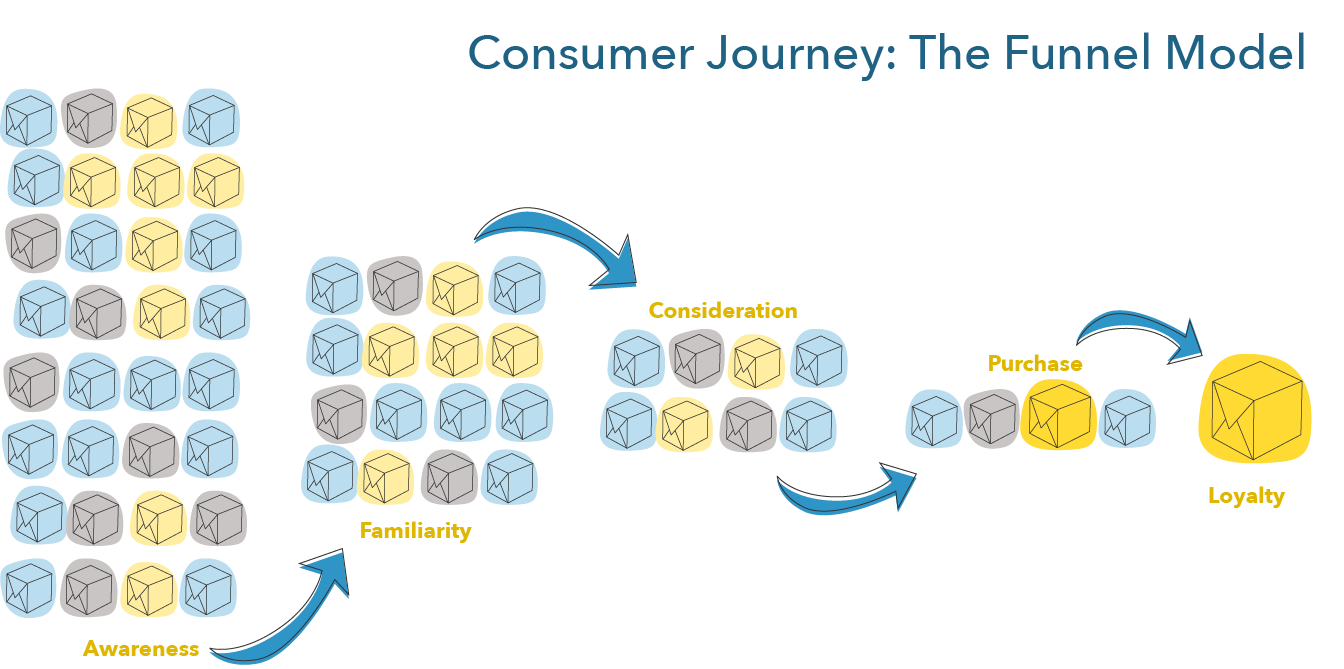
This understanding of the journey is based on a funnel model, where consumers start by being aware of a large number of brands and, over time, reduce their options as they go through each of the stages. This has a number of implications for marketers.
A first central assumption is that, to ultimately be chosen by consumers, companies need to make sure that consumers are aware of them. This partly helps explain the prevalence of mass marketing: it serves to create awareness.
A second central assumption is that consumers start with a large set of brands that they are aware of and reduce this set over time to a smaller and smaller set of brands as they search for and evaluate options.
McKinsey introduced in 2009 a competing model for the consumer journey, based on the purchase decisions of close to 20,000 consumers across five industries. They found that these two assumptions did not hold: First, consumers do not start with a large set of brands they are aware of. Second, consumers do not reduce their options as they go through the stages of the funnel. Rather, the number of options they consider increases throughout their journey.
If you think of some recent purchases you made, this makes sense. Let’s say I want a pair of running shoes. I might be aware of some brands and models, probably the ones that do the most mass advertising: Nike, Adidas, Reebok. Then, I turn to the internet to perform some searches. I’ll use general key terms like “what running shoes should a beginner get” or “reviews for running shoes 2020.” Through my search efforts, I will encounter new brands I had not considered originally, for example, Asics, Brooks, and Saucony.
In this example, rather than following the funnel metaphor, where the set of brands I was aware of reduced to a smaller set of familiar brands and an even smaller set of considered brands, I added brands to my consideration set.
This has important implications for digital marketers: First, traditional, push, mass marketing media activities are not necessary. Second, as consumers do research, they broaden the set of products or brands they consider. We will see how this has led to the rapid growth of inbound marketing activities that help consumers with their problems and help consumers evaluate their options. This is because brands now understand that by supporting consumers throughout their journey, they can enter consumers’ consideration set and ultimately make a sale.
McKinsey thus proposes a competing model, a circular model for the consumer journey. The model is circular because consumers enter a loyalty loop where they cycle between using a product or brand, buying this product or brand again, participating in post-purchase activities, and so on. The McKinsey model has the following stages (also depicted in Figure 2.5):
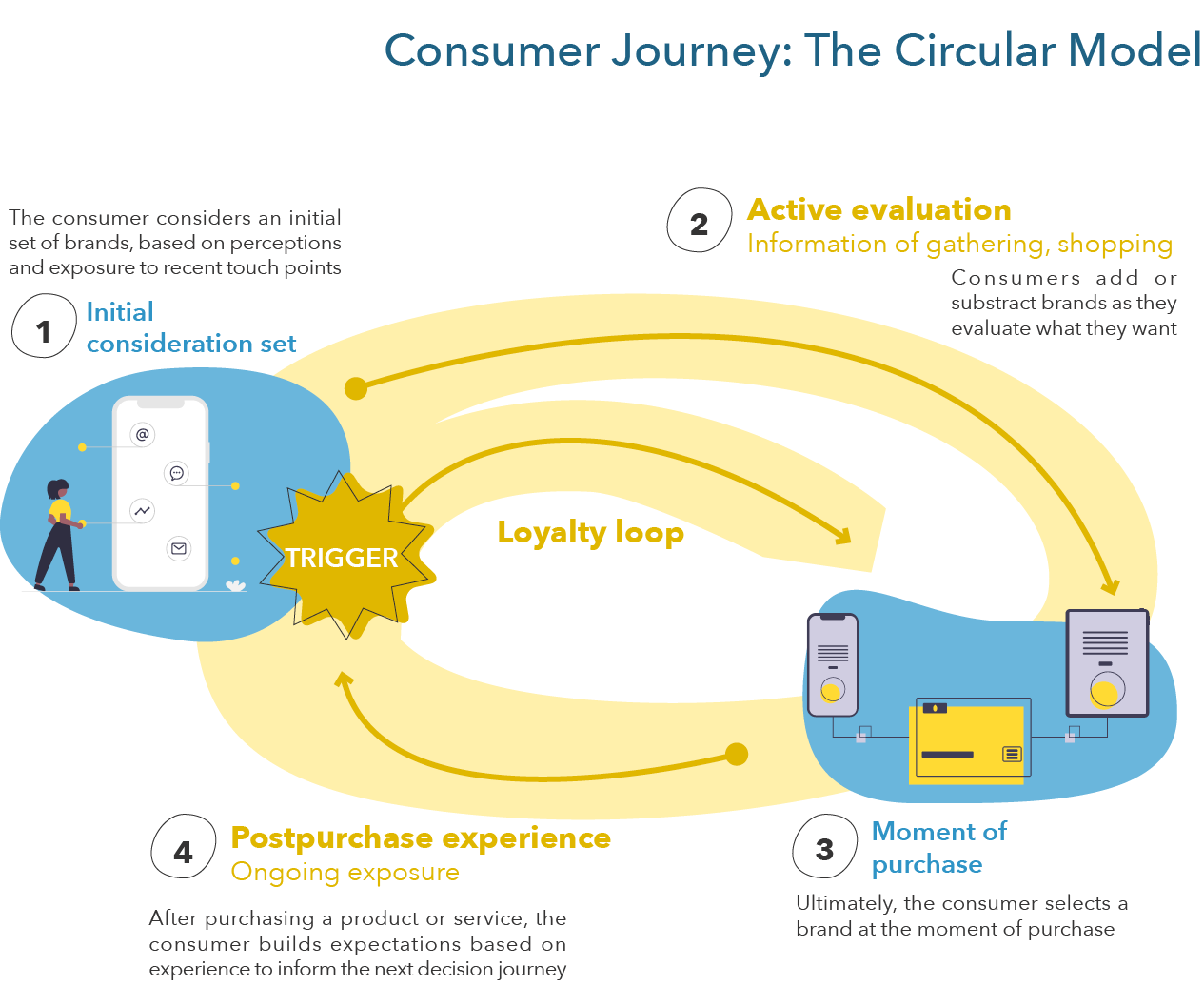
These two important revisions to the journey—the expansion of the consideration set during active evaluation and the importance of consumers participating in consumer-driven marketing at the post-purchase stage—open up many content-based possibilities for digital marketers. As we’ve discussed, our goal in digital marketing is to represent the customer: What are their needs? Goals? Problems? How can we support them in addressing these? Our objectives are not to sell products or talk about our brand. Rather, we will see that we make sales online by supporting consumers throughout their journey—helping them understand their problem, helping them evaluate solutions, helping them better understand our product.
In an example of great content marketing for themselves (i.e., this concept helps sell Google products!), Google introduced in 2011 the concept of zero moment of truth (ZMOT), “a new decision-making moment that takes place a hundred million times a day on mobile phones, laptops, and wired devices of all kinds … that moment when you grab your laptop, mobile phone, or some other wired device and start learning about a product or service (or potential boyfriend) you’re thinking about trying or buying.” It turns out to be quite a useful concept to think about how consumers make purchases in the digital era.
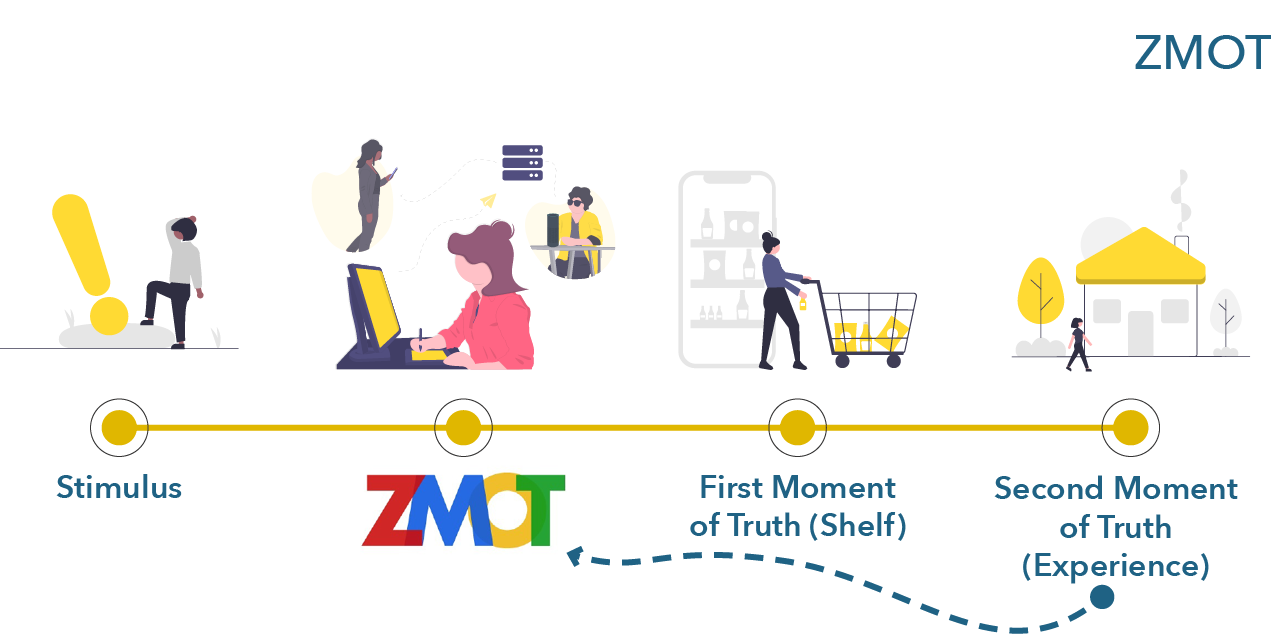
A moment of truth is a contact with a brand or a product during which a consumer forms an impression (Carlzon 1989). To understand the ZMOT, it is important to contextualize it historically. Why is it called the “zero” moment of truth? Quite simply, prior to Google introducing this concept, there were already two moments of truth (Figure 2.6):
The ZMOT is the moment of truth—the context between a consumer and a brand—that happens prior to a shopper noticing a product in a shopping environment. Concretely, ZMOT “moments” could appear while
In contrast, the first moments of truth happen while
According to Google, the essential characteristics of ZMOTs are that they happen online, when the consumer is in charge (and this relates to inbound marketing), and during multiway conversations. To capitalize on ZMOTs, Google recommends being present in moments that matter. By this, the marketing juggernaut means that you should have content and ads that respond to the needs, problems, and goals that consumers are typing in the form of search queries in a search engine. All of this requires, as you might have guessed by now, a deep understanding of your consumers and their journeys.
Google identifies four ZMOTs and briefly explain how these interact with journeys here. The four types, also shown in Figure 2.7, are the following:
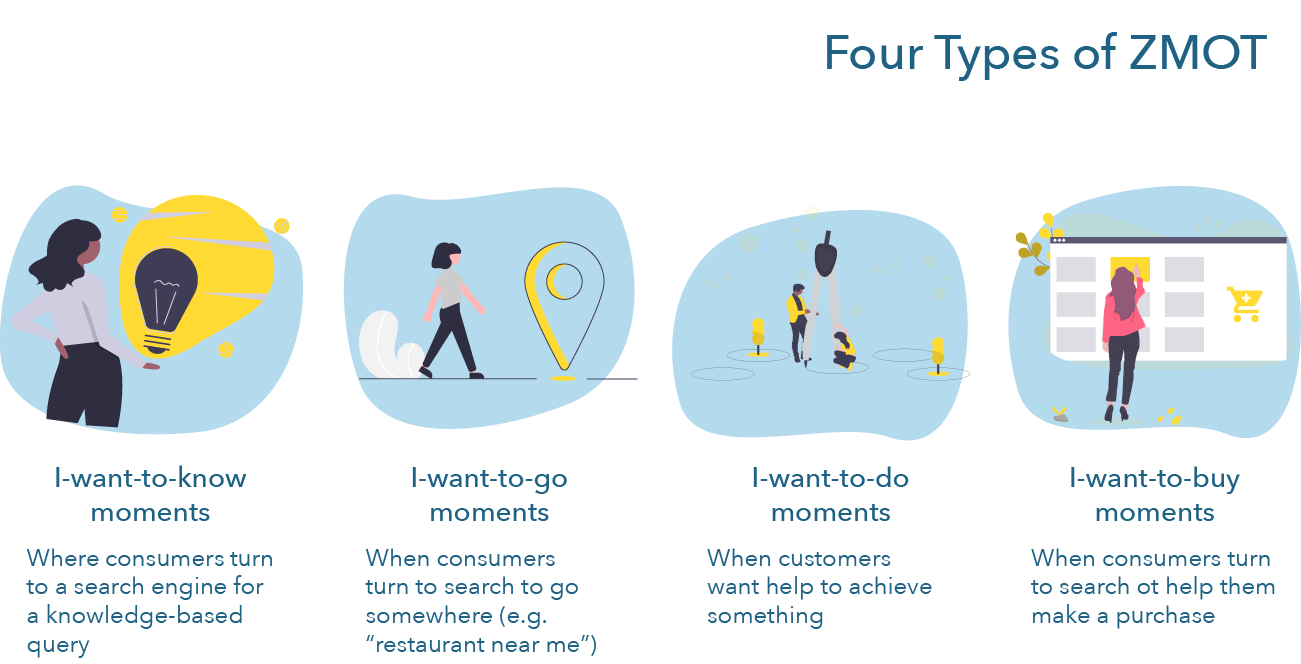
These are important conceptual tools. They represent opportunities for companies online to create content. These are not simply ways to understand how consumers use search engines and interact online. Rather, they are tools to help us create better content. What kind of content would you create for these four different ZMOTs?
Now that we have the vocabulary for these concepts, it’s time to turn our attention to using them in practice. The journeys and ZMOTs are generic ways to understand how consumers go about buying products. Knowing how consumers conceptually move from a trigger to making a purchase to becoming loyal to a brand or product might be interesting in itself, but it is much more useful if we can actually use this in real-life campaigns. Effective strategies demand a tailored understanding. We cannot stay at a conceptual level. We need to translate them to real-life experiences. To do so, we can perform journey mapping.
A journey map is a visual representation of the journey of a consumer. It brings together the conceptual tools we have seen in this chapter: persona, consumer journey, and moments of truth. Journey maps vary based on segments/personas. Each persona represents a different consumer segment. These segments will go about buying products differently. Think about, for example, how you go about buying products and how your parents go about buying products.

Journey maps exist in a wide range of shapes and forms. They all, however, share some common elements:
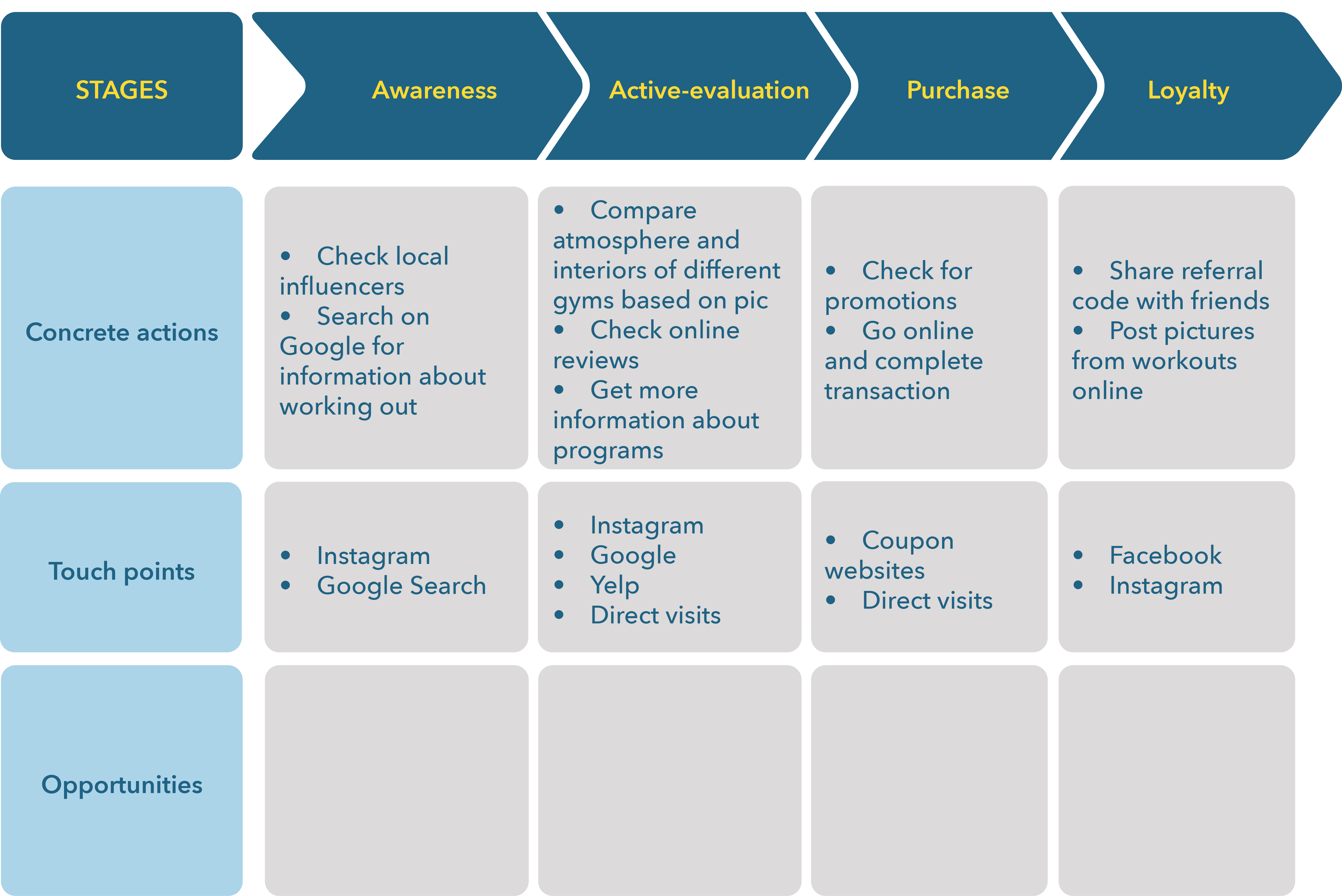
This page presents a clear example of this kind of journey template.
Journey maps are useful. They help you understand how consumers move through their journeys to address their needs and problems. Each action they take represents an opportunity for your brand to create a connection with a consumer. A clear understanding of the concrete steps that consumers take to buy products should be the starting point of the creation of your marketing campaigns. What do consumers do at the awareness stage? How can your brand support their actions? Do consumers search for specific things? What about at the active evaluation stage? In the next chapter, we examine how firms can position websites on specific searches. This will help create a bridge between what consumers are doing online and how we can answer their search queries.
Let’s take as an example the following persona, “RV Betty”:

Betty lives in a suburb of a city. Her husband is also retired. They have been talking about traveling in an RV upon retirement for years—this is a long-time dream of theirs. The kids are self-sufficient and have been out of the house for long enough that Betty doesn’t have to worry. She’s been retired just long enough to be bored. While she doesn’t consider herself wealthy, she and her husband have substantial savings and are prepared to enjoy their retirement.
Betty is worried about the logistics of traveling in an RV—how easy will it be to find utility hookups, where are the best places to stay if you have one, etc. She also wants something comfortable; she plans on spending a lot of time in it. She has other retired friends, so she wants additional sleeping space, and she wants to make sure they have plenty of room for food and even cooking. She wants as much ease as possible when traveling.
Based on this persona, briefly sketch three pieces of content. More precisely, concentrate on the general idea of what this piece of content would be about and draft the following:
Sketch up a persona for a Montreal real estate company specializing in first-time house buyers. To do so,
Tip: Ask yourself why these people would need a house. For example, you might ask yourself the following questions:
In this chapter, we discuss how to use keywords to create pages and content that respond to consumers’ needs and goals and how keywords can help us understand how our competitors are positioned online. We start with a brief introduction to search engine optimization (SEO) and why SEO is important online. We then turn our attention to ranking factors in order to emphasize why designing pages for people, by keeping people’s needs and goals in mind is what makes pages rank high. We then cover customer-related, firm-related, and competitor-related implications of SEO.
Learning Objectives
Understand SEO and keywords, and why they matter for your firm, for consumers, and for competitor analysis.
SEO is “the process of affecting the online visibility of a website or a webpage in a web search engine’s unpaid results” (Wikipedia). This differentiates SEO from the use of paid ads in order to appear at the top of search engine result pages (SERPs). Take the following two screenshots, for example (Figure 3.1). On the left-hand side, we have paid results that appear at the top of the SERP because the company has bid on certain keywords used in a search query (in this instance, “car rental montreal”). On the right-hand side, we have organic search results that appear because the company has practiced SEO on similar keywords. In other words, they have optimized certain pages of their websites to maximize the chances that these pages would rank high when people search for specific keywords (e.g., “car rental montreal”).
People use keywords to interact with content online, and most online experiences start with a search (Forbes 2017). As we will soon see, people turn to search engines for a wide variety of reasons, and these reasons provide opportunities for your firm to show up when people are searching for something.
Ranking high in search engines also confers a competitive advantage. In 2015, the first spot on Google received 35% of the traffic for a specific search. More than 50% of the traffic went to results located on the first result page (Advanced Web Ranking 2015). Search matters for physical stores, too, and local searches lead 76% of mobile visitors to visit stores within the day. Of those visits, 28% resulted in a purchase (Google 2016). SEO also matters because most people ignore paid ads (User Centric 2011). Clearly, ranking high can benefit a firm: Being well ranked provides a clear advantage over competitors.
In order to understand how to rank high, it is important to understand how Google works. Let’s watch the following video from Google:

A YouTube element has been excluded from this version of the text. You can view it online here: https://opentextbooks.concordia.ca/digitalmarketing/?p=314
The main job of a search engine is to serve results that best address people’s search queries. Let’s say you want to know how to clean your cat. You have questions such as what kind of soap to use, how warm the temperature should be, and how you should wash their paws. You can turn to a search engine to answer these questions. People turn to search engines and use search queries, the “query based on a specific search term that a user enters into a web search engine to satisfy their information needs” (Wikipedia). For example, you might turn to Google and type in “how to bathe my cat,” “easiest way to wash my cat,” “wash a cat,” or “cat wash soap.”
We will use the term keyword to talk about the key terms people use in search queries. Keywords are central for digital marketers. They are what we use to both talk to search engines in order to ‘tell’ them what search query a specific webpage is supposed to respond to (and we are going to see shortly how to do so), but it is also what we use to talk to consumers and make sure our webpage shows up when they search for something. Keywords link consumers’ search queries and whether or not our webpages show up when they search for something specific. It is thus important for us to think ahead when creating pages about what are the keywords and search queries this webpage answers?
The search queries above all use slightly different keywords, which might indicate that they are looking for slightly different things: the first user seems to want a tutorial, the second an easy way to wash a cat, the third is rather undefined, and the last one is more specifically focused on soap. As a result, search engines will deliver slightly different result to best address what they think the person wants in terms of information (i.e., what exactly they are looking for).
The role of search engines is thus to deliver the best result possible for people who are making a specific search. Thus, in order to rank high in search engines, you need to create pages that best answer specific search queries.
You do so by creating specific pages for specific search queries. Each page should have content that best matches that query and keywords that are, ideally, perfectly aligned with the query you believe people will be making. This reflects the importance of representing (and understanding) the customer; your pages need to address questions, needs, wants, and challenges that people have. In addition, you should ideally write about topics you are knowledgeable about (or an expert in), on which your site has authority, and your information should be honest, accurate, and trustworthy. This is summarized in the EAT acronym (expert, authoritative, and trustworthy).
As shown by the video explaining how Google works, there are more than 200 variables that are taken into account when ranking websites. Some of them, though, are more important than others. Namely, we can identify three broad categories of highly important ranking factors (Figure 3.2):
Note: A backlink is a link back to your website from another domain. For example, www.othersite.com has a link somewhere on their website that links to www.yoursite.com.
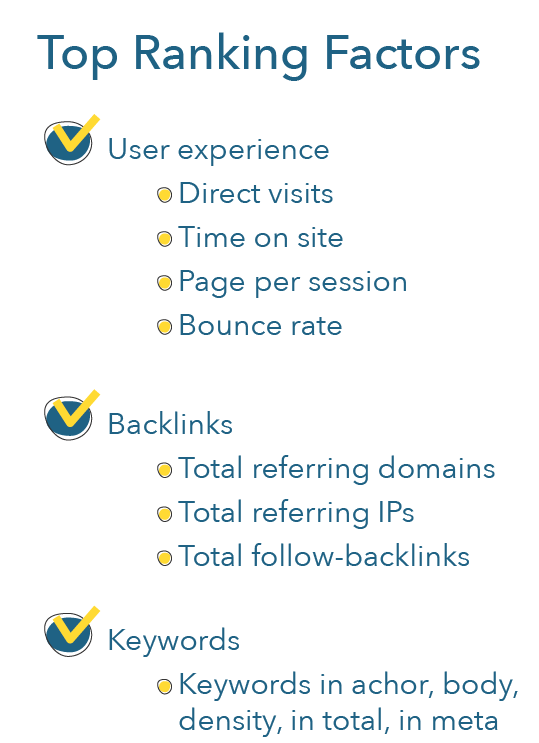
Search engines use these three broad types of factors because they are trying to evaluate questions such as “For a specific search query, which website should I show first? Which should I show second?” And so on. Again, as a reminder, the goal of a search engine is to show websites in the order it believes will best answer the search query. As presented in the video, the role of search engines is to make users happy: If you can easily and rapidly find an answer to what you are looking for, you will continue to use this search engine. Your job, as a digital marketer, is thus to create pages that best answer the needs people have when they formulate specific search queries. This is the key general idea behind SEO.
But search engines cannot read the whole web to evaluate how well a webpage answers a search query. Rather, they base themselves on a set of variables to rank webpages. Webpages are ranked for each and every independent search query.
Let’s look at these three sets of factors one by one to understand how this affects our work as digital marketers.
The first and most important set of factors relate to user experience, or “a person’s perceptions and responses that result from the use or anticipated use of a product, system or service” (ISO 9241-210, 2010). Put in very simple terms: Do your visitors like the experience of your page, and does it meet their expectations? Since we are looking at ranking pages, we can see expectations as answering the need associated with the search people are doing. Hence, this first set of factors, concerning user experience, relate to whether or not your page answers the search that people are making and whether it does so in a way that is enjoyable for visitors.
This is a crucial element in understanding SEO: We are not optimizing pages for the sake of optimizing pages. We are optimizing pages in order to answer specific search queries made by people. Optimizing a page should thus be about creating the best page possible to answer a specific search query. We should optimize pages with users in mind.
This approach makes sense if we look at the specific factors above. Direct visits mean that people click on your link when they are on the SERP. We can optimize our page to maximize site visits by creating page titles and meta descriptions that incite people to click on our links. Let’s look at the screenshot in Figure 3.3, which shows a result for the search “how to bathe my cat.”
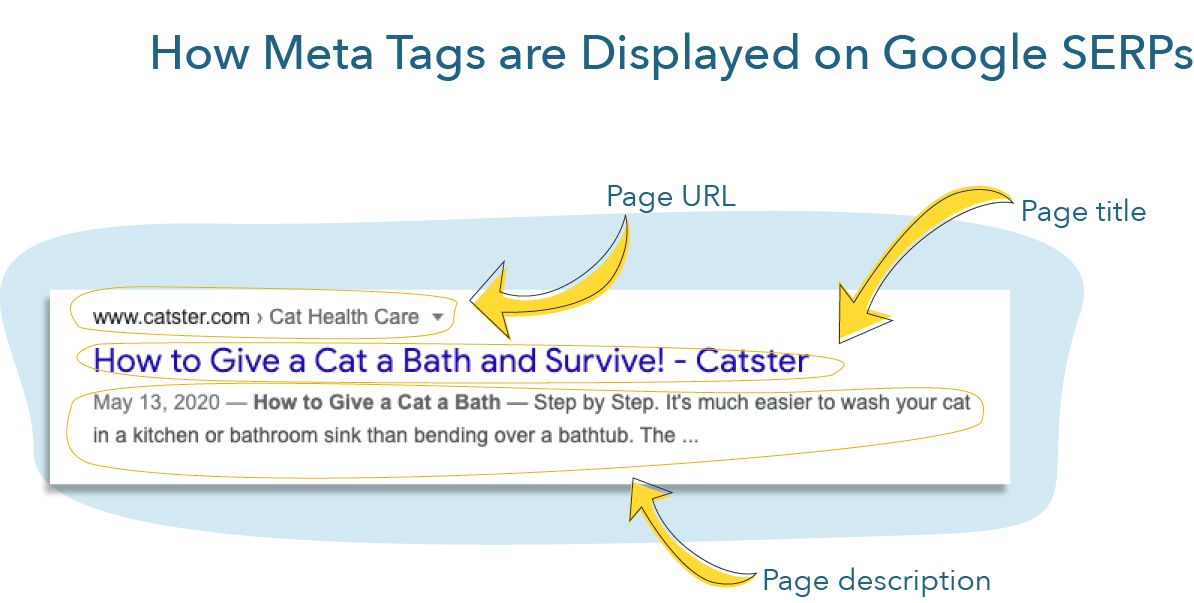
If, as a user, I am searching for “how to bathe my cat,” my goal is to find information that will help me achieve this task. As a website owner (and perhaps, a brand that sells bath products for cats), your objective is to provide me with a page that will help me achieve my goal. By doing so, you are creating value in my life. Later, when we introduce conversion-based marketing, we will discuss how this type of value creation—offering free content to people—brings visitors to your site and offers opportunities to turn these visitors into leads.
When creating webpages and positioning them on specific search queries, we have only a few options to communicate with consumers. Three of these are the page URL, the page title (which shows up on SERPs and is also what you read in your tabs next to the website icon), and the page description. These are resources that you create when creating webpages. They are part of what is called the “meta element.”
Ideally, you want to write your page title and page description in a way that will incite people to click on your link rather than the links of your competition. Your title and description thus directly address a specific search query, show that the page has the information required, and provide a call to action to incite people to click on your link. In this case, the page title repeats the exact same keywords I used in my search. This is great! It makes me feel like this page is exactly what I am looking for. The description could be optimized, but it provides me with first-hand experience and the start of a tutorial on how to bathe my cat. I at least know that, if I click this link, I’ll be given instructions on how to bathe my cat. Perhaps a better description could have been (keeping in mind that a description should be limited to about 150 to 160 characters to show in its entirety on SERPs):
Learn how to bathe your cat easily! Your cat will love it! No scratches! Easy 5 step tutorial so that you and your feline buddy have a fun time.
Let’s break this down: [Start with a call to action] Learn how to bathe your cat easily! [Express some benefit associated with your content] Your cat will love it! No scratches! [Tell people what’s on your page] Easy 5 step tutorial so that you and your feline buddy have a fun time.
In short, optimizing for users means having people in mind when creating your pages and considering what they are searching for, how you can best answer their needs and goals, and how to tell them that you are doing so.
This will help address the rest of the user experience factors: time on site, page per session, and bounce rate.
Time on site is the time a user spends on your site. If your page is well designed and readily answers a query, we can assume that users will stay and spend time on your site.
Bounce rate is the “percentage of visitors who enter the site and then leave rather than continuing to view other pages within the same site” (Wikipedia). Again, if people have a nice experience, this should lower the bounce rate.
Since bounce rate and page per session (the average number of pages a person views in a given session, where session here can be substituted to a website visit; i.e., the average number of pages a person views once they clicked your link on a SERP) are associated with moving between pages on your website, it helps if you provide incentives for people to do so.
Typically, this is done by practicing cross-linking, or linking pages of your own website with one another. We often see two ways through which websites do this.
The first way is to insert links within your pages that bring visitors to other pages of your website. Take this example for this page. The page is on “How to do a mask,” and within the text, it provides a link to a face mask sold by the website. If you click on this link, you will be visiting another page on the same website, increasing the average number of pages visited per session.

Another way that websites invite you to go through multiple pages is through recommended articles. Having a lot of content is quite important in maximizing your ranking for many reasons, but one of those reasons is to keep people on your site for a longer period of time by having them visit many pages. For example, at the end of each page for blog posts, Zoella invites visitors to related articles that might interest them (Figure 3.4).

The second most important set of factors relates to backlinks, or links back to your website from other websites. Backlinks can be thought of as votes of confidence from other websites. It’s like a popularity contest: The more people endorse you, the more others think you are relevant in a given domain. Or, applied to the web, the more backlinks to your website, the more relevant search engines think you are in a given domain.
This is important for search engines because if you are providing a good user experience and other sites link heavily back to yours, chances are you are doing something that people like. People liking you/voting for you/linking back to you thus become a good proxy for how high you should be ranking for specific searches.
The list of factors above (Figure 3.2) offers three important backlink-related factors, two of which we will discuss here.
Total referring domains represents the total number of domains (e.g., domain1.com, www.domain2.com, and so on) linking back to your domain.
Total follow-backlinks represents the total number of links that are allowed for web referencing that link back to your page. Without getting technical, search engines differentiate between types of links on websites so that they only consider “real” votes of confidence. They thus exclude, for example, links back to your website done as part of promotions. Follow-backlinks represents these “real” votes of confidence, while nofollow-backlinks represents links that are not taken into account for referencing.
Importantly, backlinks need to be earned organically, meaning that they cannot be incentivized. Paid promotions with bloggers, where bloggers link back to your website, for example, should be tagged as “nofollow” links. This means that, to create backlinks, firms need to think of strategies that will create links back to their websites without paying people to do so. Other types of backlinks that should be nofollow include links in blog comments, press releases and most social media and forums, as well as links on all of the following social media platforms: Quora, Reddit, YouTube, Wikipedia, Twitch, and Medium. Interestingly, although social media backlinks do not directly contribute to the ranking of a website or webpage, they can do so indirectly by increasing web traffic. Google is notoriously secretive about its algorithm and how it ranks websites. Recently, it indicated that it may follow certain nofollow backlinks, and several examples exist of backlink strategies where webpages shot up in ranking even though the links that contributed to the increase were nofollow links.
In addition to these two factors, which generally represent the quantity of backlinks to your sites (i.e., the total number of domains and the total number of links), it is also acknowledged that your website ranking will also depend on the quality of the backlinks.
High-quality backlinks are “natural,” meaning that the referring website (the website that links back to you) links back to your website in a way that naturally makes sense in the context. For example, it might use a relevant, natural anchor text. Anchor text is the clickable text that is underlined for a given link. Most of the hyperlinks in this chapter give examples of natural anchor text. The closer the anchor text to the keywords on which you want to rank your webpage, the better. For example, if you want to rank a webpage on how to bathe a cat, it will help if websites link back to your webpage with the anchor text how to bathe a cat. High-quality links come from authoritative pages, i.e., pages that rank high on search engines. They also come from sources that are topically relevant to your webpage. For example, if you are creating a webpage on fitness routines, backlinks from sites on fitness will have a greater impact on your ranking.
The last set of factors concern keywords. Keywords are terms you include on your webpages to communicate with search engines and with people. They help you clearly identify the ideas and topics on your webpage. Keywords are what link your webpage to the SERP through people’s search queries. Keywords need to not only represent your content well and naturally but also address what people you want to attract to your website are searching for.
The central implication of this is that you should be creating webpages to rank on specific search queries that people you want as customers are searching for. This is why representing the customer and understanding the need, goals, and challenges of personas are so important!
For example, for the search query “how to bathe a cat,” the webpages that are positioned on these keywords are likely to rank first. This is because these webpages are telling search engines, “Look at our keywords, we have created a webpage specifically for this search query.” As a result, search engines can assume that these webpages will be better at answering the needs of people for a specific search query. People who get good search results that answer their needs are happier about the search engine, and they will continue to use it. The goal of search engines is to have people coming back and use them again. By helping search engines answer exactly what people are searching for, you are making sure you rank higher.
How do you position webpages on keywords? Basically, by putting keywords in a few key places on your website to “talk” to a search engine and indicate what search query a certain webpage is meant to rank on. To talk to a search engine, you want to put the keywords on which you want your webpage to rank in the following specific places (Figure 3.5):
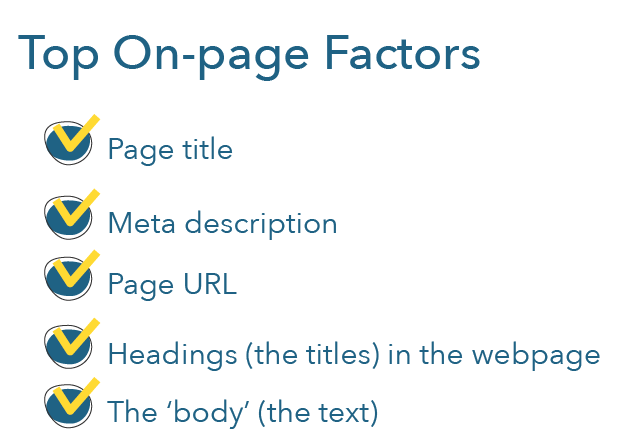
Take the “What Are Keywords” page on Moz.com on as an example. This page clearly aims at positioning itself on search queries related to keywords, and more specifically, the search “what are keywords.” How do we know this? Because it has those specific keywords repeated over and over again in the five aforementioned places.
As we saw above, the top factors associated with keywords are the following: keywords in anchor, body, density, in total, in meta.
Keywords in anchor are not controlled by the owner of a website. Rather, as explained above, they are controlled by whoever is linking to your site. Therefore, we won’t be considering them in this section.
The rest of the keywords factors are controlled by the website owner.
Keywords in body refers to the keywords used throughout your text in a given webpage. Ideally, you want to create a tight semantic network of keywords that relate to one another. For example, let’s say you are creating a page to rank on the keywords “best dresses at the 2020 Oscars.” To indicate to search engines that this is what you what to rank on, you can put these main keywords in the URL, page title, and one or more headings. But repeating these keywords over and over again in the body of the text won’t feel natural and will hinder user experience. As a result, you can come up with synonyms to use in the body. Here are a few examples of keywords and possible synonyms:
Using this approach will not only help you create a webpage that fares better in terms of user experience, but it will also help you have both a high density keywords in the body (i.e., a high ratio of keywords to total number of words) and a high total number of keywords.
Keywords in meta refers to having the keywords in the meta elements of your webpage, which for the sake of this course will be represented by page title and meta description.
To recap, search engines consider more than 200 factors, but the top factors used to rank website can be grouped into three categories:
When doing SEO, your role is to create webpages that directly address specific search queries. This will help you craft content that will provide a great user experience and tie your webpage to specific keywords associated with a search query. In the world of search optimization, this is referred to as on-page optimization, which is achieved by making changes to the page code, content, or structure of the website to make it more accessible for search engines and improve the user experience.
The other type of optimization talked about is off-page optimization, which focuses on improving the popularity, expertise, authority, trust, and relevance of a website. For example, it includes building backlinks, getting brand mentions, and increasing social media shares. Strategies to improve backlinks might have to do with creating highly shareable content and public relations activities to bring attention to the content you have created. For example, a strategy we used in a firm I worked in was to create benchmark studies (studies that compare competitors based on a set of variables and provide some baseline). These were heavily shared by firms and discussed in the media, which drove a lot of traffic to our website. Companies like McKinsey are continuously producing free content, like their “Featured Insights” website section, to generate discussions around their firm.
Since user experience is central to ranking high, it becomes quite important to understand how people search for stuff online. We are going to talk about three ways of thinking about this.
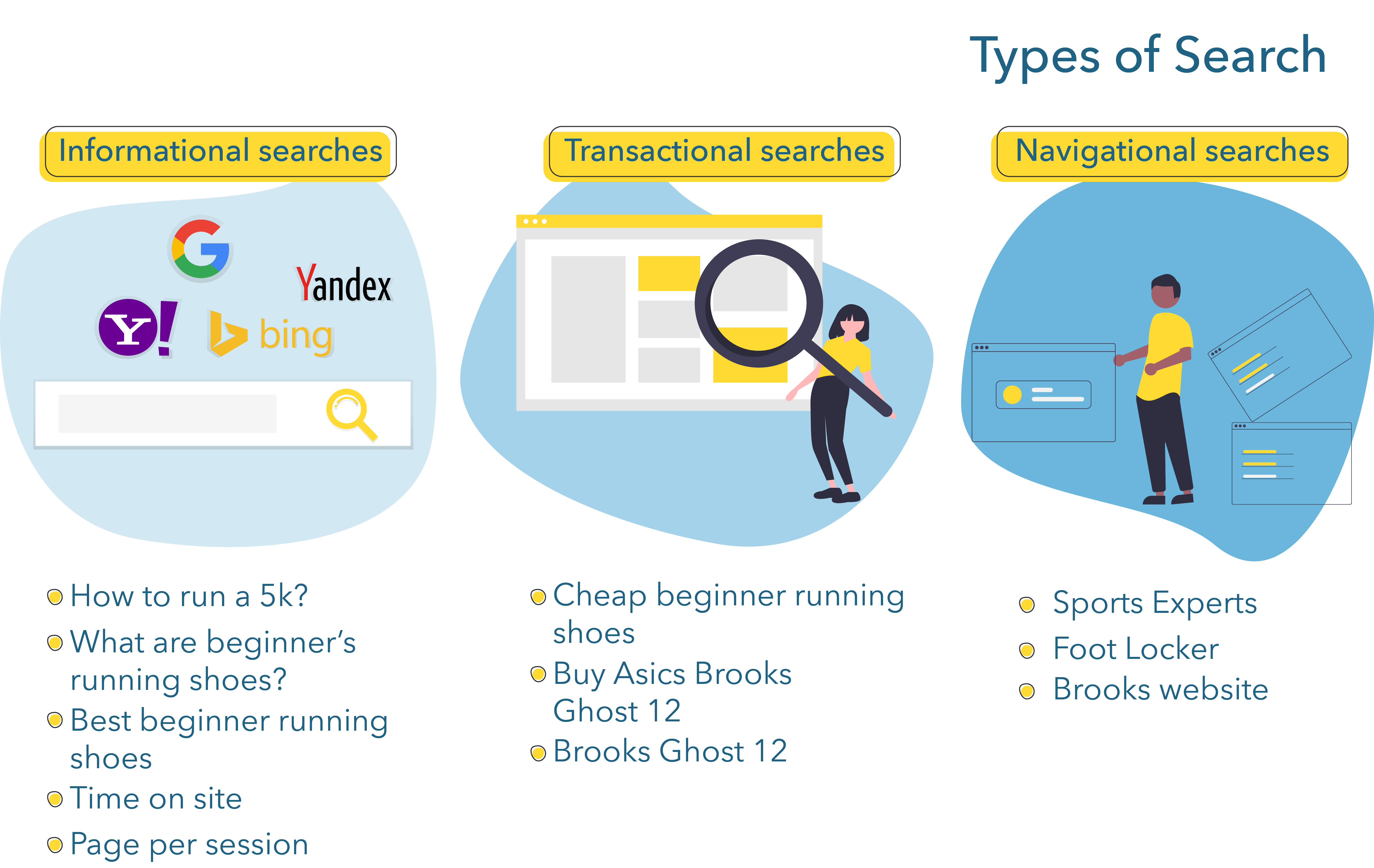
A first way of thinking about how people search is to consider the objective of their search. Three types of searches are typically referred to by SEO professionals (e.g., Moz 2016; Figure 3.6).
Consumers perform informational searches when they are looking for information about a specific topic. Examples might include
Consumers perform transactional searches when they are looking to perform a transaction. Transactions have been both narrowly defined (i.e., buying a product) and more broadly defined (i.e., performing an interaction). Examples of transactional searches might be
Consumers perform navigational searches when they are looking for a specific website. Such a search might look like
Considering the objectives of people performing search queries is helpful for us as digital marketers because it allows us to create webpages to answer these specific objectives. The kind of keywords on each page will be vastly different.
These objectives can also be placed in a process, where someone moves from needing information about a specific need or challenge to wanting to perform interactions (or a transaction) to address this need to wanting to visit a specific website.
The key idea here is that, as digital marketers, knowing why people are searching for something allows you to create pages that more directly align with their searches. This helps you improve user experience and choose the right keywords, both of which should allow your webpages to rank higher.
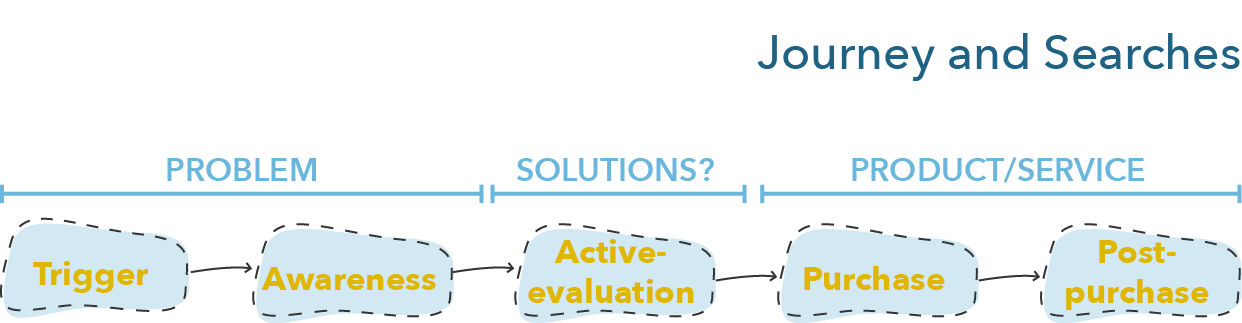
A second way to think about why people are searching is to start with their needs, challenges, and goals. This has a few implications: First, as we have seen with RV Betty, different segments/personas have different needs, challenges, and goals. That means that you will need to create different webpages to attract different personas to your website, where each webpage should address a specific need, challenge, or goal (and, perhaps, could do so by targeting different search objectives). Thus, when creating webpages, the first questions that should come to your mind are the following: What are the needs of my persona? What goal are they trying to achieve? What challenges are they facing when trying to address their need or achieve their goal? Answering these questions should allow you to generate many different content ideas, from which you can think of specific search queries. We will cover this in more detail when we talk about content marketing. In this course, we will emphasize how consumers’ searches vary depending on where they are in their journey:
Similarly to the three objectives of searches, knowing that consumers first concentrate on problems, then on potential solutions, and finally on the product or service they are interested in is the first step to creating a marketing campaign. Keeping in mind that our goal is to create value for consumers by representing them (rather than talking about our company), this means that we will need to create ads and content that (1) inform consumers about their problems, (2) help them evaluate their options, and (3) position our product as the best or create product or service-specific information. When we introduce the conversion-based framework in the next chapter, we will see how each of these stages can also be used for different strategic goals (namely, attracting visitors, converting visitors to leads, and converting leads to customers). This is visually represented in Figure 3.7 below.
We will cover the last way to think about searches very briefly, since we discussed it in the last chapter: Google ZMOTs. As we saw, Google proposes four ZMOTs: I want to know, I want to go, I want to do, and I want to buy. Some of these overlap with what we just saw. I-want-to-know searches are informational searches. I-want-to-buy searches can be thought of as transactional searches (a broader definition of transactional searches could also include I-want-to-do searches). These moments again present opportunities to create content. Google presents numerous ways for marketers to capitalize on I-want-to-do moments here.
We conclude this chapter by examining how keywords can be used to analyze your competition. To frame what follows, we will assume that competitors know and follow the same rules as you should when creating webpages and choosing keywords.
This is useful from a competitive analysis viewpoint because it means you can easily study your competition based on specific keywords. It is also important to understand here that you should think of ranking on search queries in a way that is similar to selling products: you need to find a positioning that optimal for your webpage. That means finding a search query that is not overly competitive, and on which you believe it is likely that you will rank high. Hence, a first step is to understand how to analyze the competitiveness of specific keywords and associated search queries.
We should understand well, at this point, that we are creating webpages with the goal of ranking high on specific search queries. We also understand that not all consumers will use the exact same search query to address a specific need. Let’s go back to the search queries we used to introduce this chapter and assume we are trying to create a webpage that will address the consumer need of wanting to know how to bathe a cat. As a reminder, those queries were the following:
These are different search queries, and how competitive they are will thus be different. A few easy steps can help you understand how likely you are to rank high on a specific search query. The first step is to understand how old the domains that show up on the first SERP are. This is because the older the domain, the more time they have had to build content and backlinks, and the harder they will be to displace from the first SERP. The older the domains on the first SERP, the more competitive the search query.
To know how old domains are, pick the keywords you want to rank on. Search these keywords on a search engine (e.g., Google). Then, use a whois service (e.g., who.is) and check the “registered on” date. For example, for the search “how to bathe my cat,” the first domains are:
It seems that most domains for this search query have been registered prior to 2010, which makes it likely to be a competitive search query. Additionally, most of these webpages seem to have been created to rank on this exact search query, or something closely related:
This combination of webpages clearly positioned on specific keywords that compete against yours and older domains means that trying to rank a webpage on “how to bathe my cat” might thus be a rather difficult exercise. It doesn’t mean it isn’t possible to do, but it would require a lot of work to create backlinks and a page that answers consumer needs better than other pages. Trying to position the webpage on other keywords might be an easier path. You can repeat this exercise with new keywords until you find a search that you believe consumers will be using and that is not overly competitive.
Another approach to studying keywords is to search for webpages that are exactly positioned on the keywords you are aiming for. A few Boolean search operators can help you here:
These are useful because, as we just covered, SEO should lead webmasters to put the keywords on which they want to rank in the page title and page URL, and because being linked to keywords in anchor text helps our rankings. In short, by using these Boolean search operators, you can get a clear list of exactly who your competition is for a specific search query. This becomes useful, for example, if you want to understand what kind of content their pages offer, how the pages are structured, whether they have multiple types of media, and so on. Or, put differently, you can analyze the webpages of your competition to create a general benchmark to beat and create a better webpage that will more clearly and fully answer consumers’ needs.
You are a real estate company located in Montreal that specializes in first-time buyers.
Let’s assume a quick draft of a persona.
Bill and Jane are newly wed and are looking to start a family. They want to have some space because they are planning to have two kids, and ideally a backyard. They would also like their house to become the family house. In other words, they would like the family to grow in the house. Ideally, that means finding a family friendly neighborhood, where the schools are good and accessible. Their budget is somewhat limited, because they are quite young, which can be a problem when wanting to find a home. Lastly, they are also first-time house buyers, and they are quite unaware of the whole process of buying a home.
You are a real estate company located in Montreal that specializes in first-time buyers.
Pick one search out of the three searches you have identified prior. For this search, come up with an idea for a webpage, concentrating on the following elements of the webpage:
Backlinks
How can we boost backlinks for our real estate company? Identify five concrete ways to do so.
Competitive analysis
Reverse engineer the SEO efforts and content marketing strategy of competitors. Again, consider the page title, description, URL, headings, keywords in content, and alt tags.
Then, go to news.shupilov.com and pick three blog articles. Identify
Finding novel competitive spaces
Based on the searches we previously talked about, find five alternative, less competitive searches to rank on.
In this chapter, we discuss some key vocabulary associated with digital marketing, covering concepts such as inbound and outbound marketing and paid, owned, and earned media activities. We then turn our attention to the framework we are going to cover for the rest of the semester, the RACE framework. We briefly cover the four stages of the framework before turning out attention to how to link persona, journey, and strategy. We conclude the chapter by understanding how the RACE framework can support competitive analysis.
Learning Objectives
Understand key terms associated with online strategy, the objectives of the four stages of the RACE framework, how it links to personas and journeys, and how to use it to support competitive analysis.
Inbound and outbound marketing represent two broad approaches to connecting with consumers. Inbound marketing aims at bringing visitors “in,” drawing them to your company via, typically, content marketing, social media, and well-optimized websites. In this first approach, consumers find you because you represent them.
Outbound marketing is what we typically think of when we think of advertising: the promotion of products or services through advertising and promotions. In this case, a message goes “out” from your company and stops consumers in whatever they were doing (e.g., a consumer is “stopped” by an ad when scrolling on Instagram or reading their Facebook feed; they are stopped by an ad at the start of a YouTube video, or they are stopped by an ad which cuts a newspaper article or a blog post in two).
Inbound marketing is also associated with permission marketing, where advertising is welcomed because permission to be advertised to has already been obtained and advertising is anticipated (e.g., email marketing), and two-way communication, meaning that there can be an interaction between consumers and the brand (e.g., consumers can comment on social media posts and on blog articles). A few further characteristics of inbound marketing are that it is
Conversely, outbound marketing is associated with interruption marketing, where marketing efforts such as ads interrupt what a consumer is doing, and one-way communication, because consumers cannot talk to ads. Outbound marketing is also
Examples of inbound marketing include blog posts, infographics, e-books, whitepapers, social media posts, tutorials, and the like.
Examples of outbound marketing include advertising of any sort, which we are going to cover in more detail in the next chapter.
We differentiate between three types of media online: paid, owned, and earned.
Paid media are media activities you pay for. These media activities are typically performed on a third party channel (i.e., not your own website) that is paid by your company to conduct the activity. Your company controls the content, but the third party controls where this content is shown. Examples include search ads, display ads, paid influencers, paid content promotion, social media ads, product placements, and the like.
Owned media activities are media activities that are hosted on channels that you own, i.e., on your own platforms. They include your web properties (e.g., blog posts on your website) and social media channels.
Earned media activities are media impressions that you earn because your content is shared. Here, consumers (and sometimes professionals) become the channel. Shared social media posts, reviews, and other consumer-generated content such as ratings, social recommendations, content created on wikis, or forum discussions are examples of earned media activities. The coverage of your company by journalists also falls under earned media activities.
Very importantly, although these are conceptually distinct types of media activities, an ideal campaign will integrate them. For example, you can create content on your website and social media channels that you will also push by advertising on social media websites and other websites using banner ads, and you are making these efforts in the hopes that your content will be widely shared by others. This is the typical strategy underlying viral marketing campaigns.
Take, for example, the widely successful ad for Doritos during the 2020 Superbowl. Doritos created an ad that they hosted on their website and social media channels (e.g., YouTube). The ad was pushed as a paid media activity during the Superbowl to the tune of several million dollars. It was also associated with a Tik Tok hashtag campaign, #coolranchdance, which fueled earned media impressions. It is this intersection of paid, owned, and earned media activities that leads to the creation of successful online marketing campaigns!
Objectives, goals, and KPIs are the next set of concepts we will cover. Objectives represent what you want to achieve for your company. Ideally, objectives should be SMART:
Goals are actions that you want users to take. We use the vocabulary of goals to designate user’s actions since this is typically how goals are positioned in web analytics (e.g., Google Analytics). Distinguishing between objectives (what you want to achieve) and goals (what you want your users to achieve) just makes things clearer.
KPIs—key performance indicators—are metrics used to evaluate the performance of your company based on a particular objective or activity. KPIs typically have targets, specific values that your company is aiming to achieve within a certain time period.
These concepts work together to help you plan campaigns: Objectives can be used to identify goals for users to achieve, which can be measured using KPIs (Figure 4.1).
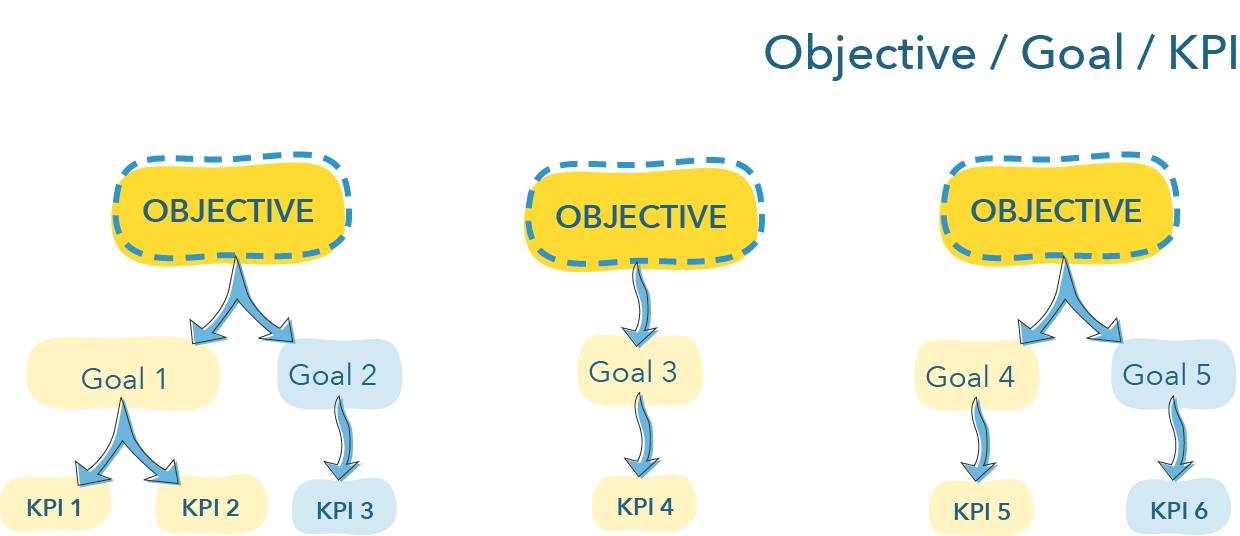
For example, an objective for your company might be to increase product awareness. In order to achieve this objective, you might set up goals for your users, such as subscribing to email updates and engaging in some key features you believe will help raise product awareness. It is then possible to identify KPIs to measure your success for these user goals, such as “number of contact forms submitted” or “use of the key feature of the virtual mirror” (see Figure 4.2 for an example or, for the text version, click here).
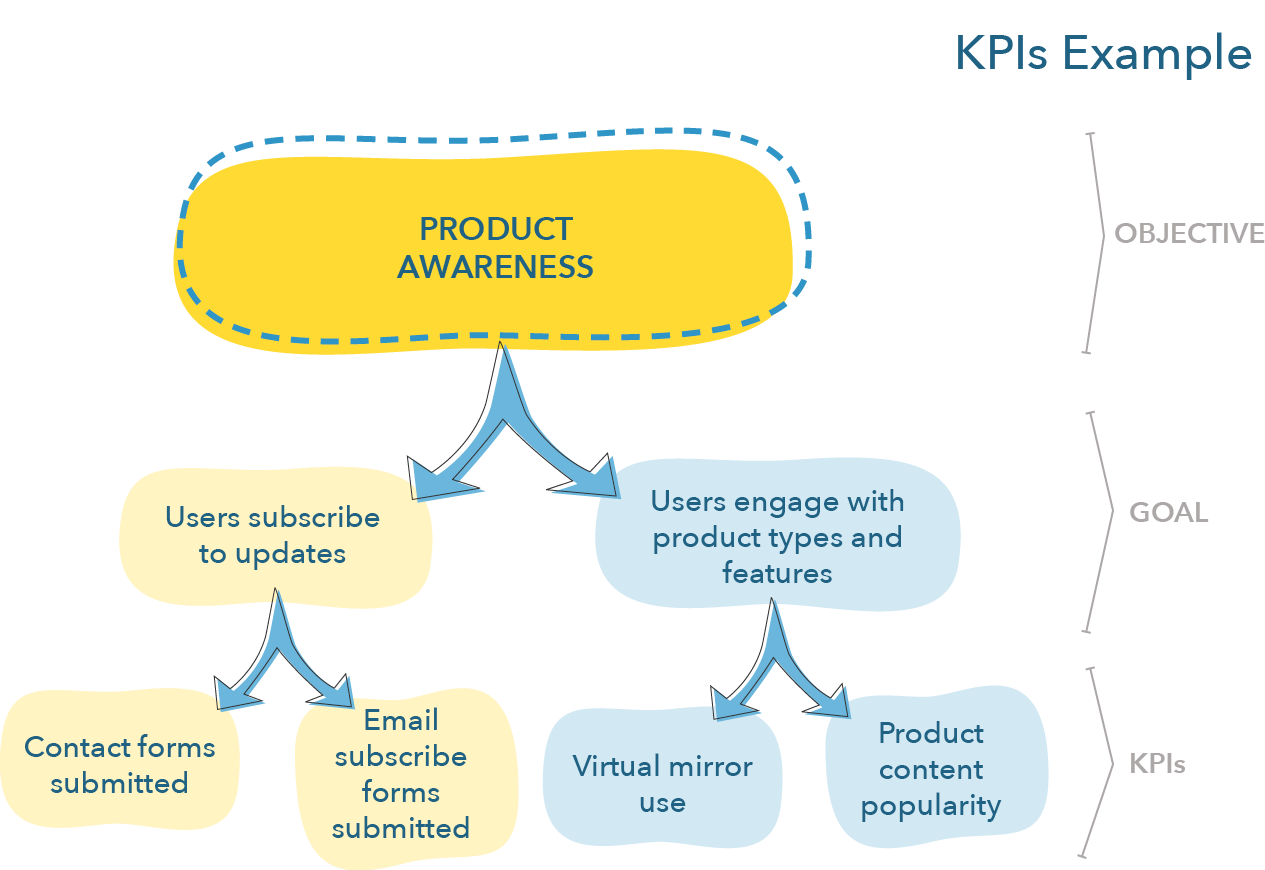
Strategy and tactics are the last key terms we need to better understand the RACE framework. Strategy represents the path you intend to take to achieve a specific objective. This aligns with Jain’s (1993) understanding of strategy as “the pattern of major objectives, purposes and goals, and essential policies and plans for achieving those goals, stated in such a way as to define what business the company is in or is to be in.”
In this course, we are going to emphasize how, to implement a strategy and achieve specific objectives, a company deploys tactics—tools used to meet objectives. Examples of tools we will discuss include banner advertising campaigns, search ad campaigns, and the use of content marketing on social media.
Let’s combine the vocabulary we just introduced in an example.
Objective
Tactics
KPIs per tactic
Targets per tactic
We can now turn our attention to the RACE framework.
Chaffey’s RACE framework is a conversion-based framework. Conversion marketing is a strategic approach that explicitly aims at increasing customers. The framework we will study here is part of a greater set of strategic approaches, such as HubSpot’s original “attract-convert-close-delight” strategy, which became their “flywheel business model,” or the grandfather of conversion marketing approaches, the “pirate metrics” AARRR model (acquisition-activation-retention-referral-revenue) shown in Figure 4.3 (text version can be found here).
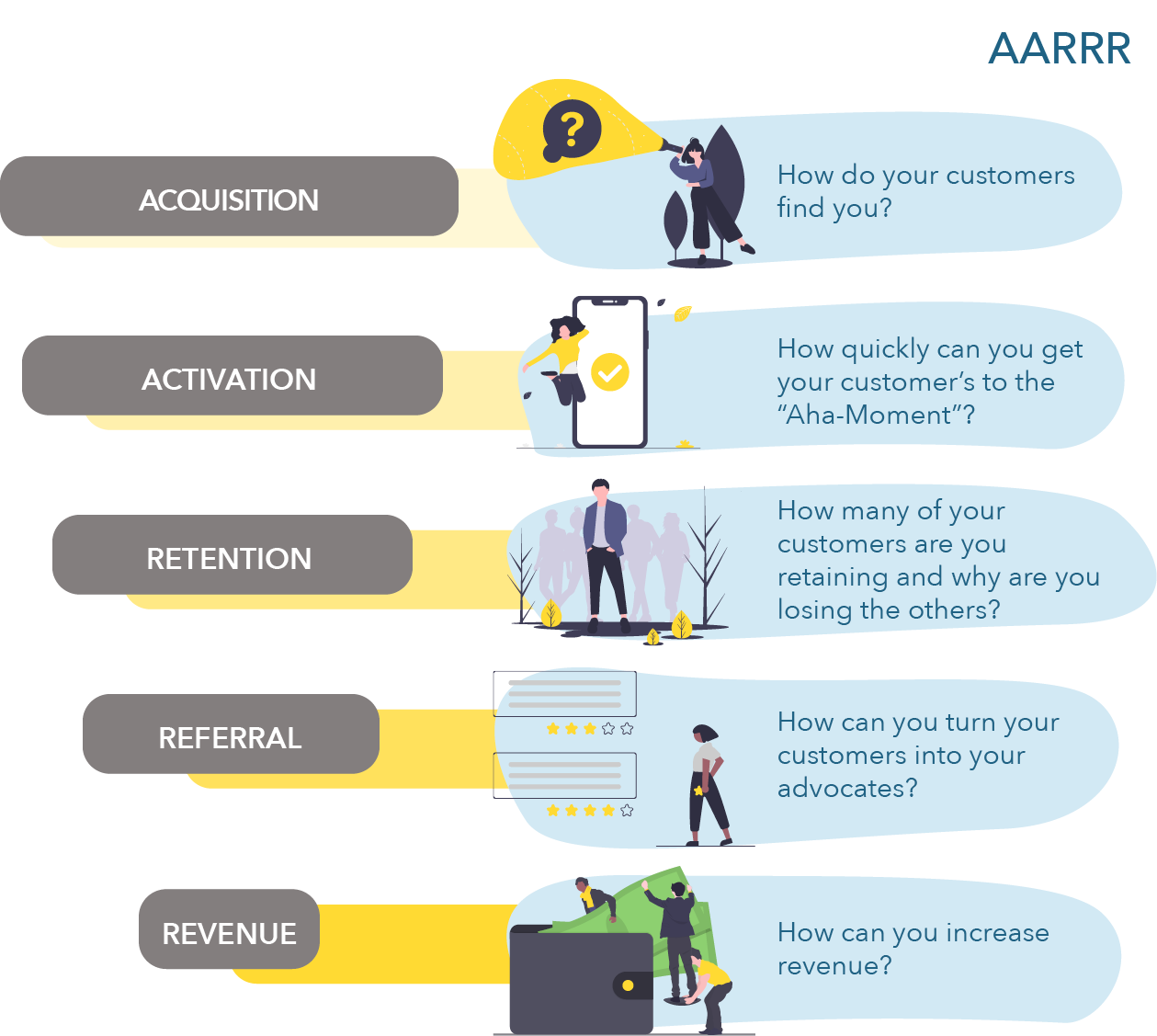
These different frameworks propose stages with different names, but the central idea of this strategic approach is the same. To convert, you need to move people through four stages:
Your goals at each stage are as follows:
The RACE framework presents four stages that help us plan for and coordinate different marketing activities to achieve these objectives.
During the Reach stage, your company has two objectives:
At this stage, you will mostly concentrate on addressing people’s problems.
During the Act stage, your company has two objectives:
At this stage, we are going to emphasize how we should focus on addressing consumers’ problems as well as helping them evaluate their options.
During the Convert stage, your company has one objective: converting leads into sales.
At this stage, we are going to emphasize how we should focus on talking about why your brand, product, or service is the best option for consumers. We will also touch on how to optimize our owned media order to maximize conversions, a process that is called “conversion rate optimization.”
During the Engage stage, your company has two objectives:
At this stage, the idea is to build long-term engagement by continuously contributing to consumers’ lives by creating value. We also want to identify engaged customers in order to foster their participation and engage them in co-creation activities to participate in our campaigns and support our marketing efforts.
Figure 4.4 presents how these objectives evolve over time with each of the stages (text description here).
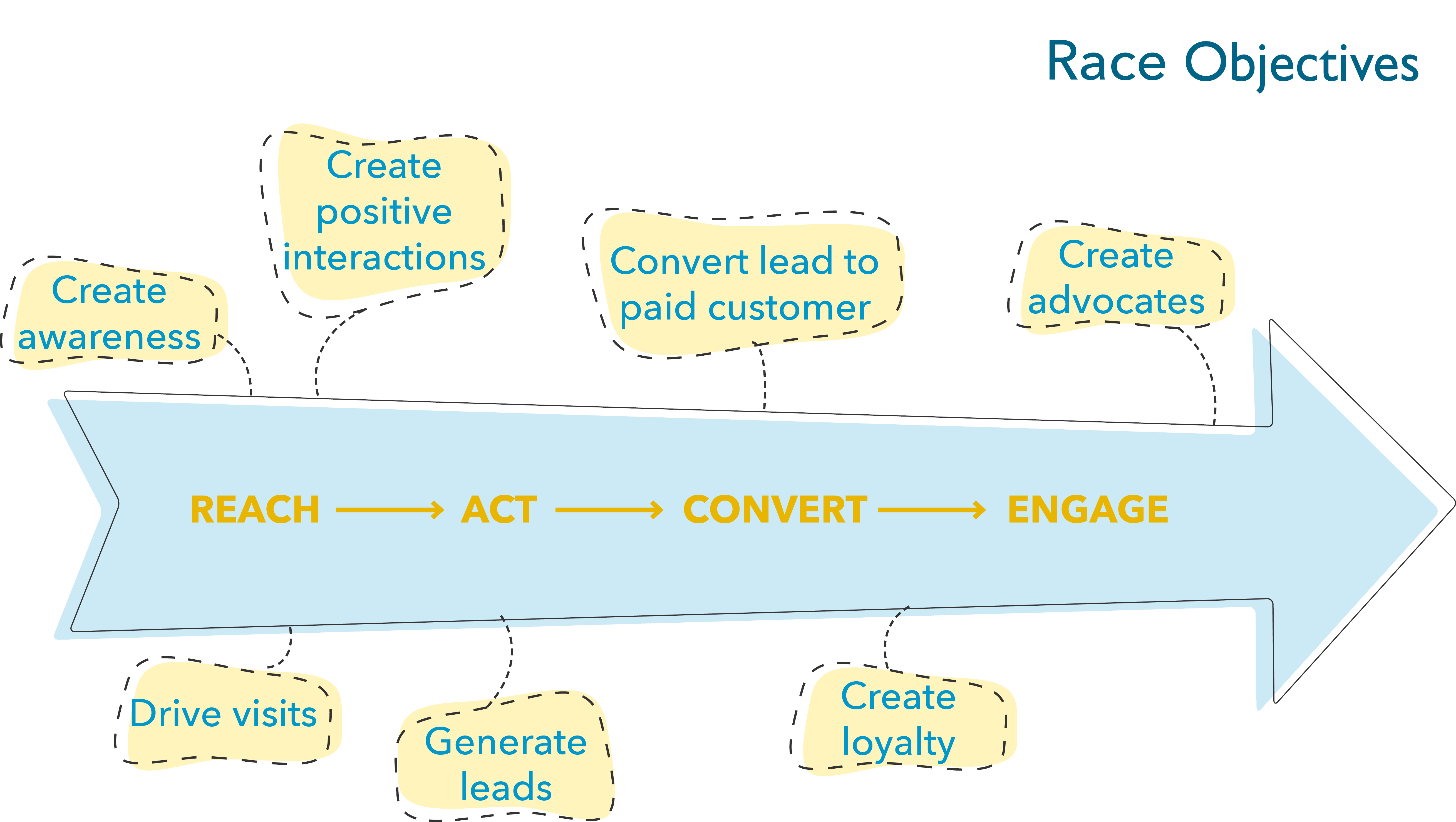
As we discussed during the last two chapters, the goals, needs, motivations, and challenges of consumers provide the raw material from which to create content for each persona. Journeys tell you what your content should be about (problem, solutions, and your product), and how it addresses different stages of the journey. See Figure 4.5 for a brief recap of Chapter 3.
Let’s take the example of making content and associated search ads, i.e., creating a blog post and then deciding to advertise this blog post on Google SERPs. As we discussed in previous chapters, your goal when optimizing your webpages is to identify keywords consumers will use to perform searches online. The idea behind making search ads is similar. We covered a few ways to help do so, including
Once you’ve identified keywords that your consumers are using throughout their journey, you can start creating content or ads based on these keywords so that you show up on a search engine when a consumer does this search.
The concept of a persona helps identify general keywords based on customers’ needs, motivations, challenges. Considering their journey helps identify specific keywords based on how users go about answering needs, motivations, and challenges throughout that journey. Here are two examples:
| Stage of Journey | ||||
|---|---|---|---|---|
| Awareness | Active Evaluation | Purchase | Post-Purchase | |
| Concrete actions | Action: Goes to Google to search for general information about their problem Search (informational): “How to reduce back pain” | Action: Goes to Google to compare alternatives Search (informational): “shoes vs. posture vs. exercise back pain” | Action: Goes to Google and types the name of the brand and product they want to buy Search (transactional): “Brand XYZ best price sale” | Action: Writes product review on retailer’s website |
| Opportunity | Create content to inform and educate consumers about back pain | Create content to inform and educate consumers about back pain solutions | Position your product as the best option for back pain | Leverage engaged consumers to create reviews |
| Tactic | Create a blog post with the keywords “how to,” “reduce,” and “back pain” Create PPC campaign on associated keywords | Create several blog posts that compare your product vs. competitors; include relevant keywords (e.g., “best shoes,” “posture,” “back pain”) Create PPC campaign on associated keywords | Search ad campaign on keywords (“Brand XYZ shoes,” “best price”) and place an ad to offer a 10% rebate for first-time clients on your website | Give a rebate for a future purchase when writing a review |
A journey map is a visual representation of the consumer journey. The map transforms a rather abstract way of understanding how consumers purchase products (i.e., awareness, consideration, purchase, and loyalty) to something concrete, with specific actions and touchpoints, that a brand can use to create a marketing strategy.
A conversion path is how a brand is thinking of enacting this strategy. It ties together multiple tactical activities (e.g., search ads and content marketing). It can be defined as a description of the steps that a company wants consumers to take so that they achieve a desired goal. In the digital marketing vocabulary, a conversion occurs when a consumer achieves a goal you wanted them to achieve. The nature of that goal can vary widely: it could be visiting a page, clicking on a link, sending you their email address, buying a product, spending more than a specific amount of time on one of your pages, viewing a certain number of pages during a session, using a key feature—the list goes on. To create a conversion path, companies plan a set of steps that they want consumers to take in order to achieve the designated goal. The shortest conversion path that is typically presented in digital marketing leads from ad to content to landing page (Figure 4.6).
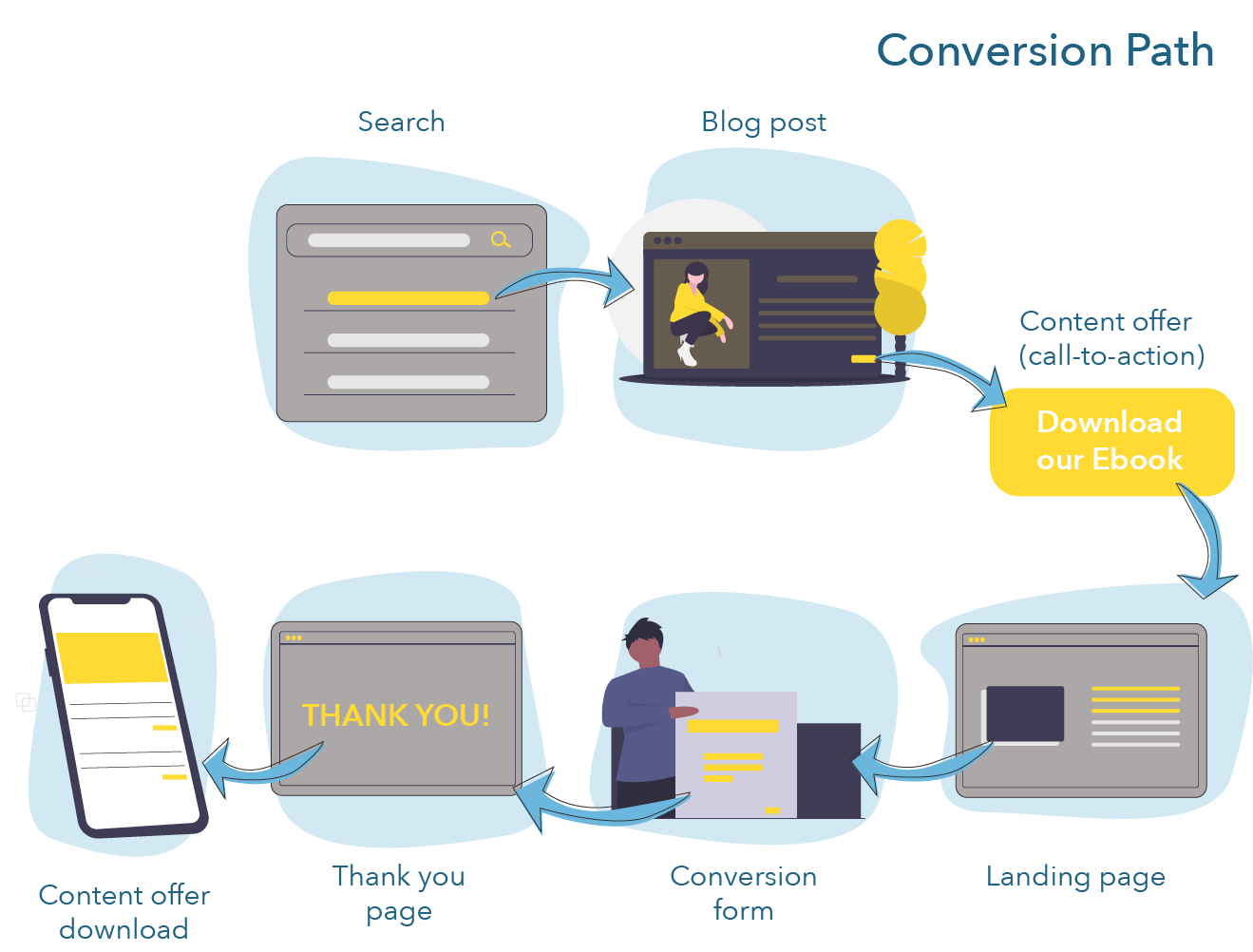
The planning of the steps consumers are going to take to achieve what you want them to achieve is central to create digital marketing campaigns. We do not simply create content and ads in the hopes that consumers are going to visit our website or click on our ads, without any idea of what will happen next. Rather, the best-strategized campaigns always answer the question, What comes next? For example, if you’re creating an ad to appear at the top of a SERP, what comes next? What are you expecting people to do? Where are you leading them? What should they be doing once they get on this page? Why? Answering these questions is how you can create highly converting campaigns because you have a clear idea of the goal consumers should achieve, and you can therefore create pages and ads that will lead them to achieve these goals.
Depending on who you ask, it takes between 5 and 13 touchpoints (or interactions with your brand) to generate a qualified, sales-ready lead (Salesforce 2015; Online Marketing Institute 2013). We will come back to the notion of qualified lead (i.e., a lead that you believe can be your customer) and sales-ready (i.e., a lead that is at the purchase stage) later during the semester. For this chapter, what is important to understand is that, without planning ahead in advance what these 5 to 13 touchpoints will be, it will be quite difficult to create sales. The task of a digital marketer is thus understanding how to bring people through a set of smaller goals, like visiting a blog post, spending 3 minutes reading the post, giving the company an email address, opening the first email (and so on), that will lead them to achieve certain milestones toward making a purchase. Otherwise, a company will be flying in the dark, with no clear strategy as to how to make sales, apart from putting ads online and creating content.
For your term project, your goal is to create a clear conversion path composed of three inbound and three outbound marketing activities. They can be part of the same path (see the example in Figure 4.7) or part of different paths (see Figure 4.8 or text description), but you need to think ahead to a set of tactics and associated marketing activities that are clearly linked to making people “walk” along the path you’ve created for them. Ideally, your path should indicate what you are doing (i.e., your tactic) and what you expect consumers to do (i.e., a goal).
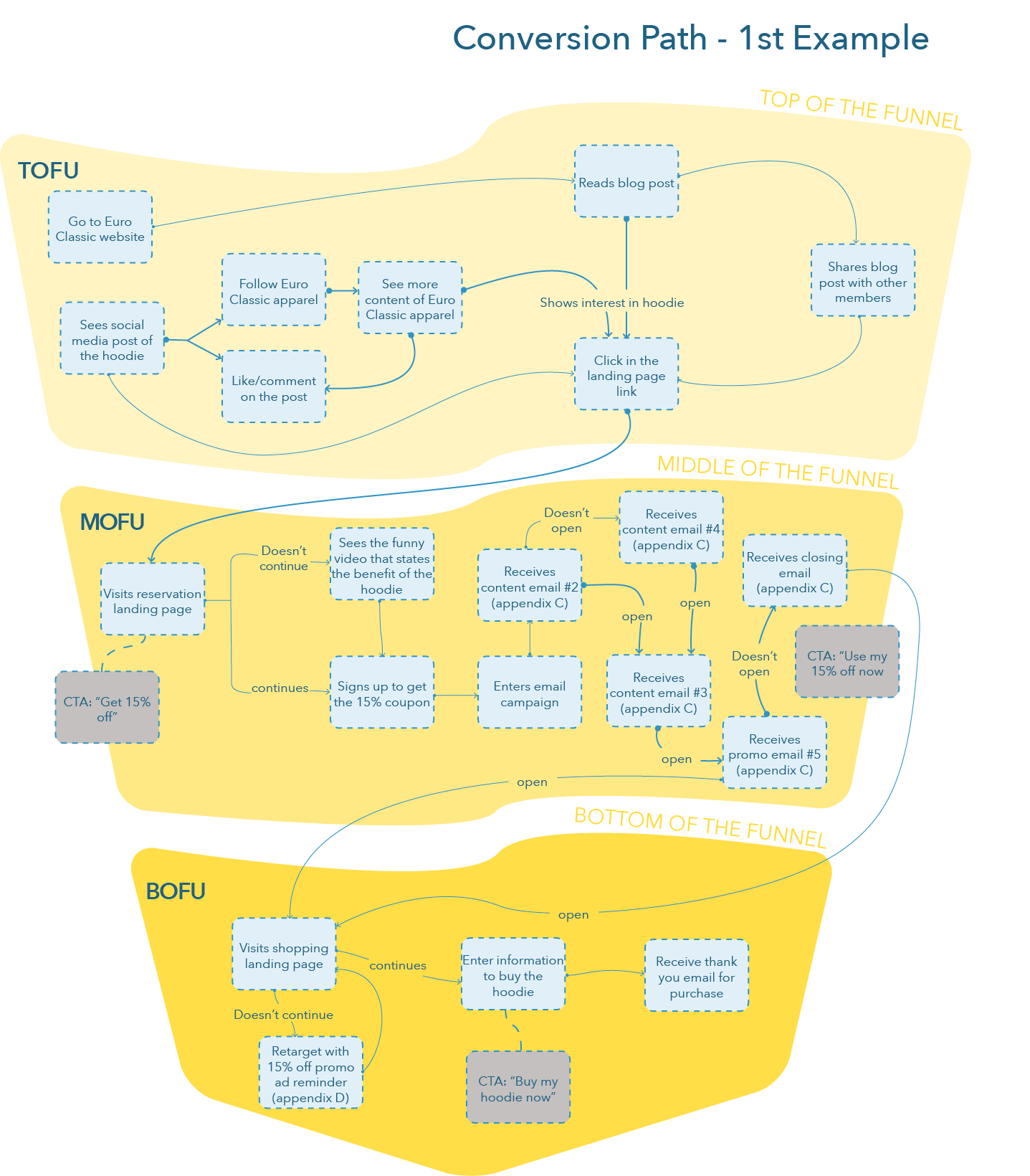

The RACE framework (Figure 4.9; text description) is highly useful in creating a strategy for digital marketing campaigns. It helps answers questions such as the following:
The strategic value of the RACE framework also makes it a great tool to guide competitive analysis. You can turn these questions around to better understand the digital marketing strategy of your competitors:

Understanding how your competitors bring in visitors can be of great use in crafting your own strategy for attracting people to your web properties. Questions to ask include
Similarly, an analysis of your competition should include a better understanding of the user experience on their website. For this stage, you can answer questions such as
The next stage is to better understand how your competition converts their leads into customers. To understand this, it is important to take the same steps a customer would: Register for your competitors’ newsletters, understand what happens once a cart is abandoned, and analyze persuasion attempts within webpages. To assist you, questions you should be able to answer include:
To conclude your competitive analysis, become a customer of your competitors! Understand what happens once you buy a product. See whether there exist forums for your competitors’ brands, services, or products. How are consumers of your competitors interacting online? What are your competitors doing to foster such interactions? Here, you can ask
A great approach to try to better understand your competitors is to approach them as you would if you were a persona-related consumer going through the motions of their journey. This is a different logic from evaluating your competition based on other strategic frameworks, such as SWOT. SWOT, indeed, can be used to understand the strengths and weaknesses of your competition as it relates to their digital marketing resources. But never before were we able to analyze exactly how our competitors are operating. Because everything is archived online, and because you can readily have access to marketing efforts such as ads and content, understanding your competitors’ strategic efforts has perhaps never been more accessible. To conclude, to gather as much (targeted) information as possible, be sure to
You are a fitness center creating a campaign for people who want to get back into shape.
One of the personas you are targeting is Avery.
Avery is a person living in a major Canadian city center. They are their late twenties to early thirties and are in the top 20% in revenue in their city. With increased responsibilities at work and a newborn, Avery had put exercising aside for a few years. They feel sluggish, lack energy, and miss having a stronger connection with their body. With age, their body has also started to transform, and they have started to feel self-conscious about it. To remediate this, they want to get back into exercising weekly. They don’t have much time, and they also don’t know much about working out or the market—for example, where to work out or how to work out.
Think of the implications for generating awareness, attracting visitors, creating leads, converting leads into customers, and generating engagement.
Integrate paid, owned, and earned marketing activities for a campaign for your fitness center based on the journey map provided.
For one or two stages, accomplish the following actions:
In this chapter, we cover the strategic bases associated with the Reach stage. We start by covering the main objectives of the Reach stage and some KPIs associated with goals for consumers. We then move our attention to discussing paid media activities. To do so, we first emphasize the necessity of building landing pages whenever we are creating marketing campaigns and describe what landing pages are. We then turn our attention to the online ecosystem, discussing elements such as types of paid media activities (e.g., banner advertising, search advertising, affiliate marketing, and influencer marketing) and expand on payment models and types of targeting that the new online ecosystem allows.
Learning Objectives
Understand the Reach stage, landing pages, different paid media activities, and key terms associated with payment models and targeting approaches.
Reach is the first stage in the RACE framework. It entails the publication and promotion of content in order to draw visitors to our website. The two main objectives at this stage are to build awareness (about your website, brand, products, and/or services) and to bring visitors in. We do so by using both inbound and outbound marketing activities (although we will concentrate on the latter in this chapter) and through paid, owned, and earned media touchpoints.
The goals we have in mind for people at this stage might include for them to come to our website from a SERP, stay on our website once there, or click on our ads. Internally, we can have objectives like creating high-ranking pages and ads with a good ad score (briefly, an ad quality score can lead to lower prices for your ads and better placements on SERPs).
Accordingly, examples of KPIs that are important at this stage include number of unique visitors, bounce rate, clickthrough for ads, page authority, page rank, and ad quality score.
In the rest of this chapter, we will cover outbound marketing activities. Since you should Never Start A Marketing Campaign Without a Dedicated Landing Page (NSAMCWADLP), we start our review of paid marketing activities by digging deeper into landing pages.
A landing page is a campaign-specific page distinct from your main website that has one goal and one link (ideally, a call to action).
Two main types of landing pages exist.
Figures 5.1 and 5.2 present examples of clickthrough landing pages, and Figures 5.3 and 5.4 present examples of lead generation landing pages.



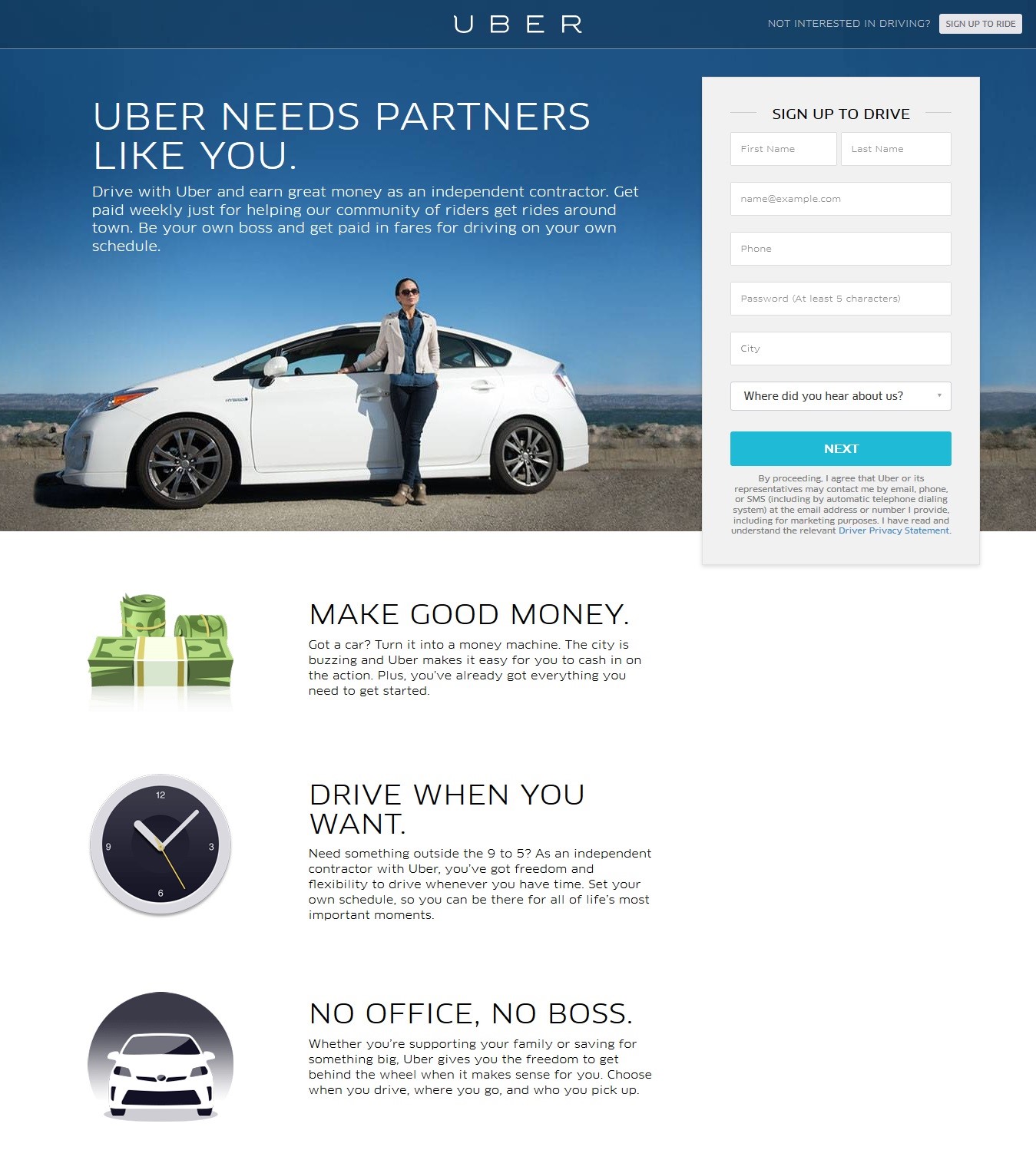
Ad campaigns can aim at building awareness, but they are typically associated with making consumers achieve specific goals, such as trying out software for free, registering for an account, sending an email to a company, or downloading a free piece of content.
When running ads that have such goals, sending visitors to a website is counterproductive: a website is not meant to convert, i.e., to make consumers achieve a specific goal. If consumers are directed to a website, they will be faced with hundreds of potential actions (associated with the links available on a website), one of which is the action they should be performing. It becomes easy for consumers to get lost.
Inc comparison, landing pages are focused on help consumers achieve only one goal. They facilitate conversion. They do so by allowing to tailor the page to the exact goal that users should accomplish. This can be achieved, for example, by offering a clearer message to consumers (vs. bringing consumers to a website), by minimizing the potential actions they can perform on the page, and by matching the visuals of an ad with that the landing page. We will delve in depth into some of these benefits of landing pages when discussing conversion optimization in chapter 10.
Take, for example, the ad for Shopify shown in Figure 5.5.

The goal for consumers associated with this ad is to try Shopify for free and create an online store today. How can we maximize the chances that consumers will do so?
When creating this ad, the question that a digital marketer faces is: where do I bring visitors? Ideally, you want to bring visitors to a place that will ensure that they will achieve the goal of trying Shopify.
A first option could be the homepage of Shopify shown in Figure 5.6.

Although this page has a box at the very top that incites people to try out Shopify for free, visitors are also offered a wide array of competing actions. They can click any of the links at the top of the page (“Start,” “Sell,” “Market,” “Manage,” “Pricing,” and “Learn”); they can scroll down to learn more about Shopify, and at the very bottom, they can also access information such as “About” Shopify and “Terms and Conditions.” In short, they can do a lot more than simply trying Shopify for free.
Over time, digital marketers have learned that one of the easiest ways to ensure that visitors will do what you want them to do is to limit the possibilities to just the one action you want visitors to take—in this case, signing up to try Shopify for free. The chart in Figure 5.7 exemplifies this by showing the conversion rate vs. the number of links on a page.
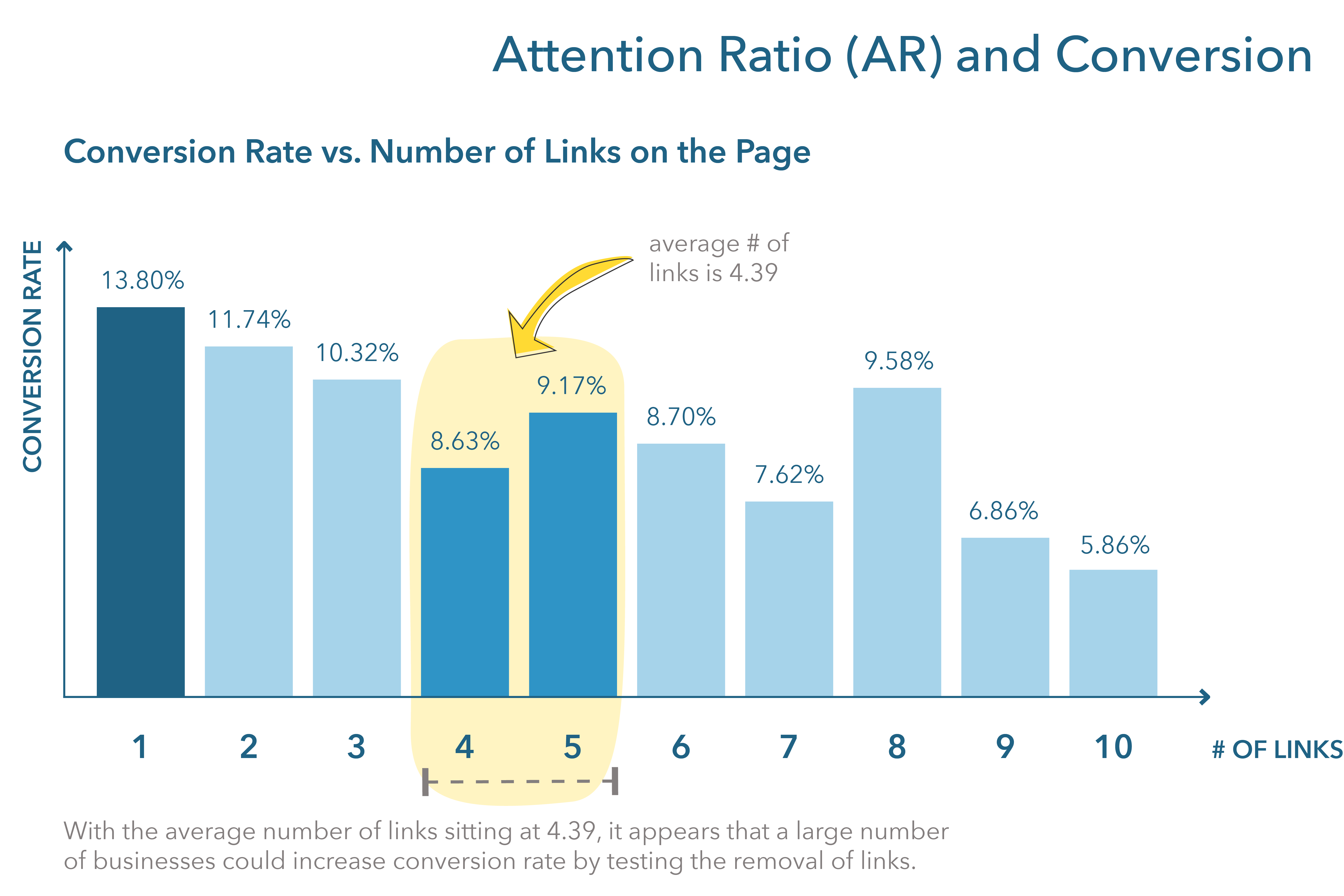
For this reason, the Shopify ad doesn’t redirect consumers to the Shopify homepage. Rather, they created a dedicated landing page where the only possible thing for visitors to do after clicking the ad is to start their free trial. Figure 5.8 shows the landing page.
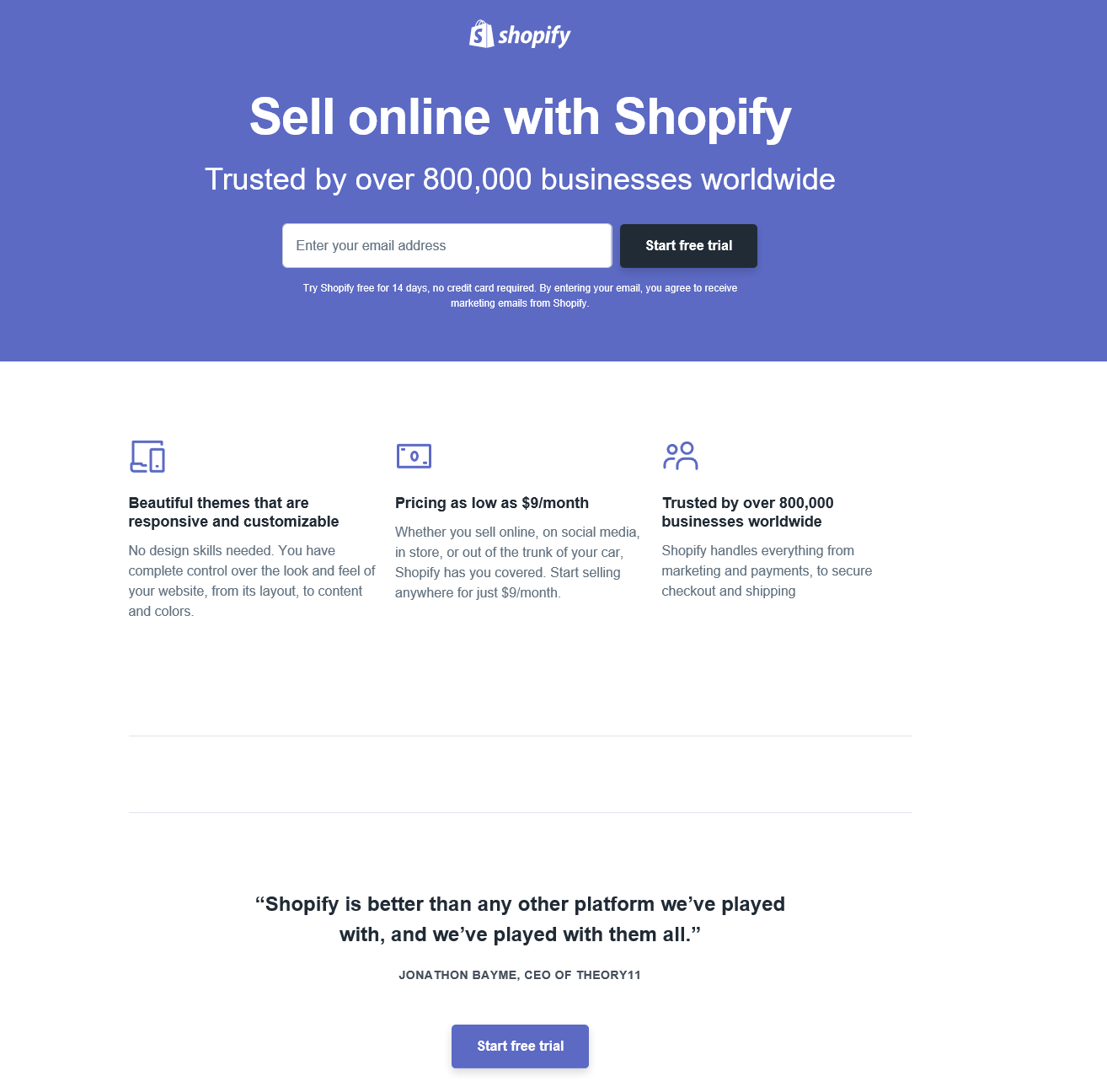
By focusing visitors’ attention to the task at hand (i.e., trying Shopify for free), we can maximize the conversion rate, i.e., the number of visitors who will achieve the goal we want them to achieve. A metric created to better understand the relationship between the number of possible actions on a website and the number of goals for consumers is the attention ratio. Figure 5.9 demonstrates how a website has a high attention ratio (i.e., many possible actions vs. what you want consumers to be doing) and why a landing page is ideal for pushing visitors to perform the action we want them to perform. Landing pages should have an attention ratio of 1:1, meaning one possible action to one goal.
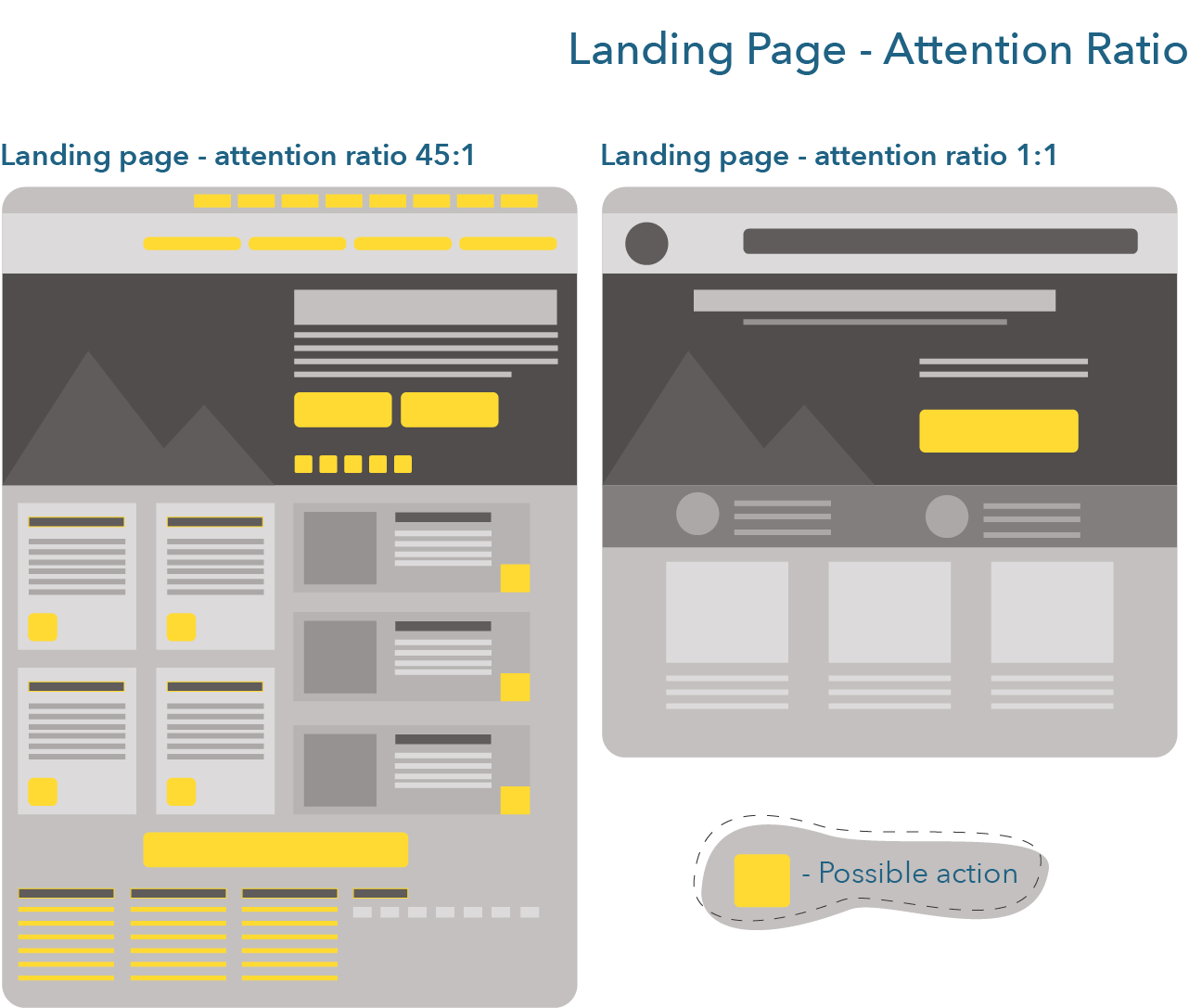
A landing page has five basic elements: First, a unique selling proposition (USP), a “unique” benefit offered by the product or the service (I put unique in quotation marks because companies usually present a benefit without it being unique). The USP is typically communicated through a headline and a subheadline that explain the value and purpose of the product or service. It is also sometimes reinforced in a mid-page statement and a closing argument at the bottom of the page. Second, a hero shot, which is a visual associated with the product or service. Third, a benefit statement that explains how the product or brand helps consumers, typically using bullet points or small paragraphs. Fourth, social proofing such as testimonials, awards, client list, or media logos, and finally, fifth, one link, typically a call to action.
Let’s see these five elements in a recent Shopify landing page (Figure 5.10).
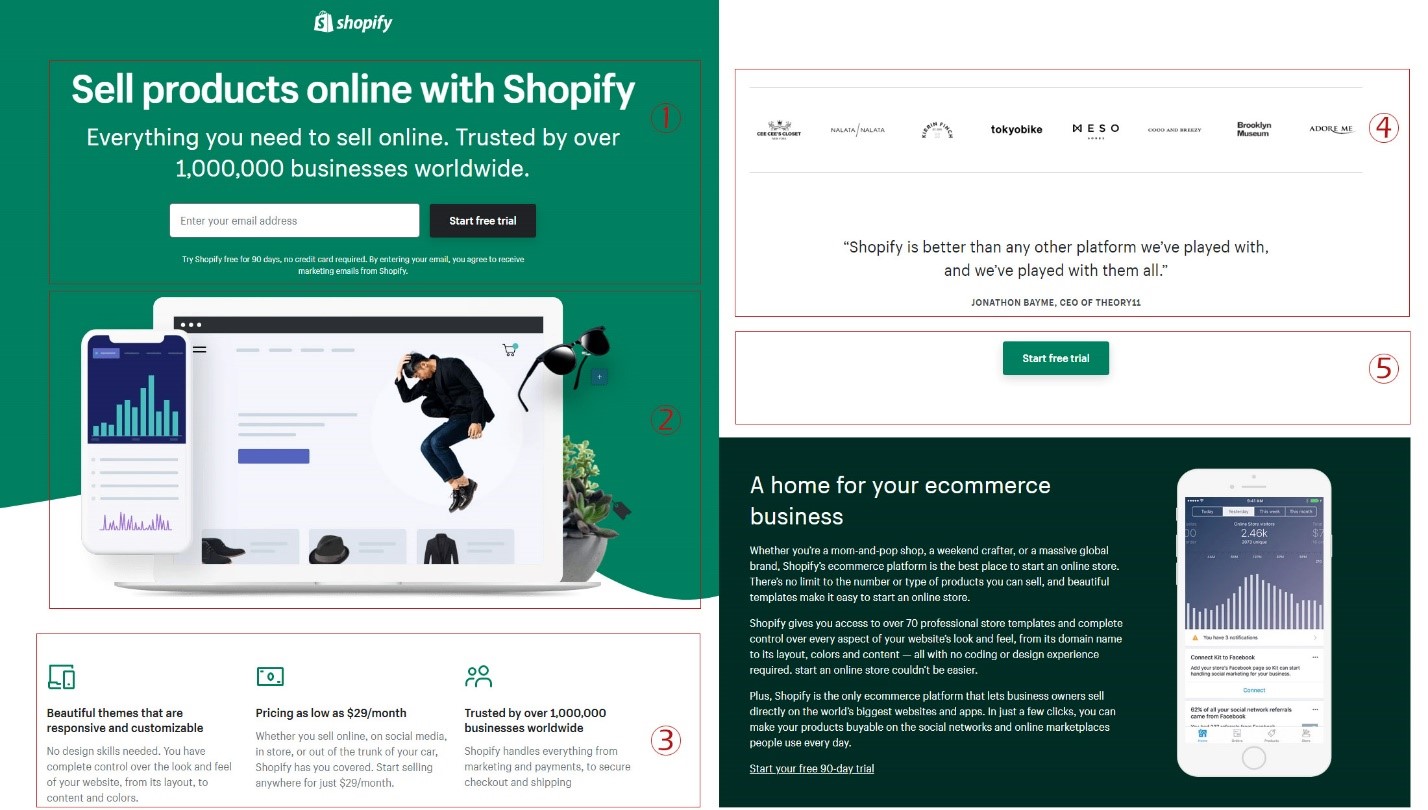
Digital marketers typically advertise online through advertising networks, such as Google AdSense, and advertising exchanges, such as Google AdX (the differences between these are summarized succinctly here but are outside of the scope of this course). Although these two approaches to providing advertising space to advertisers differ, from an advertiser’s perspective, both provide an entry point where advertising space can be purchased. Networks, for example, aggregate ad space across websites and sells this inventory to advertisers.
Nowadays, much of advertising space is sold through programmatic buying, the automated purchasing of digital advertising space. When marketers purchase space through the Facebook Ads or Google Ads platforms, for example, they are making use of programmatic buying. These platforms have been transformed in recent years by the use of algorithms and predictive analyses to help identify the optimal placement of ads to reach specific objectives. Facebook Ads, for example, gives advertisers options such as reach, awareness, or lead generation campaigns. Choosing a specific objective will influence where ads will be placed (i.e., who will see the ads) to maximize the effectiveness of the ad campaign.
We now turn our attention to different ways of reaching customers. More precisely, we will briefly cover banner advertising, search advertising, social media advertising, affiliate marketing, and influencer marketing.
Banner ads are images or animations that advertise brands, products, and services on websites. They can be likened to the ads one would find in newspapers and magazines. Many types of banner ads exist, including the following:
Figure 5.11 shows an example of a standard banner ad.
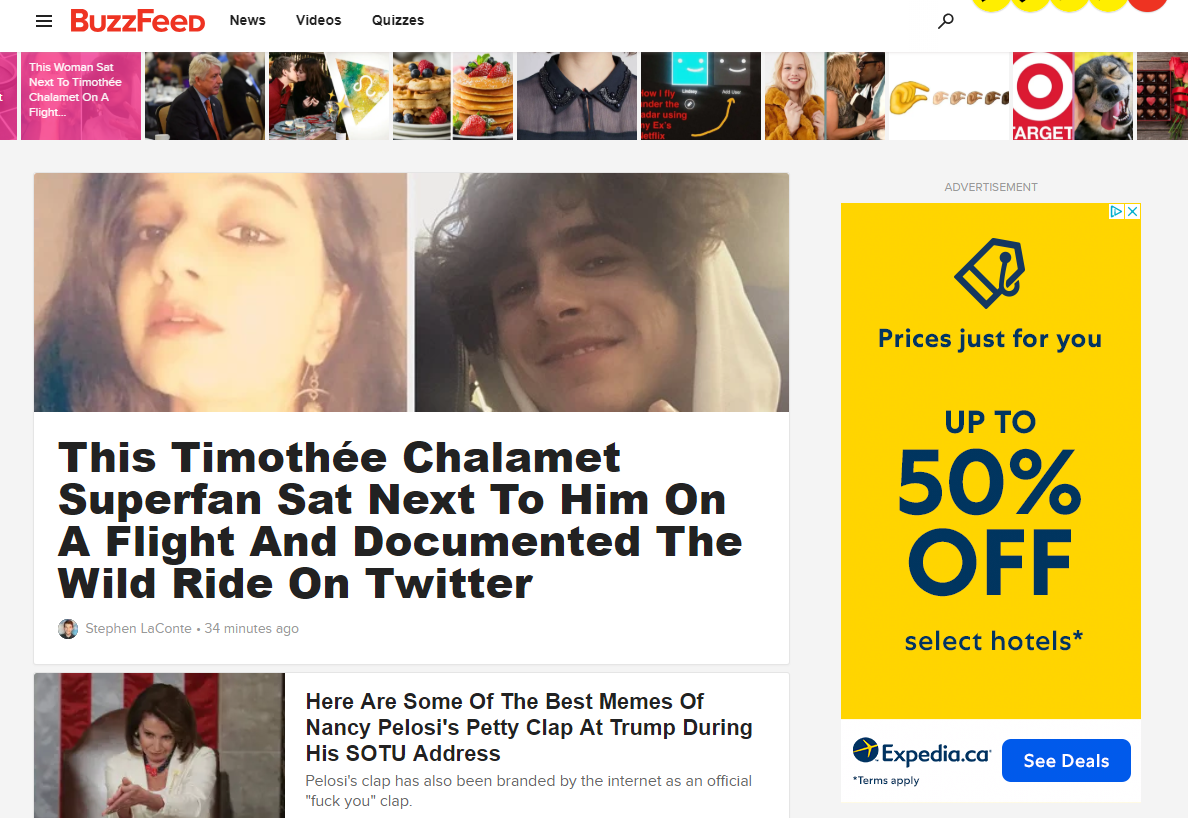
Figure 5.12 shows an example of an interstitial banner ad.
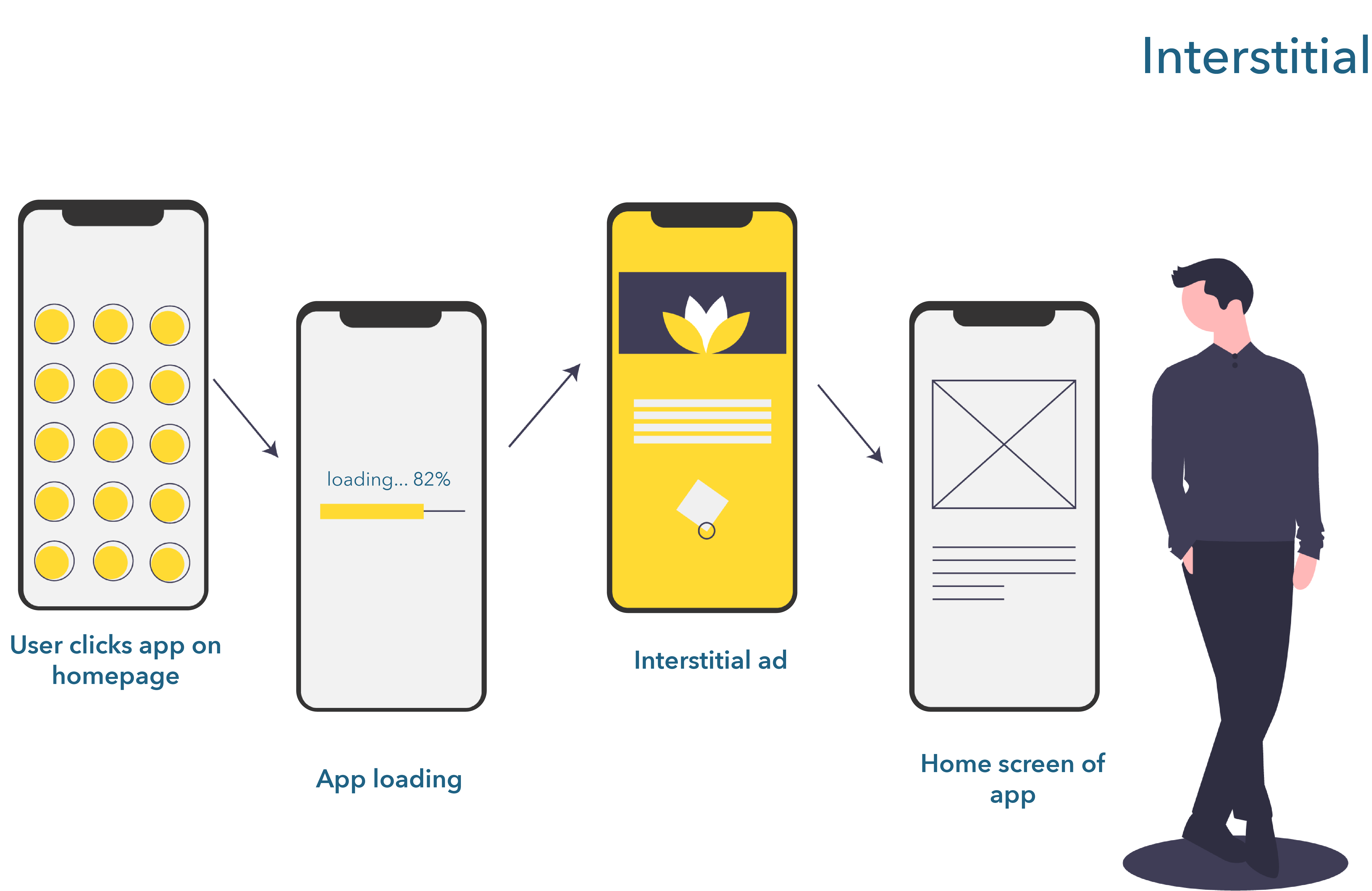
Figure 5.13 shows an example of a pop-up ad.
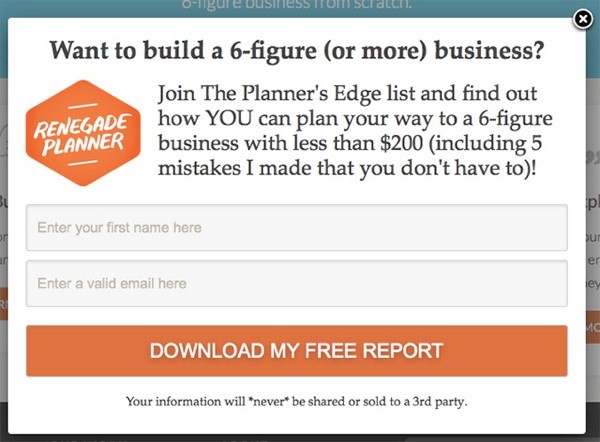
Figure 5.14 shows an example of a floating ad.
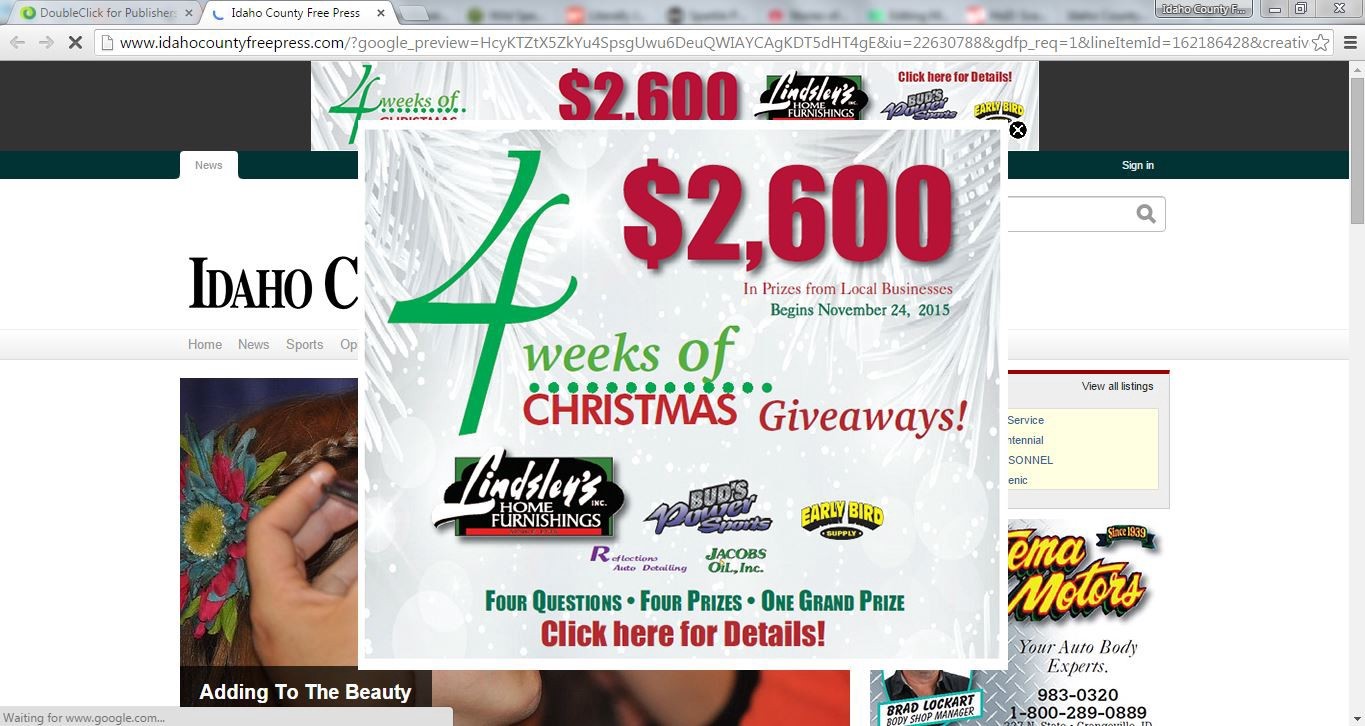
Figure 5.15 shows an example of wallpaper ad.
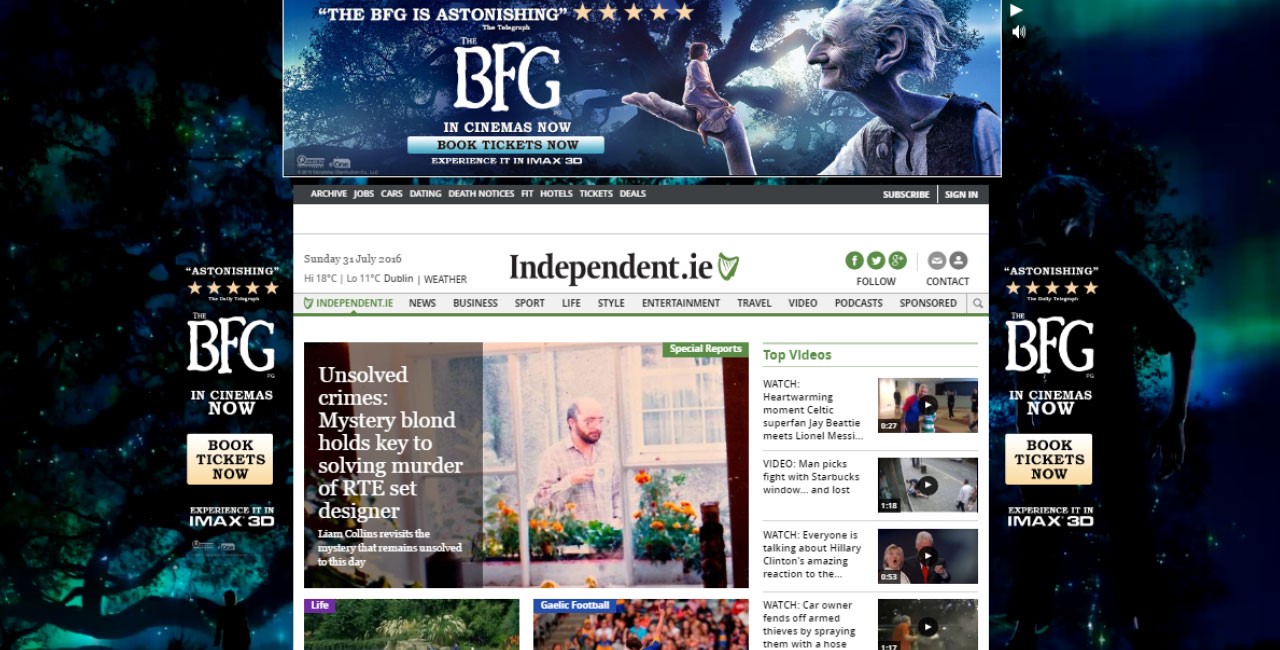
Figure 5.16 shows an example of a map ad.
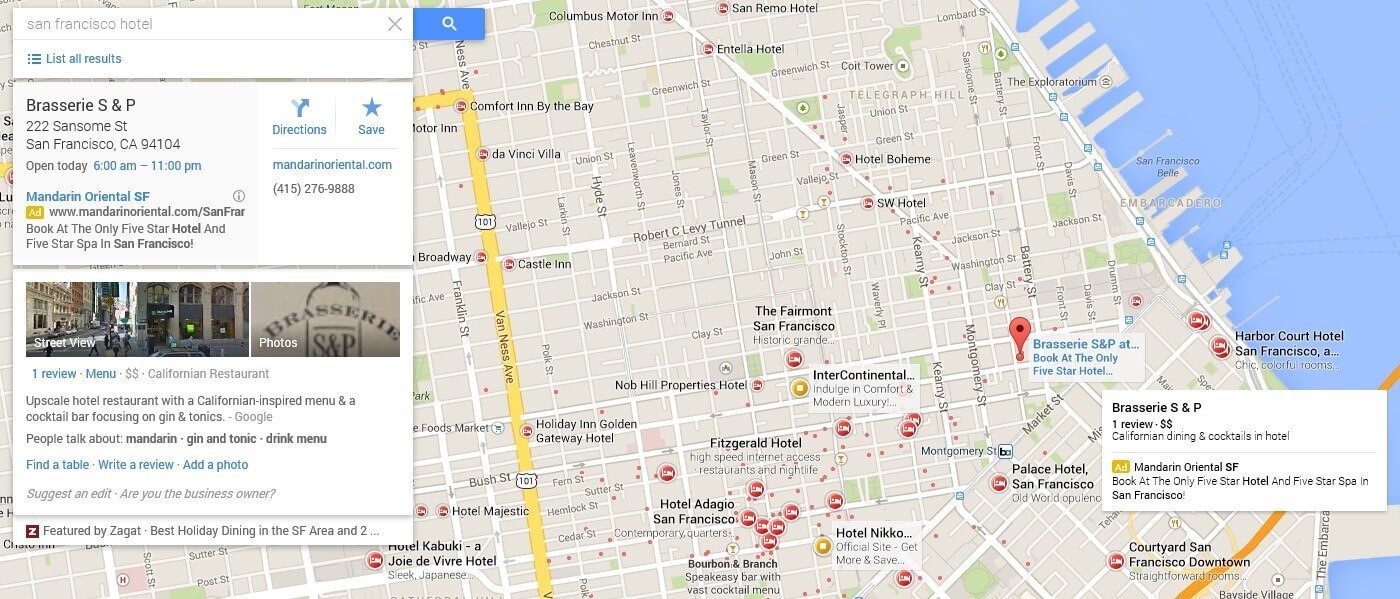
Figure 5.17 shows an example of a native ad.
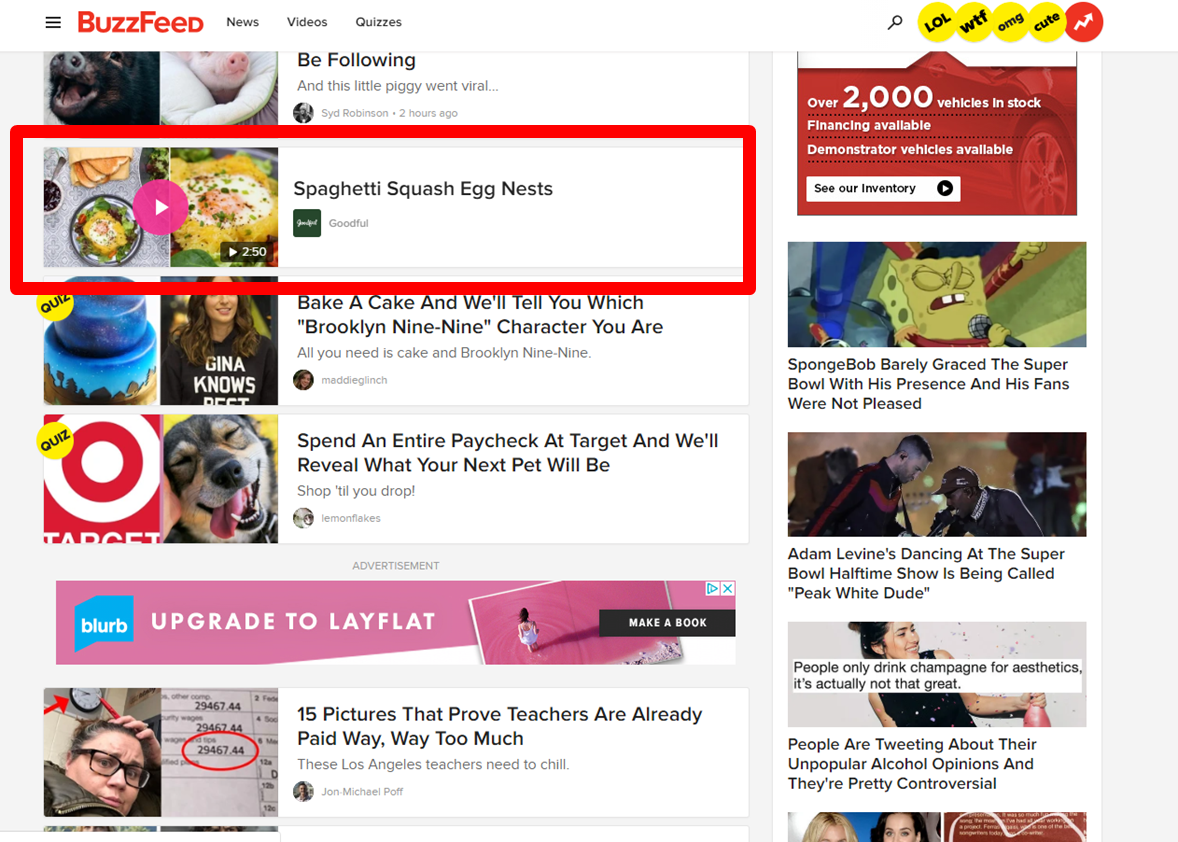
In comparison to SEO, search advertising entails gaining traffic on SERPs by bidding on keywords. Search advertising is also referred to as PPC advertising because of the mode of payment: Advertisers typically pay search engines for each click their ad receives.
Search ads are sold and delivered on the basis of keywords. Advertisers decide on sets of keywords they would like their ad to show up for, and when users search for these terms, their ad might show up. Keywords are sold through an auction process. As a result, industries with very high customer lifetime value, such as insurance or mortgage firms, can pay upward of $50 per click.
To better understand how to bid for keywords, let’s watch the following video, which explains how the Google search ad auction works.

A YouTube element has been excluded from this version of the text. You can view it online here: https://opentextbooks.concordia.ca/digitalmarketing/?p=348
Using search ads requires combining three main elements: the keywords you want your ad to show for, your ad (i.e., a headline or two, a URL, and a description), and a landing page. In short, you buy keywords that will be used by a search engine to display your ad when people search for those keywords. Your ad needs to be relevant to the search and attractive to the consumer. When your ad is clicked, you direct consumers to your landing page.
The guidelines for writing effective search ads are similar to those for writing effective page titles and meta descriptions. This is the only element that users will see on SERPs, and it is therefore important to make it as attractive as possible. First, the ad should ideally target a clear need or goal that consumers have, dependent on where they are in their journey. Is the consumer looking for information? Comparison tools? To purchase something? How can your ad help the consumer achieve their goal? Second, the ad should have a clear call to action.
Searches follow a long-tail distribution (Figure 5.18; text description here). This has implications when doing search ads: Most consumers might be using generic, high-volume keywords, while others might be using hyper-precise, low-volume keywords. Although bidding on high-volume keywords might seem like a good strategy, it comes with drawbacks. First, these keywords are likely more expensive. Second, they are less likely to bring quality traffic. By quality traffic, I mean visitors who can eventually become your customers. This is particularly important for search advertising, because each visitor is associated with a specific cost. Devising effective search advertising campaigns thus entails balancing volume and quality: Bringing in enough visitors that can buy your product or service but making sure that visitors who won’t buy it don’t click on your ad.
To do so, firms typically combine high-volume and low-volume keywords to tailor their search ads to visitors who can potentially be customers. This helps lead generation efforts down the line while ensuring more cost-effective search ad campaigns.
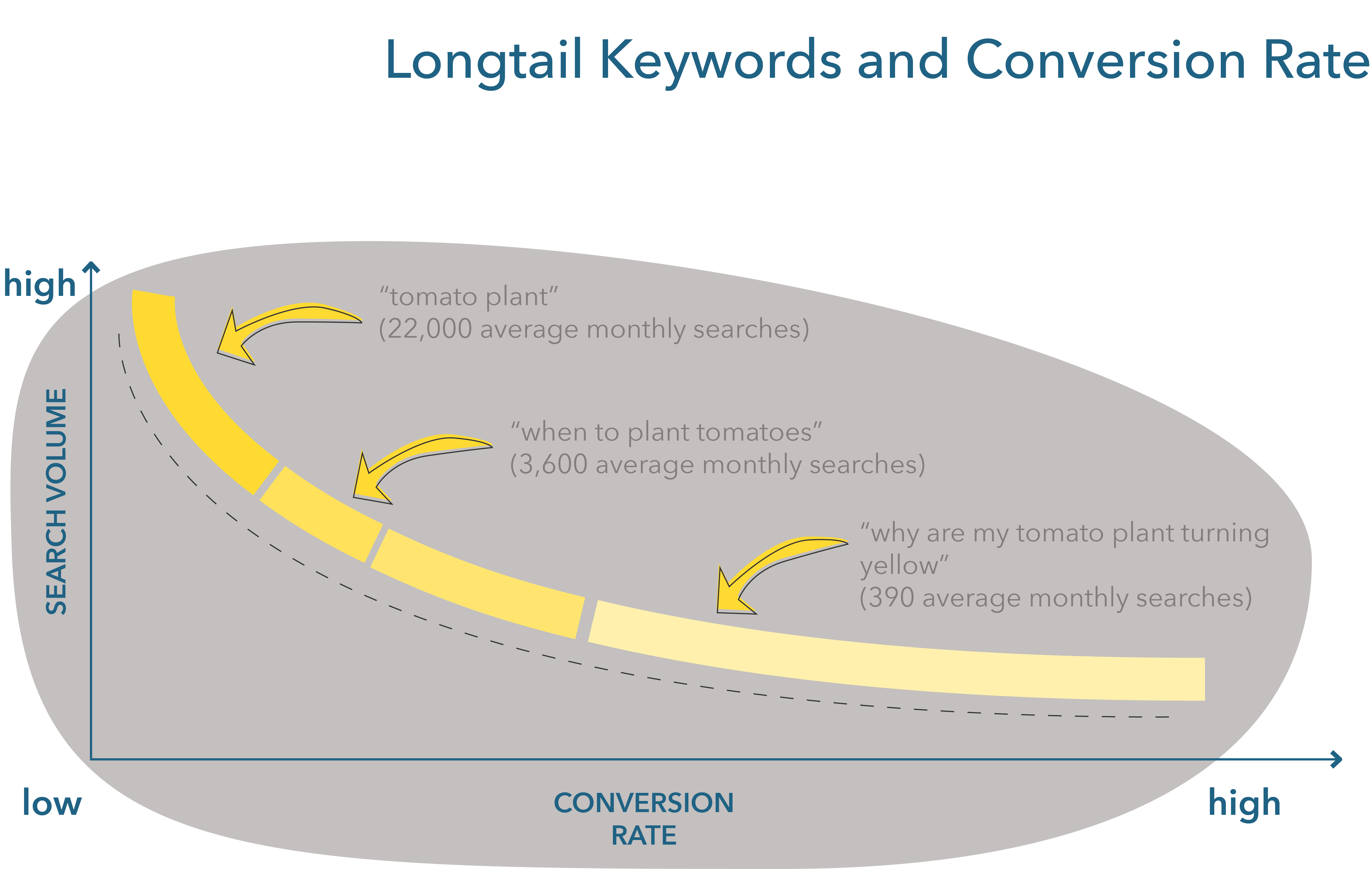
After deciding on keywords, you can choose how keywords will be matched to specific searches. Four main types of match exist: broad match, phrase match, exact match, and negative match.
A broad match shows your ad for any search that contains the keyword(s) you are bidding on, and any other keyword in any order, as well as variations on your keywords such as misspellings, synonyms, singular and plural forms, stemming (e.g., a search for “flooring” will match “floor”), related searches and other variations.
For example, let’s assume you are bidding on the keyword “kitten” using a broad match. Any search containing a variation on “kitten” would show your ad, such as “kittens,” “kitten photos,” or “adopt a kitten.”
Associated with broad match are broad match modifiers, which allow more control over matches by including some other necessary keyword. For example, if you want your ad to be shown only for searches that contain both “adopt” AND “kitten,” you can specify that. Your ad could then show for searches such as “adopt a kitten,” “how to adopt a kitten,” or “best kitten to adopt.”
Phrase match shows your ad only for searches that include the exact phrase (or close variations of that exact phrase with additional words before or after). For example, let’s assume you are bidding on the key phrase “how to adopt a kitten.” Your ad could show for searches such as “how to adopt a kitten now” or “best ways how to adopt a kitten.”
Exact match only shows your ad for searches that use the exact phrase, or close variations of it, and no other words. For example, the key phrase “adopt a kitten” will match the searches “adopt a kitten” and potential misspellings (e.g., “adopt a kitten”).
Negative match prevents your ad from being shown when certain keywords are included, such as keywords that might cater to customers searching for a different product. For example, let’s say you’re an optometrist who sells eyeglasses. In this case, you may want to add negative keywords for search terms like “wine glasses” and “drinking glasses.”
A few metrics that are important for evaluating your success when doing search advertising include the following:
Social media has become central to most consumers’ lives. In some countries, social media networks have become synonymous with the internet, to the point where “many use the internet without realizing it” (Pew 2019). Social media has also fueled consumer content co-creation efforts (or “user-generated content”), and we can now publish our own content and share the content of others. Many social media businesses rely on the work of consumers (e.g., without us posting content and images, there would be no reason to use Instagram or Facebook).
There are many platforms for advertising on social media, with new ones accumulating millions of users in ever-shortening periods of time (TikTok being a prime example of the latter). As we favor a strategic outlook, a review of all existing social media platforms is outside of the scope of this chapter, but the following links give precise instructions on how to post an ad on each of the major ones:
The variety of social platforms has an important implication when using them to advertise: the importance of understanding social and visual norms in order to create impactful campaigns. Social norms refer to what is considered acceptable behavior on a social platform. Understanding the social customs, shared actions, and behaviors that are standard for a platform is also important. Marketers that understand these have been able to create successful campaigns around them, such as the Guess #inmydenim campaign that used the “transformation” trend, the #JLoTikTokChallenge that used the challenge customs, and the Doritos #CoolRanchDance campaign that leveraged TikTok dances and the capabilities of the platform of using songs.
This approach of capitalizing on norms and customs is found throughout social media platforms. Old Spice, for example, tailored its advertising efforts to each platform and offers many good examples. The brand created one of the first iconic ad campaigns by emphasizing two-way interactions and video sharing capabilities on YouTube, with a response campaign associated with their ad “The Man Your Man Could Smell Like.” They translated the Twitch Plays Pokémon phenomenon, where thousands of users direct video gamers to perform certain actions to create a campaign where Twitch users could control the actions of a man for three days for the Nature Adventure campaign. And they used the idea of gif wars on Imgur and the platform’s upvote capability to create the Smellmitment campaign.
These campaigns all followed the same precepts: They engaged with the norms and customs of the platform they used. They created ads that aimed to generate a conversation with users rather than solely talking about the product. And they leveraged the technological specificities of each platform (e.g., songs for TikTok, turning comments into controller inputs for Twitch, and using upvotes on Imgur).
Social media has also become one of the main pillars for advertising, and it can support most of the objectives of the different stages of the RACE framework. That is, using social media for advertising can help with increasing awareness, bringing visitors, creating leads, converting leads to customers, fostering loyalty, and engaging customers in co-creation activities. This is well exemplified by the social media ad objectives that most platforms ask you to choose from when starting an advertising campaign. Take, for example, Facebook ad objectives (Figure 5.19; text description here).
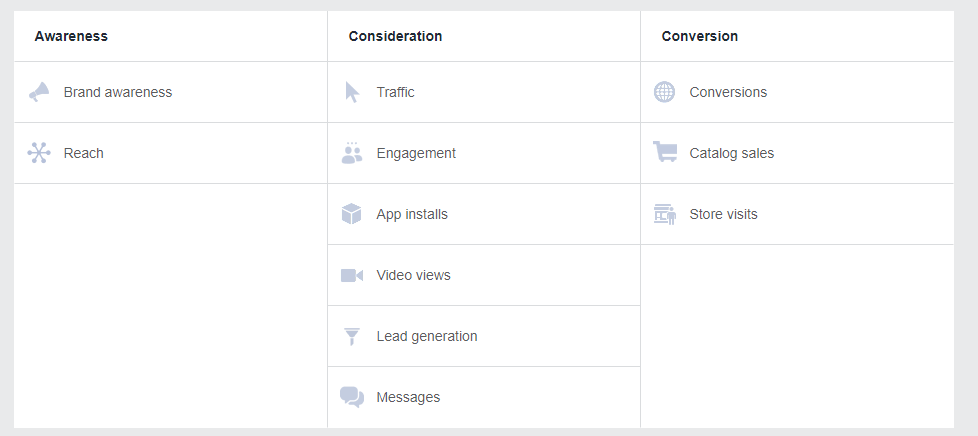
Facebook has divided its ad objectives into three categories that almost perfectly align with the RACE framework: “Awareness” is associated with Reach, “Consideration” with Act, and “Conversion” with Convert. Let’s examine each objective in more detail.
Under the Awareness category, brand awareness “increases overall awareness for your brand by showing ads to people who are more likely to pay attention to them,” and reach “shows ads to the maximum number of people in your audience while staying within your budget.”
What is the difference? While both align with Reach objectives, brand awareness is designed to help advertisers find the audiences most likely to recall their ads. The goal is to increase brand recall, and this ties to Facebook “Estimated ad recall lift.” Reach maximizes the number of unique people who will see your ad while capping the frequency of impressions (e.g., one a day).
Objectives in the Consideration category overlap with all three stages.
Traffic addresses a Reach objective as it aims to grow “the number of people who are visiting your site, app or Messenger conversation,” but it is also associated with Act because it aims at “increasing the likelihood they’ll take a valuable action when they get there.”
Engagement can be seen as both an Act and an Engage activity: it wants to “get more people to follow your page or engage with your posts through comments, shares and likes. You can also choose to optimize for more event responses or offer claims.”
App installs can be seen as both Act and Convert activities (depending on the strategic goal of having people install your app; if the app is free and purchases happen within it, it’s a lead generation activity; if it is a paid app, it’s a convert activity).
Lead generation includes a menu where users can directly enter their personal information. It is an Act activity that aims at creating leads.
In the last category, Conversion ads align with the Convert stage by helping advertising to convert users into customers.
These categories use the Facebook ad delivery algorithm differently, with Awareness objectives targeting ads to people more likely to respond to Awareness generation and Conversion objectives to people more likely to convert. Some objectives also offer specific types of ads, such as a catalog (catalog sales), a form (lead generation), or a redirection to app installs (app installs).
The last important strategic piece to cover associated with social media is their targeting capabilities, or how they allow you to display ads to specific groups of people. All platforms will allow you to target your ads based on key customer variables, such as demographics, location, and interests, and each also has some specific targeting capabilities. For example, LinkedIn allows you to use LinkedIn audience segments to programmatically reach professional audiences based on their company size, seniority, professions, and other key professional variables.
Most platforms allow for behavioral targeting, where ads are delivered based on purchase behaviors or intents or people who have a specific kind of connection to your page, app, group, or event. For example, advertisers could target any users that have engaged with their content across the Facebook family of apps and services.
After Facebook introduced the highly useful Lookalike audience option in 2013, other major advertisers such as Google followed suit. Lookalike audiences use platforms’ algorithms to create groups on social networks that resemble other groups. This is a new and unique way to target that was never before possible and can help companies unearth some group of consumers who would be highly qualified but have not yet been identified by the company. A lookalike audience could be based on a previously highly engaged audience (i.e., finding another group of consumers that shares some commonalities that will also make them highly engaged) or an existing segment of customers.
Payment structures for social media advertising are typically one of the following:
Influencer marketing—a form of social media marketing that capitalizes on people or organizations with large followings who exert some sort of influence over others because of their expertise or charisma—has become both a marketing and a societal phenomenon. There were more than 3.7 million ads by influencers on Instagram in 2018, and some estimate that the market will reach US$10 billion by 2020 (Wired 2019). Ninety percent of Instagram campaigns in 2018 used micro-influencers, influencers who have somewhere between 1,000 and 100,000 followers (HubSpot 2019). Micro-influencers represent about 25% of the Instagram user base, or about 250 million people (Mention.com 2018). While most micro-influencers charge a few hundred dollars per post, top ones can charge upward of US$50,000.
Although influencers can be used throughout all RACE stages, they historically have been used as an awareness generation channel. Even today, most of the main objectives reported by brands for the use of influencers relate to the Reach stage, such as improving brand awareness, share of voice, reaching new audiences, and managing reputation (Fipp 2017). Over the last few years, there has been a trend toward moving marketing budgets away from top influencers to micro-influencers, who are believed to have a stronger connection with their followers and thus generate stronger engagement (Wired 2017).
Ideally, when planning for an influencer campaign, firms should aim to choose influencers who correspond to the size of their business. It is easier for smaller firms to create relationships with micro-influencers, and these individuals might support the firms’ goals if a trusting relationship can be established. To facilitate the internal management of influencer campaigns, it can be useful to create influencer personas, i.e., personas that represent the kind of influencer the firm should aim to recruit for their campaigns. Firms should aim to find influencers that align with their brand identity, can resonate with the brand’s customers, and can help the firm achieve their objectives (i.e., perhaps different influencers can help achieve different objectives, whether it is reaching a wide number of consumers, generating leads, or converting leads to customers). Firms should also support influencers’ efforts by providing marketing materials. Some influencers might want to work with firms to align the firm’s interests and objectives with theirs. For example, many influencers report only taking on clients that represent their values or whose products they already like. When choosing influencers, ask yourself:
Two main routes exist for recruiting influencers: using influencer agencies, networks, or platforms, which centralize interactions between a firm and many influencers or contacting influencers directly. If reaching out directly, make sure to send personalized messages that clearly show that you understand who the influencer is and why you see a fit between your brand and the influencer’s brand. Different influencers have different goals: some might want to push products they strongly believe in, some might want to be a positive influence on their followers, and some might be in it for the money (Kozinets et al. 2010). This should play a role in how you “sell” your campaign to an influencer.
The main payment structure for influencers is pay per post, which varies depending on the domain or the influencer. In 2017, according to influence.co, payments averaged US$217 per post, which could be broken down as follows, with influencers with fewer than 1,000 followers commanding 83$ per post and those with more than 100,000 followers, 763$ per post. Posts mediated by The Influence Agency cost more, ranging from 2,000$ to 10,000$ per post by influencers with more than 100,000 followers. Blog collaborations are priced by the number of monthly impressions the blog receives:
Other payment structures include pay per lead, pay per engagement (when a user performs an action associated with a post, such as a click, a comment, or a share), or pay per view.
Influencers like Zoella often create a revenue stream by participating in affiliate programs, an “agreement in which a business pays another business or influencer (‘the affiliate’) a commission for sending … sales their way” (Hubspot). There are many different approaches to affiliate marketing, such as comparison-shopping websites, coupon websites, email lists, or reward websites (Authority Hacker 2020). Affiliate marketing differs from influencer marketing in that it is overwhelmingly focused on the Convert stage: Since pay is typically associated with making sales, affiliates aim to convert people to sales. There are, however, affiliate programs that pay per lead (and hence participate in the Act stage) and others that pay per visit (and hence participate in the Reach stage).
Affiliate marketing works as follows: An advertiser, a company that sells a product or a service, offers to pay a third party (e.g., a blogger or a coupon website) to help them promote and sell products and services. The affiliate conducts online activities in order to sell products or services. For example, Figure 5.20 shows a blog post in which Zoella presents her “10 scary reads” for Halloween. Each book is associated with the affiliate program Reward Style. Let’s say a reader reads this blog post, likes the sound of a book, clicks on the link for that book, and purchases it: Zoella will then receive a small percentage of the sale for helping make this sale happen.

You can typically easily identify whether a link is part of an affiliate program or not. For example, for Zoella, the link looks like this: https://rstyle.me/+U7XZh4aYDVf0s7elU5SykA. We can thus see that it is associated with the Reward Style program. Affiliate programs will create different types of links, which typically include the publisher (affiliate) website ID (or PID), the ad id (AID), and the shopper (or visitor) ID (or SID). This allows tracking of sales across publishers, ads, shoppers, and reward affiliates accordingly.
The two main payment structures that exist for affiliates are the following:
As in the previous chapter’s exercise, you are a fitness center creating a campaign for people who want to get back into shape.
One of the personas you are targeting is Avery.
Avery is a person living in a major Canadian city center. They are their late twenties to early thirties and are in the top 20% in revenue in their city. With increased responsibilities at work and a newborn, Avery had put exercising aside for a few years. They feel sluggish, lack energy, and miss having a stronger connection with their body. With age, their body has also started to transform, and they have started to feel self-conscious about it. To remediate this, they want to get back into exercising weekly. They don’t have much time, and they also don’t know much about working out or the market—for example, where to work out or how to work out.
In this chapter, we cover some central activities associated with content creation. We introduce the chapter by explaining the importance of content creation and how content creation should resemble what your competitors are doing but also be different from them because of your own unique brand voice. We then turn our attention to structuring content creation activities. We examine how content creation can be guided by the RACE framework, the difference between gated and ungated content and when to use each kind, why and how to build topical relevance, and how pillar pages can help us do so. Finally, we conclude the chapter by discussing what a content creation calendar is and how it supports content creation efforts.
Learning Objectives
Understand the basics of content creation, how it ties in with the RACE framework, gated and ungated content, pillar pages, and content creation calendars.
Content creation is important for two main reasons. First, it helps build a website’s relevance and authority, contributing to its ranking on search engines—according to most marketers, content marketing is the most efficient SEO tactic (Ascend2 2015, cited in marketingprofs.com). Websites with blogs also have four times more pages indexed on search engines, making them more likely to show up during searches (Forbes).
Content is also a cornerstone of customer acquisition strategies, and it is one of the most powerful tools for use in the RACE framework. According to HubSpot, a consumer consults three to five pieces of content during their journey toward making a purchase. Leads generated using inbound marketing efforts are also less costly by about half compared to leads generated using outbound efforts. Inbound leads are also 10 times more likely to convert (vs. outbound ones), and studies have shown that content marketing efforts boost company revenues by an average of 40% (Hubspot).
Before starting content creation efforts, a company should have in mind a clear persona and associated journey, understand its own website, and ideally understand how its competitors are positioning themselves on search engines (i.e., have performed a competitive keyword analysis).
Creating content is a balancing act. First, it is a balance in that you must be similar enough to competitors to address the general needs of the market and look like a trustworthy organization, while being different enough to attract customers. This idea of standing out while fitting in is termed “optimal distinctiveness.”
Second, it is a balance between what you can offer and what consumers want. When creating content, firms need to keep in mind that they should represent the customer. This entails understanding what customers are looking for based on their needs and challenges and how what they need evolves throughout their journey.
Creating unique and relevant content thus entails understanding the market and knowing the codes that organize content production, knowing what specifically about your brand gives it a unique voice (or “brand voice”), and combining these pieces of knowledge to create something unique that will interest consumers and is based on your capabilities, i.e., what you are able to do (Figure 6.1).
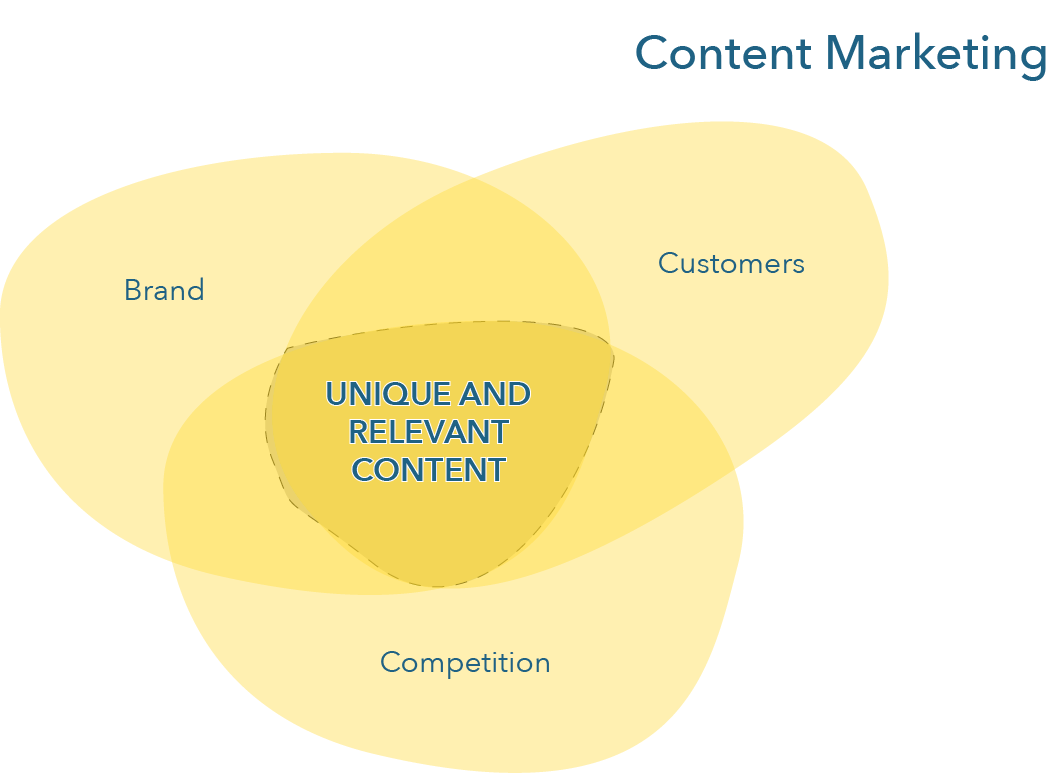
Let’s explore this further through the example of creating content on Instagram.
Something to keep in mind when creating content for social media platforms is associated with prototype and exemplar theories. Without getting into too much detail, the central idea here is that in order to stand out, you first must fit in.
The idea goes as follows: Each category has some sort of a “standard” member, a “prototype” that people measure whatever is in this category against (or, from an exemplar perspective, each category has “dominant examples,” or exemplars, that are used to evaluate whatever is in this category; Figure 6.2). In order to fit in, such as to be considered legitimate as an Instagram account on cosmetics, cars, or tattoos, you must share attributes with the prototype or exemplar. This allows you to fit in.
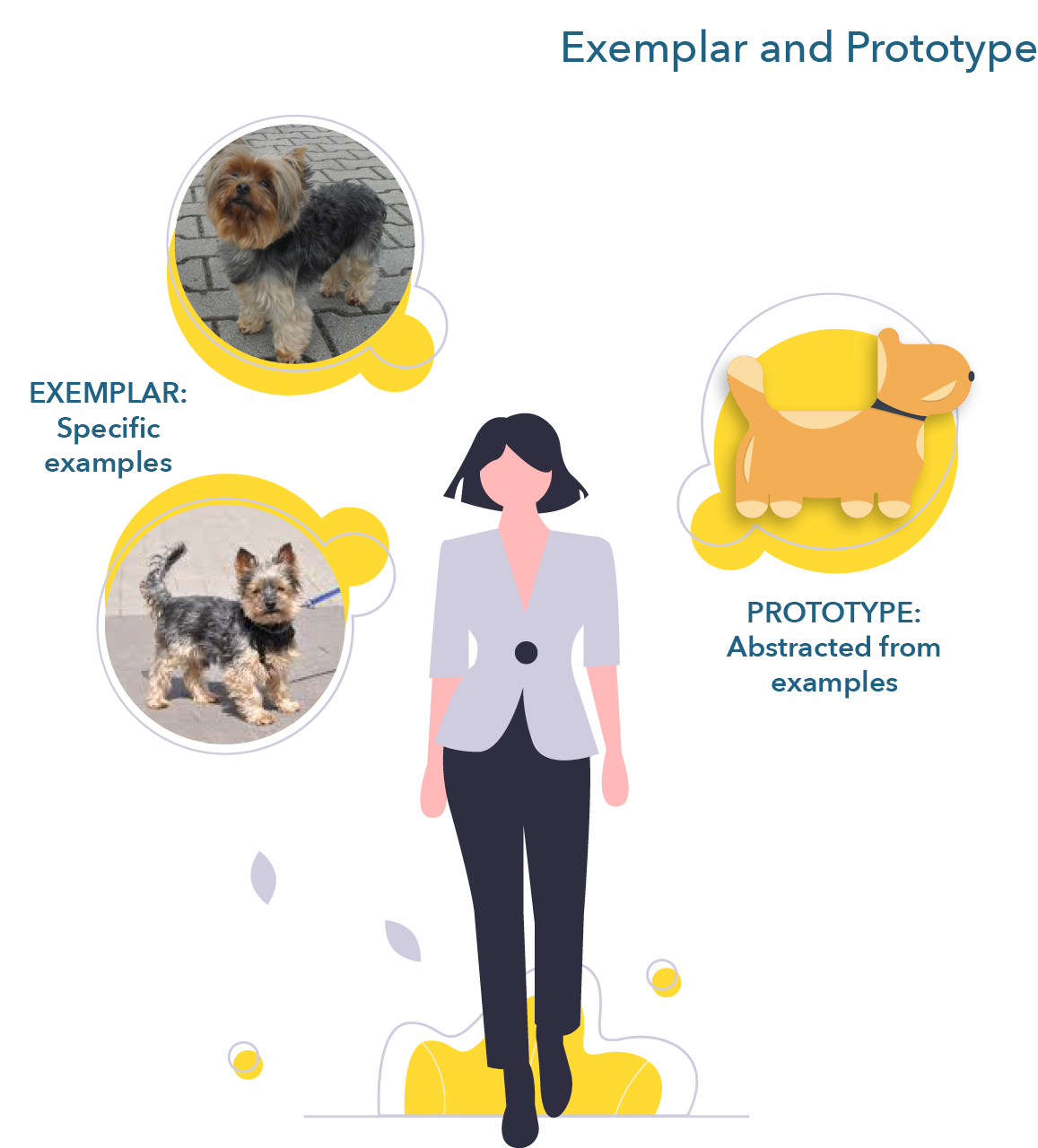
For example, fitness accounts tend to share characteristics in terms of what influencers look like (dressed in fitness attire and either looking fit or really, really fit), the setting in which they create their videos (typically, a gym), the kinds of things they post (how to exercise, diet posts, motivational posts, etc.), and so on.
Yet within the fitness category, there exist subcategories organized around different subtypes of fitness influencers. A first example is the fitness therapy profile, a type of fitness account exemplified by influencers such as achievefitnessboston, squatuniversity, and joetherapy. This type of account typically emphasizes science-based knowledge and instructionals on how to properly practice fitness and recovery.
A strikingly different type of profile, still within the fitness category, is the “fitness motivational” account, exemplified in accounts such as zacaynsley, joesthetics, mssannamaria, and anna_delyla.
Knowing which subcategory a firm wants to participate in is important because not all personas will be reading all subcategories of fitness accounts. It also allows a better understanding of the category as a whole and how to potentially mix and match approaches, as exemplified by massy.arias.
Once you have gained membership by fitting in, your job is to find ways to distinguish yourself from others. In short, you want to fit in just enough that you are part of the category but you want to differentiate yourself enough that people will want to follow your Instagram account rather than one of your competitors. This is where the uniqueness of your brand comes into play.
A brand is a name, term, design, symbol, and/or other feature (e.g., Off-White and Off-White “quotes,” Coca-Cola and the Coke red, Bottega Venetta and its weave design) that identifies a company’s products or services and differentiates them from those of other companies.
Over the last three decades, practitioners and academics have developed many terms to help us better understand brands. For example, we now know what brands are more or less generally understood in the same way by consumers who have a certain image of the brands in their minds (brand image). The descriptive features that consumers use to describe these images are called brand attributes. We also know that marketers can play on this by assigning certain attributes—personality traits—to brands (brand personality). Marketers also strive to position their brand in a market in a way that is distinct and valued by consumers (brand positioning).
The main messages here are that brands serve to differentiate products and services, and, in our case, content created online, from other companies; that consumers form images of brands in their minds; and that, as digital marketers, we should strategically think of how to use brands to position ourselves, our products, our services and, importantly, our content.
Hence, once you have developed an understanding of the codes used around content creation in a market and how your competitors are uniquely positioned, the next step is to create content that will uniquely speak to consumers. Ideally, you will want this content to reflect who you are as a company, i.e., to reflect your brand.
Let’s take the example of brand personalities. Aaker (1997) identified five dimensions to the personality of brands:
We would expect that brands that aim to show a rugged image would create content differently from those aiming for a sophisticated one. Think, for example, of the latest Jeep ad that you might have watched and how it compares with the latest Mercedes ad that you have seen. Over time, interactions between consumers and touchpoints lead them to develop an image of your brand. Representing your brand in ways that align with the image you want to create in consumers’ minds is thus central.
Hence, to create unique content, ask yourself: What does my brand stand for? What do I want consumers to think of when they hear my brand name? How can my content properly showcase my brand?
Take Wendy’s, for example, which has become infamous for its sassy, cheeky, in-your-face, bordering-on-trolling social media presence. It, for example, challenged a teen to get a million retweets in exchange for a lifetime of chicken nuggets (the #nuggsforcarter campaign). It created a Spotify playlist taking shots at its competitors (as the company regularly does on Twitter). All of which, according to Wendy’s Chief Marketing Officer Kurt Kane, “is a natural extension of the Wendy’s brand Dave Thomas founded in 1969” (Fast Company).
Last, and to reaffirm what has been said throughout the last chapters, your main role as a company when creating content is to represent the customer. That means to understand their needs and challenges, how what people look for varies throughout their journey, the types of searches they do (e.g., information, transaction, navigational; associated with ZMOTs; linked with their needs and challenges), and how you can answer consumers by providing them with content that is educational and entertaining.
In this second section, we are going to touch on a few key terms and approaches to help structure content creation: gated vs. ungated content and their respective roles in marketing campaigns, how to build topical relevance, and pillar pages.
Gated content is “any type of content that viewers can only access after exchanging their information. Essentially, the content is hidden behind a form. Companies use gated content to generate leads and, ultimately, sales” (Hubspot). In contrast, ungated content is any content that users can freely access without having to exchange information.
An example of gated content is shown in Figure 6.3, where consumers are asked to “Download our exclusive trend reports.”
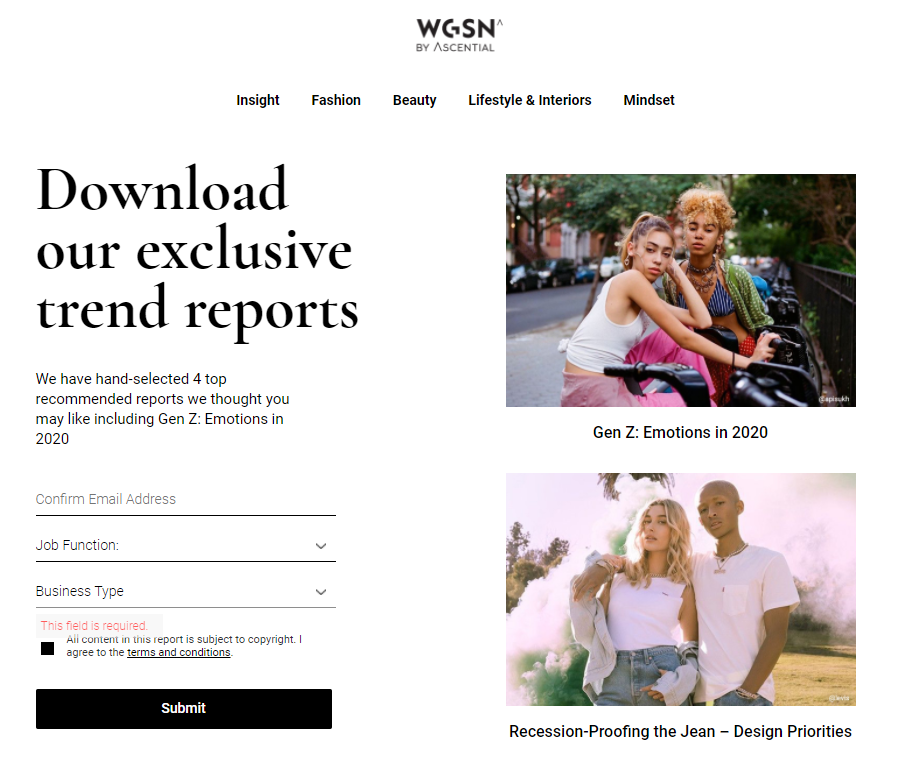
Gated content should be more extensive than ungated content, harder to find, and rather unique, so as to entice users to exchange their personal information for it. Examples include a white paper, an e-book, a report such as the one in Figure 6.3, a template, or a webinar—in other words, high value and rarer content.
You might ask why you should gate content, and the typical answer is to generate leads, such as in a lead generation landing page. Gated content should be thought of as the endpoint of a lead generation campaign, where consumers will provide their personal information, which will then allow a firm to enter into lead nurturing efforts, which we cover in the next chapter.
Typically, a firm will create ungated pieces of content (e.g., social media posts and blog posts) that will drive consumers to a piece of gated content. In other words, the content supporting the campaigns is ungated, and the endpoint where a visitor is converted into a lead is gated (see Figure 6.4, where a blog post is linked to an e-book).

Over the last few chapters, we covered the basics of SEO, how to think about content creation and ads based on consumers’ needs and challenges, how to identify opportunities based on the concrete actions during their journey, and how to respond with ad hoc marketing activities.
Building topical relevance is part of a firm’s longer-term strategy for positioning itself and its web properties. It entails breaking down the general needs and challenges that consumers are experiencing into key topics that will orient our marketing efforts.
For example, if we wanted to build topical relevance on the topic of content marketing, we would come up with potential searches and areas of interest to create many blog posts, social media posts, and pieces of gated content on this topic (Figure 6.5).
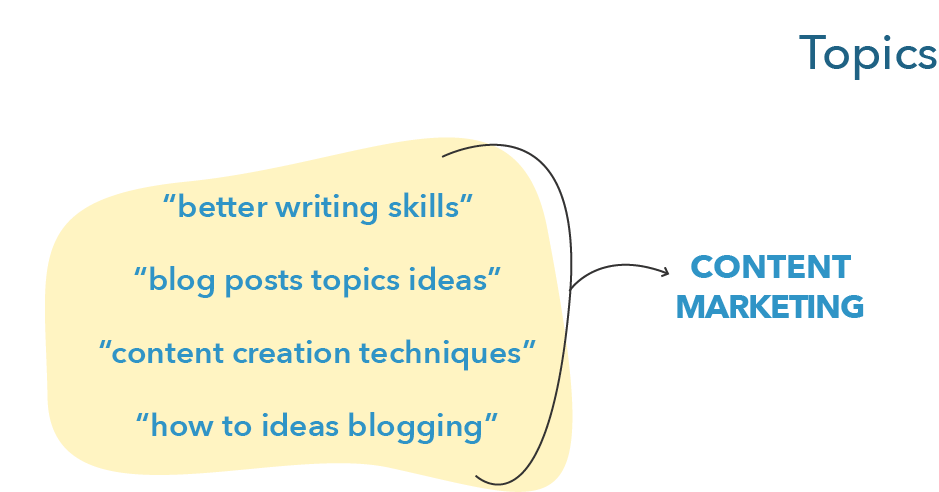
To start building a web presence around certain key topics of interest to your consumers, the first step is to identify which topic you are interested in. A first, customer-driven, way to identify topics is by looking at the type of searches being carried out by consumers, which can be done using tools such as Google Trends or Search Reports in Google Analytics. Firms can also survey and interview consumers to better understand what is relevant to them, what their key needs and challenges are, and how they turn to the web to help address these. A second way to identify topics is through keyword analysis, as we discussed in Chapter 3.
Once a topic has been identified (e.g., content marketing), firms will plan their strategy to slowly build their relevance on that topic. Viewed from this perspective, each piece of content (e.g., a blog post) aims at addressing one targeted search. For example, a blog post positioned on the keywords “better writing skills” will answer a piece of the puzzle of content marketing: how to improve one’s writing skills. These might be hundreds of subtopics associated with a specific topic, opening further opportunities for content marketing efforts. A topic is thus a general domain that can tie together many specific searches (as exemplified in Figure 6.5).
Over time, building topical relevance will help a website, as a whole, show up higher on SERPs. This is because it helps address the main factors on which websites are ranked that we covered in Chapter 3: It facilitates the creation of cross-links, will help consumers spend more time on a website, boosts page views, and so on. Consumers might enter the website on the page on how to better their writing skills, for example, and once they are done reading their blog post, see and click on a recommended post on how to generate blog post ideas, increasing page views and time spent on site.
As we have briefly covered, the RACE framework helps our content strategy by informing the type of content we should be creating for each stage of the framework.
Content marketing professionals typically talk about three types of content: top of the funnel (ToFu) content, middle of the funnel (MoFu) content, and bottom of the funnel (BoFu) content. The funnel represents the purchase funnel, or what we have referred to thus far as the consumer journey (awareness, active evaluation, purchase, and post-purchase).
We can easily map each stage of the funnel with RACE stages and stages of the consumer journey.
ToFu content activities target the awareness stage of the consumer journey and align with the Reach stage. At the awareness stage, consumers are experiencing and expressing symptoms of a need, problem, or challenge they are facing. The content aims at educating them. The need, problem, or challenge that consumers are experiencing can vary in abstractness. For example, they might have lower-back pain and are looking for a solution. Or they might need a pair of new running shoes. Content should thus address problems in ways that match what consumers are experiencing.
MoFu content activities target the active evaluation stage of the consumer journey and align with the Act stage. At the active evaluation stage, consumers are looking to evaluate solutions. Content should thus speak directly to the solutions that consumers can use to solve their needs, problems, or challenges. The goal of the content is to facilitate active evaluation and to serve as a bridge from education to your product or service. It is still important to represent the customer and to limit persuasion efforts, but to balance this with slowly warming consumers to what you have to offer.
BoFu content activities target the purchase stage and align with the Convert stage. At the convert stage, consumers are looking to buy a product. Content at this stage should help consumers evaluate your product or service to persuade them to buy what you are offering over the offer of competitors.
Searches consumers might make throughout the funnel could include the following (Figure 6.6):
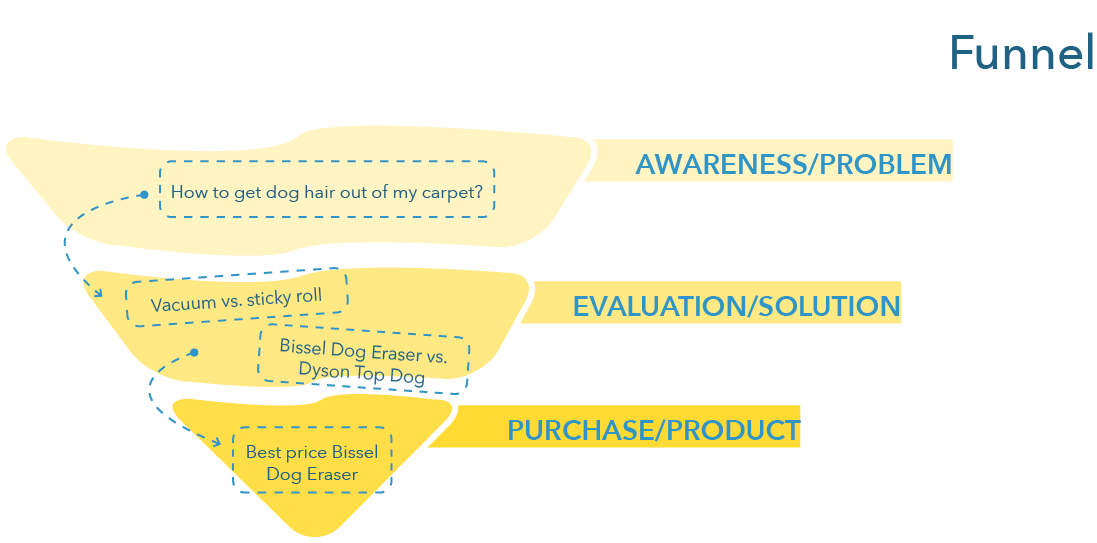
Examples of content from a firm (e.g., Bissell) to match these searches could be some of the following:
At the top of the funnel, content should educate and entertain consumers based on the need, problem, or challenge they are facing. If people don’t know they need your product or understand what their problem is, it is crucial to educate them on it!
The types of content that typically help here (although this is not a comprehensive nor an exclusive list) include blog posts, webinars, pillar pages, and longer-form content such as comprehensive guides, videos, and infographics.
In the middle of the funnel, content should help consumers evaluate their options and facilitate that evaluation by educating and entertaining consumers on possible solutions. The firm’s objective at this stage is to start generating leads.
The types of content that typically help here (although this is not a comprehensive nor an exclusive list) include lists (e.g., “Top 10 solutions for lower-back pain”), case studies, how-tos, descriptions of multiple products (aimed at educating, not selling), quizzes to help consumers discover solutions, and other types of templates to help consumers identify solutions for their problems.
At the bottom of the funnel, content should inform and persuade consumers about your product or service. The firm’s objective at this stage is to convert leads into customers.
The types of content that typically help here (although this is not a comprehensive nor an exclusive list) include testimonials and reviews, product offers, trials, coupons, samples, demos, free assessments or consultations, persuasive product descriptions, and sales-oriented webinars.
Content strategy should not stop at the purchase stage. Beyond the purchase funnel, firms should strive to create content that helps retain and engage customers. This could entail, for example, motivating social sharing, testimonials, and reviews, and encouraging loyalty through online customer events.
The types of content that typically help here (although this is not a comprehensive nor an exclusive list) include customer support and help documentation, contests, and giveaways based on product use, community forums, and strategies to encourage user-generated content. We will cover strategies for this stage in the last chapter of this textbook.
A pillar page is a comprehensive resource page that covers a core topic in depth and links to high-quality content created for the supporting subtopics.
It helps achieve the following two important digital marketing objectives:
Pillar pages come in all shapes and forms. The Content Marketing Institute, for example, differentiates between 10x content pillars, resource pillars, and service pillars. The following list presents a few examples of pillar pages on a wide variety of topics:
What do these pages have in common?
Typically, they are very, very long. They tend to use multiple types of media (e.g., text, images, and videos). They are well integrated within their domain and have many cross-links. They answer many problems around a topic of interest for consumers. As a result, they help boost SEO efforts. Remember the main factors on which websites are ranked?
Pillar pages can help with all of these factors! By being long and answering many problems and needs associated with a single topic, they are more likely than “normal” pages to become references on these topics. This should allow the reduction of bounce rate, since consumers are almost certain to find what they are looking for! These pages are also more likely to increase time on site because they give so many resources for consumers to go through. By allowing many cross-links, they can favor many pages per session. They allow for writing extensive content with many keywords and multiple types of media.
The main idea behind the creation of a pillar page is to identify a core topic of interest for consumers and break down this topic into topic clusters (or subtopics).
Take the Stronglifts squat pillar page, for example (Figure 6.7). The core topic of interest is “how to squat,” a question often asked by people interesting in exercising, bodybuilding, powerlifting, and the like.
When you enter this pillar page, you find a short summary on the squat and a few cross-links to guide consumers to other pages on the website, favoring higher page views. The summary is also useful because it can be used to hook people in, encouraging them to read on. The page then continues with several topic clusters organized around “how to squat”:
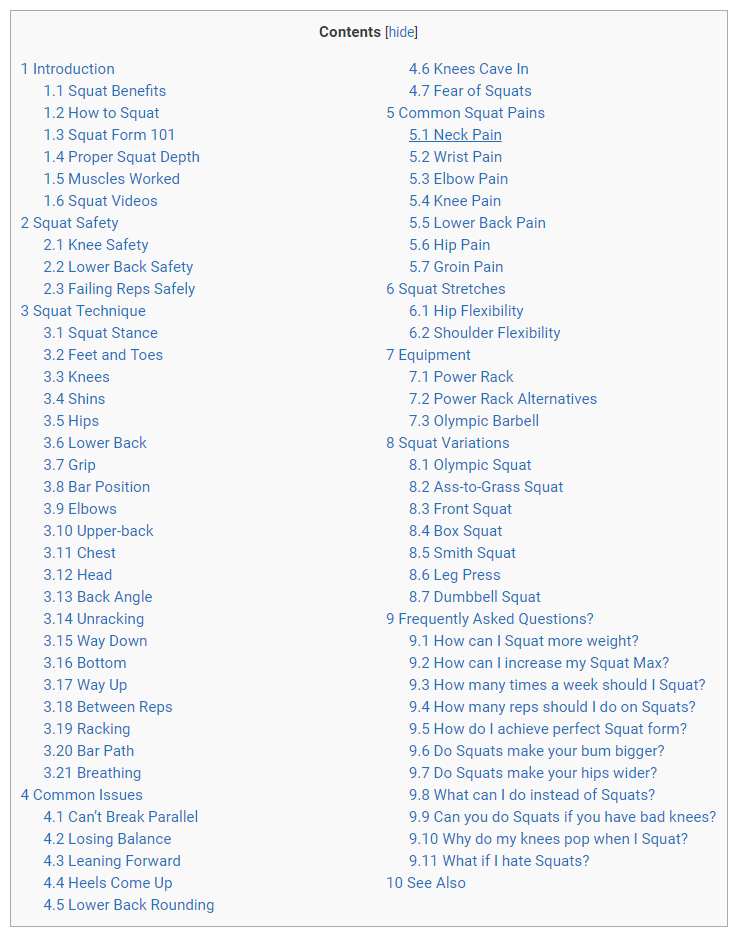
Each of these subtopics effectively represents subsections of the pillar page and addresses different needs, but they are all grouped into the same pillar page.
A pillar page can thus help build topical relevance because it provides a central and extensive resource on a major topic that can be well referenced (linked to) by other websites. It helps organize a website content around a core topic. If a pillar page is done well, the topic or problem it addresses should be one that a persona or multiple personas care about. Lastly, pillar pages help people easily navigate throughout multiple pieces of content on the same topic on the same webpage, providing a great user experience.
This is quite different from a typical content marketing approach that would have favored separate blog posts on all of these different subtopics and subsections of each subtopic!
Figure 6.8 illustrates the traditional content marketing approach and Figure 6.9 the pillar approach.
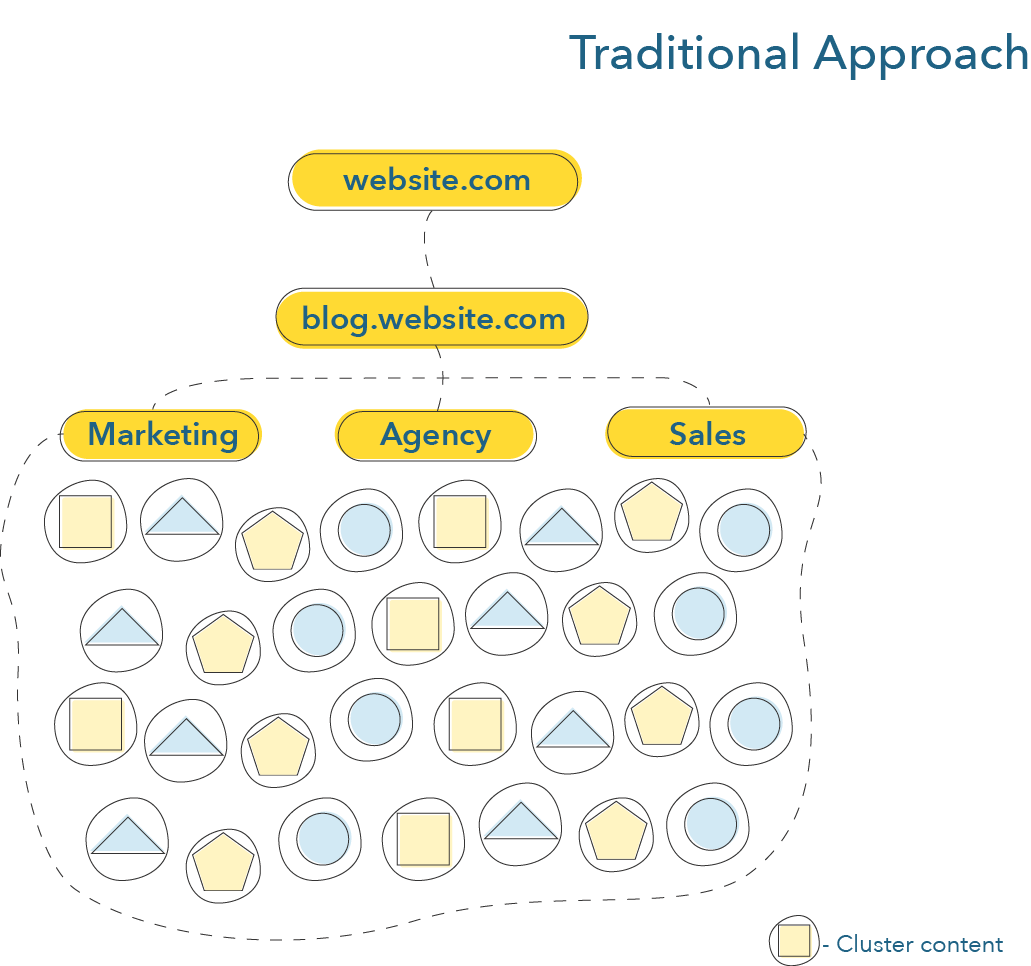

Pillar pages can also be used to support lead creation and sales.
A first way to do so is to use the pillar pages themselves. For example, a pillar page could include gated content, opt-ins (forms on the pillar page that ask for a consumer’s email address), and calls to action. Pillar pages that follow such an approach include the following examples:
Take Wild We Wander, for example, and its pillar page on “how to DIY a truck camper.” This page (Figure 6.10) has all of the characteristics of a pillar page, but it also redirects consumers to a content asset (a free resource to become a digital nomad) that is a piece of gated content (Figure 6.11).
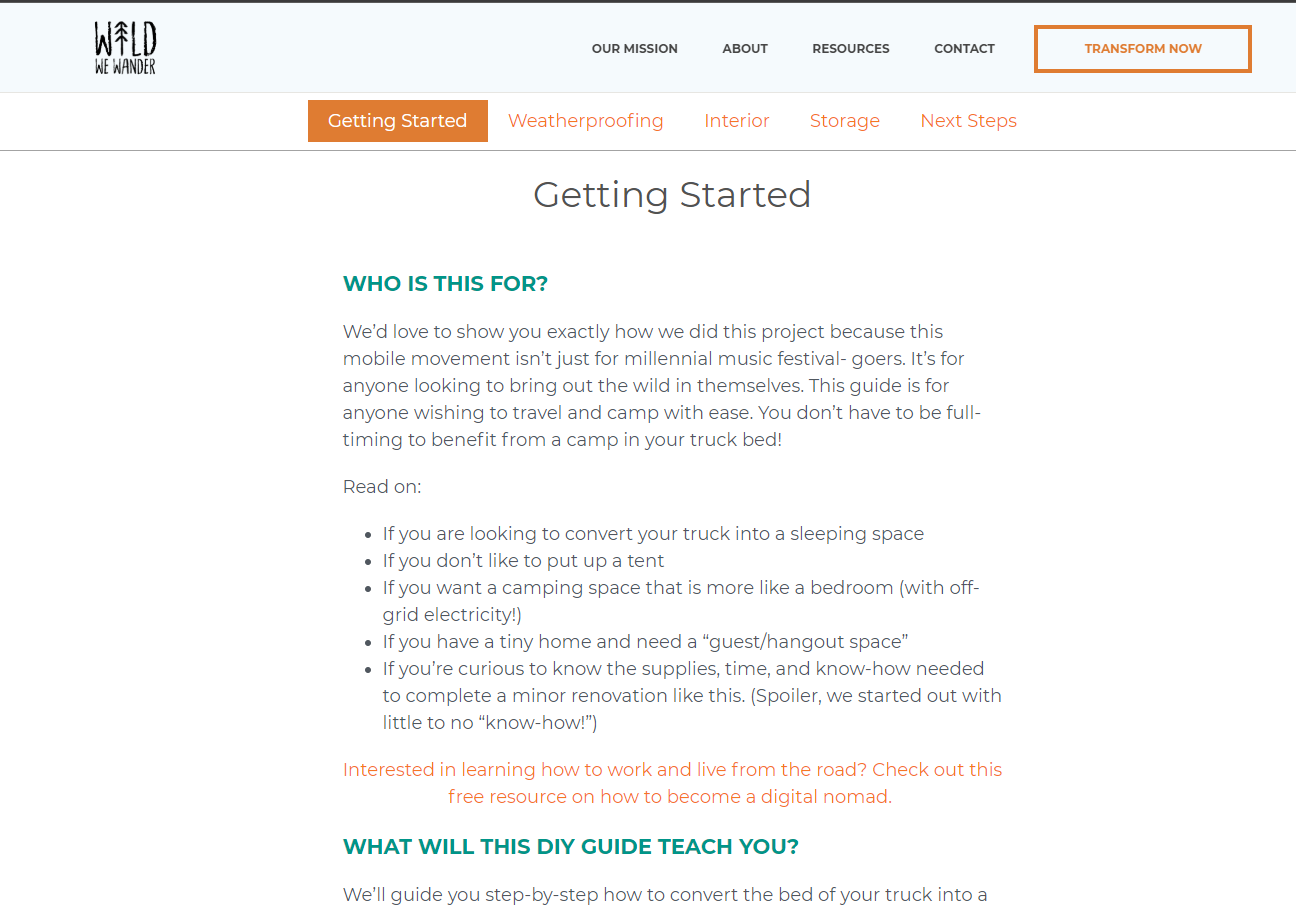
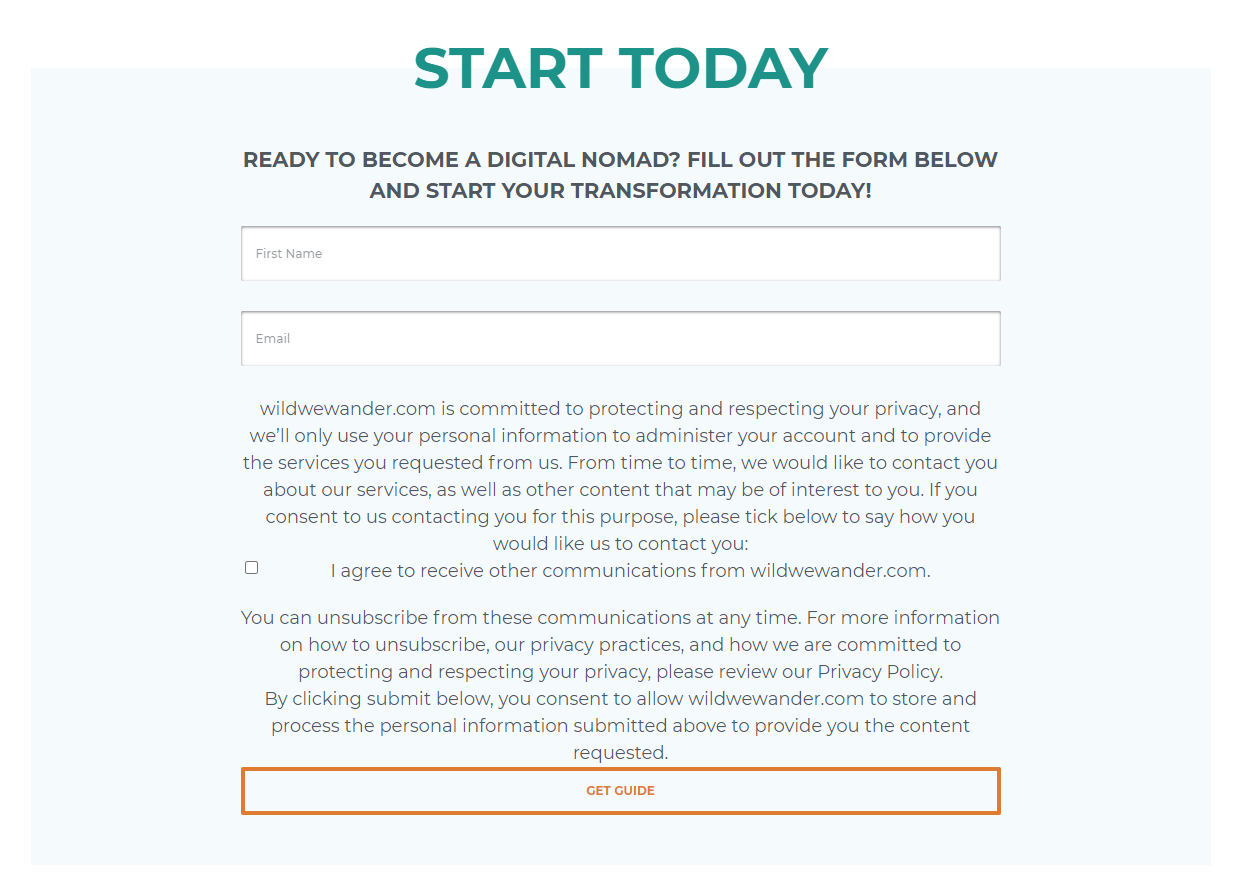
Second, pillar pages can also be thought of as part of a longer-term strategy that includes other pieces of content. It often happens that companies will initially gate a pillar page and use it to generate leads. For example, the two pillar pages we presented so far could have been initially offered as e-books that offered all the information regarding “how to squat” and “how to DIY a truck camper.” The firms could have used these two gated content assets as part of a greater content marketing strategy, breaking down the e-book into smaller, more digestible pieces. Example of this could include short blog posts (“3 tips for a better squat,” “3 reasons why squats hurt your knees”), short videos (“the right squat position”), short social media posts (e.g., statistics and quotes from the e-book), and the like. Then, once the lead generation campaign was over, the e-book could have been turned into an ungated pillar page. Visually, this strategy can be represented as shown in Figure 6.12, where all of these “smaller” pieces of content link back to the gated e-book to generate leads.
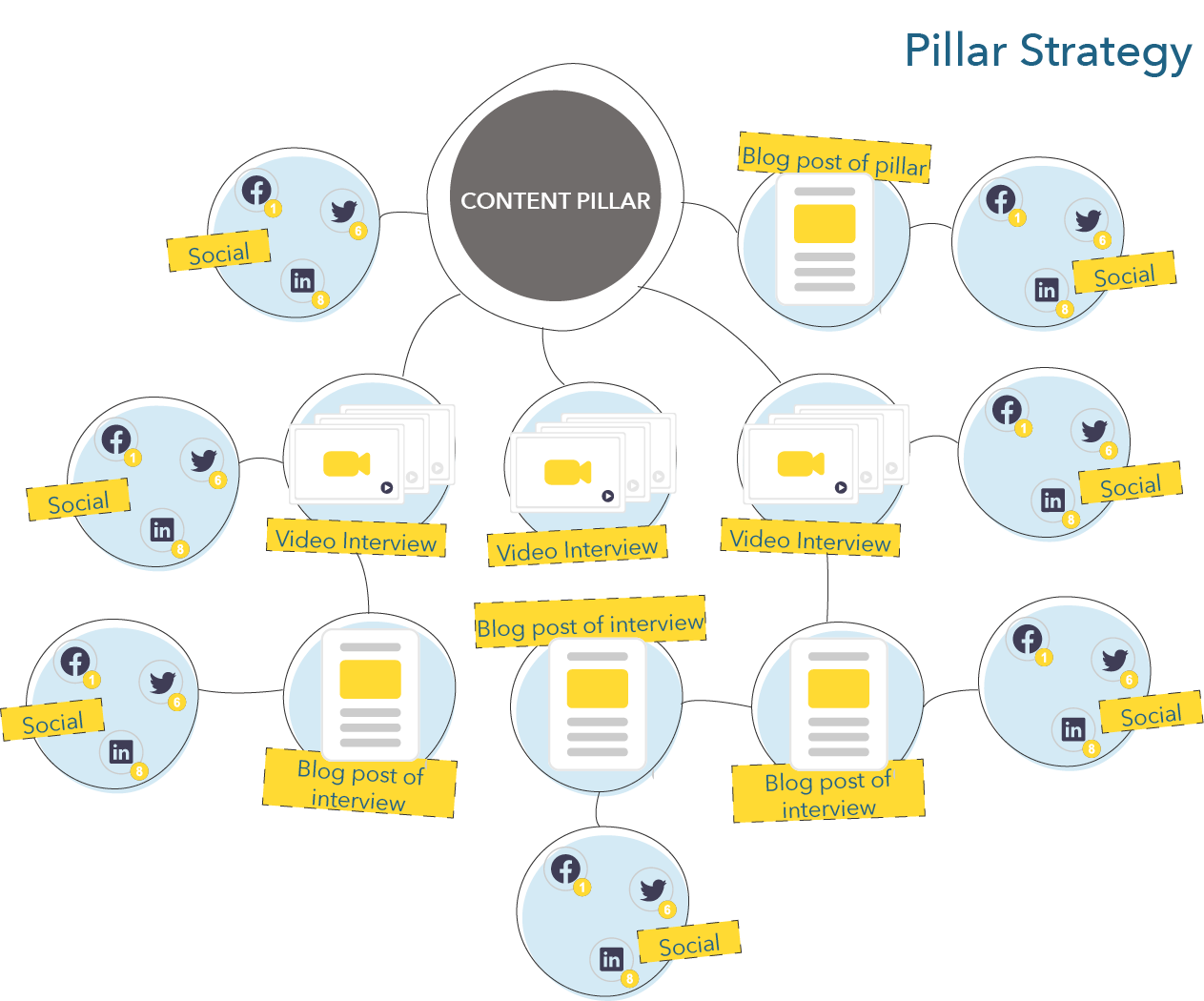
In fact, this is exactly the strategy that Unbounce used with their Conversion Centered Design e-book. Originally an e-book, the firm used it as a piece of gated content with supporting pieces of ungated content, including
These ungated pieces of content drove consumers to the e-book. To generate further leads, they also supported the launch of the e-book through other pieces of gated content, including
Then, Unbounce took their e-book and transformed it into a pillar page (https://unbounce.com/conversion-centered-design/) and broke down the webinar, making it accessible on YouTube in six different videos.
Hence, if a firm plans to create pillar pages, it might be useful to think of how the page can first be embedded in a lead generation strategy before being made accessible more freely as a piece of ungated content.
Here are a few tips for forming such a strategy:
We conclude this chapter by discussing content calendars. Although pillar pages are a great long-term investment for web referencing and lead creation, most day-to-day content activities, be they posts on Facebook and Instagram or blog posts, are ad hoc activities. However, they should still be thought of from a mid-term perspective and integrated into a strategic approach to content marketing. This strategy should think of ways to build topic relevance over time, address many personas and stages in the journey process, and address all objectives of the RACE framework.
A great way to develop this strategy is through a content calendar. A content calendar maps future content creation activities. It answers questions like these:
It can also help operationalize content marketing by providing information including the following:
Figure 6.13 shows an example of a content calendar (text description here).
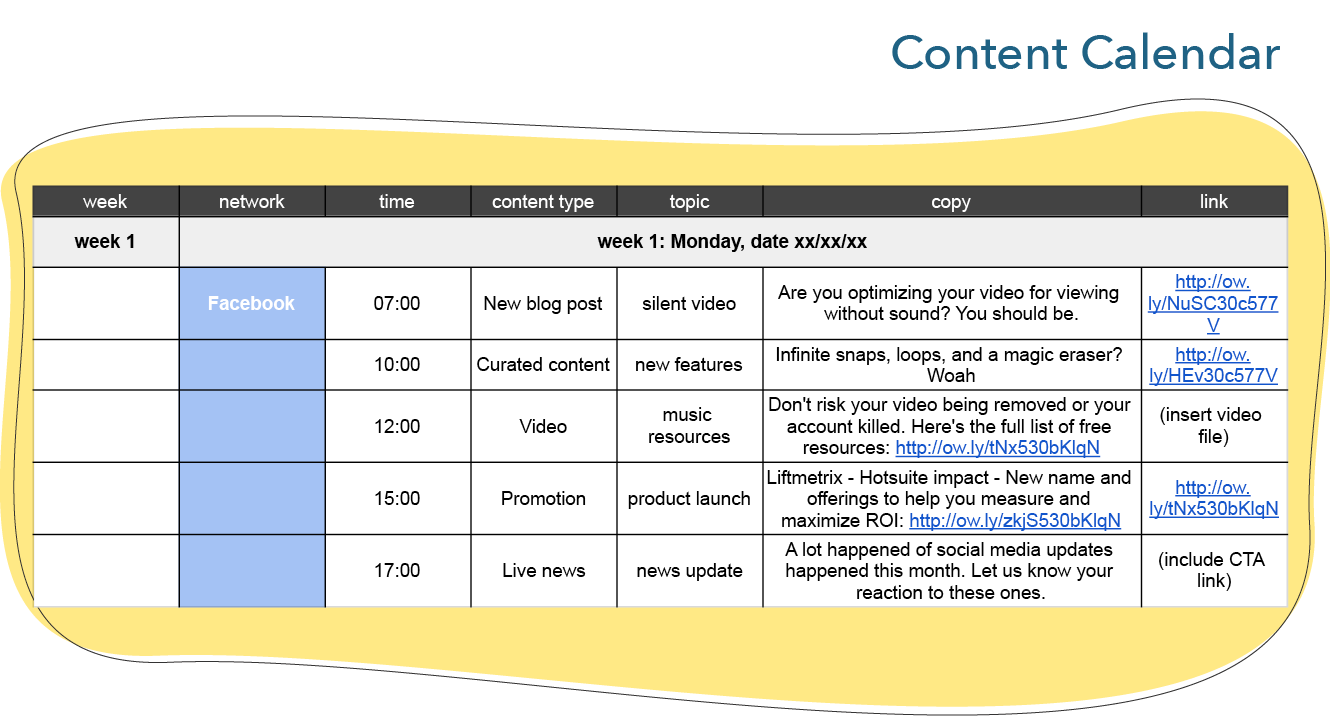
Creating a content calendar should be done with reflexive intent. A firm should make sure that they are creating content for all stages of the journey, all personas, and all objectives of the RACE framework. By planning a month or two in advance and clearly mapping the personas, topic, journey stage, and RACE objectives that each piece of content addresses, a firm makes sure to create distributed efforts that do not privilege certain personas, stages, or objectives over others!
As in previous exercises, you are a fitness center creating a campaign for people who want to get back into shape, and one of the personas you are targeting is Avery.
Avery is a person living in a major Canadian city center. They are their late twenties to early thirties and are in the top 20% in revenue in their city. With increased responsibilities at work and a newborn, Avery had put exercising aside for a few years. They feel sluggish, lack energy, and miss having a stronger connection with their body. With age, their body has also started to transform, and they have started to feel self-conscious about it. To remediate this, they want to get back into exercising weekly. They don’t have much time, and they also don’t know much about working out or the market—for example, where to work out or how to work out.
In this chapter, we cover the basics of lead generation and lead nurturing activities. We define leads and lead stages, present a few ways to generate leads and different types of opt-ins, explain how to score leads, and discuss email marketing.
Learning Objectives
Understand what a lead is and how to generate, score, and nurture leads.
InterAction is about encouraging positive interactions on a website and social media. Positive interactions facilitate the generation of leads, which lead to acquiring customers. The two objectives at the Act stage are thus to (1) encourage positive interactions and (2) generate leads. The kinds of goals we can set up for consumers have to do with these two objectives. To encourage positive interactions, we can set up goals such as spending a certain amount of time on our website or viewing a certain number of pages. When consumers achieve these goals, we can assume we are attaining this first objective. For generating leads, the kinds of goals we can set up for consumers are to register as a member or sign up for a newsletter. Again, when consumers achieve these goals, we end up achieving our objectives (i.e., acquiring leads). The KPIs to measure these goals would then be time spent on site, page views, number of members and newsletter subscribers (increase quarter-over-quarter), cost per lead, and percentage of visitors converted to leads.
The large majority of visitors to your website—some say up to 96%—will not buy anything. Given all the resources that go into bringing visitors to your site, from writing content to publishing ads, simply trying to get visitors to a website without having a strategy of what to do once they get there will lead to many missed opportunities.
To address this conundrum, digital marketers have turned to lead generation to answer the question: How do we turn a visitor into a potential customer?
Marketo defines lead generation as “the marketing process of stimulating and capturing interest in a product or service for the purpose of developing sales pipeline.” During lead generation, our goals are to gather visitors’ personal information so that we can start to market to them personally in the future—and to identify whether or not we want to market to them. Not all visitors that we gather information on are worth marketing to.
A lead is (1) a qualified potential buyer who (2) shows some level of interest in purchasing a firm’s product or service. Note that this definition has two components. First, the visitor who provided their information is a qualified potential buyer. This means that they could eventually purchase our product. For many visitors to a website, this is not the case.
Take, for example, the lead generation activity by Ferrari linked here, which is quite common in the automobile industry: a car configurator. During car configuration, visitors are invited to build their own car based on a car model, choosing between options to decide on things such as interior and exterior colors, engine, wheels, and so on. At the end of the configuration, the visitor is asked to create an account or fill out a short form and provide their email address to receive more information about this model or save the configuration. Doing so indicates to the firm that the consumer is potentially interested in this vehicle.
But are all visitors who build their own Ferrari potential Ferrari customers? Probably not.
Car configurators are probably used by many consumers who either have no interest in buying the car and are doing this for fun or, in the case of Ferrari, who have an interest in buying the car but do not correspond to the Ferrari customer (e.g., they lack the financial resources to buy a Ferrari). These visitors are not qualified. A qualified lead is a lead that has been deemed likely to become a customer. Firms qualify leads through lead scoring, which we discuss further below.
Second, the visitor who provides their email address also needs to be interested in becoming a buyer. Since many lead generation activities provide, for example, hard-to-access information such as market reports or extensive guides on topics, it often happens that visitors will provide their email address without wanting to become a customer. They do so because they want to have access to the gated content or feature of a website. Lead scoring also helps differentiate between these two types of potential leads.
Hence, a lead is a visitor that is interested in a company and that the company is also interested in.
In the process of becoming a customer, a visitor will thus go through different stages, from visitor to lead to qualified lead to customer (an alternative to this model that you might come across is lead, prospect, and opportunity). Two types of qualification exist: marketing-qualified lead (MQL) and sales-qualified lead (SQL). MQLs are viable leads that should be marketed to. In other words, they are visitors who gave a firm their email address and who the firm has established could be potential customers. They are visitors that the firm is interested in. An SQL is a lead that is sales-ready. In other words, a lead that is moving close to the purchase stage. This is important because it gives an indication of what kind of marketing activities should be conducted with these leads. As we have seen, we talk differently to consumers depending on whether they’re at the awareness, active evaluation, or purchase stages. Knowing which stage consumers are at is highly useful for creating the right marketing message.
There are many, many ways to get leads. Generally speaking, any marketing activity that leads consumers to give a firm a piece of personal information qualifies as a lead generation opportunity. Here is a non-exhaustive list:
You can find a few more ideas here and here, and the Hubspot lead generation guide here.
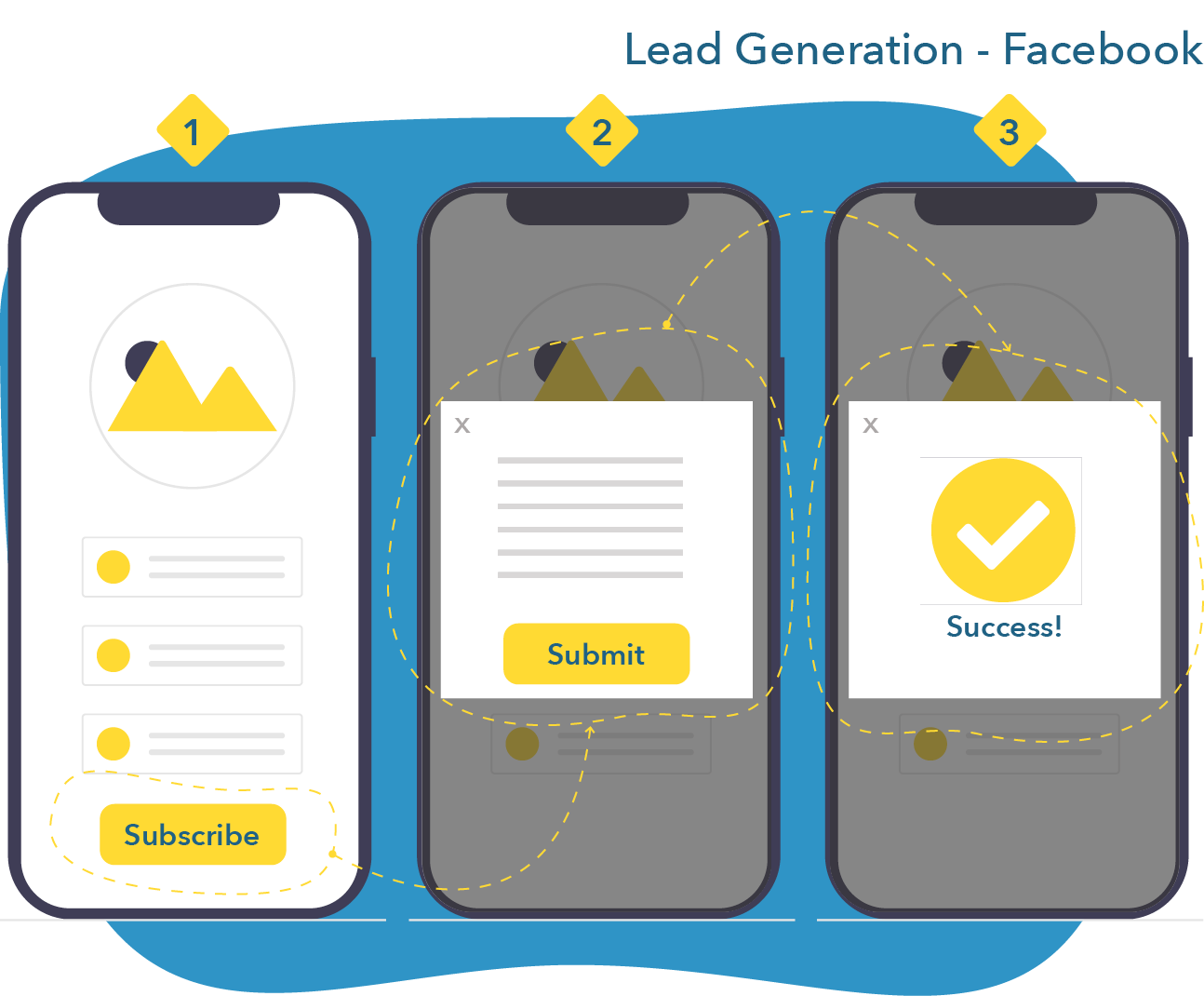
Lead generation is typically associated with lead forms. Lead forms are web forms that allow firms to capture consumers’ email addresses and sometimes other information. They are a great tool to build a mailing list and, when done correctly, help to score leads. We will turn our attention to lead scoring later on in this chapter.
Designing lead forms, and most importantly, how many form fields you decide to use, is a balancing act. It is generally argued that consumers take less than 10 seconds to decide whether or not to give their email address to a firm. There is, however, a trade-off between collecting many email addresses and collecting email addresses from qualified leads.
Take the following study from Marketo (Figure 7.2), which found that moving from five to seven to nine form fields diminished the conversion rate (defined in this case as the percentage of visitors who provided their email addresses and became leads) from 13.4% to 12% to 10% and increased the cost per lead from $31.24 to $34.94 to $41.90. Clearly, choosing how many form fields to use plays an important role in pricing and devising lead generation campaigns. (Note: The cost per lead increases because it costs a certain amount of money to run the ads associated with this lead generation campaign. Hence, the lower the conversion rate, the higher the cost per lead).
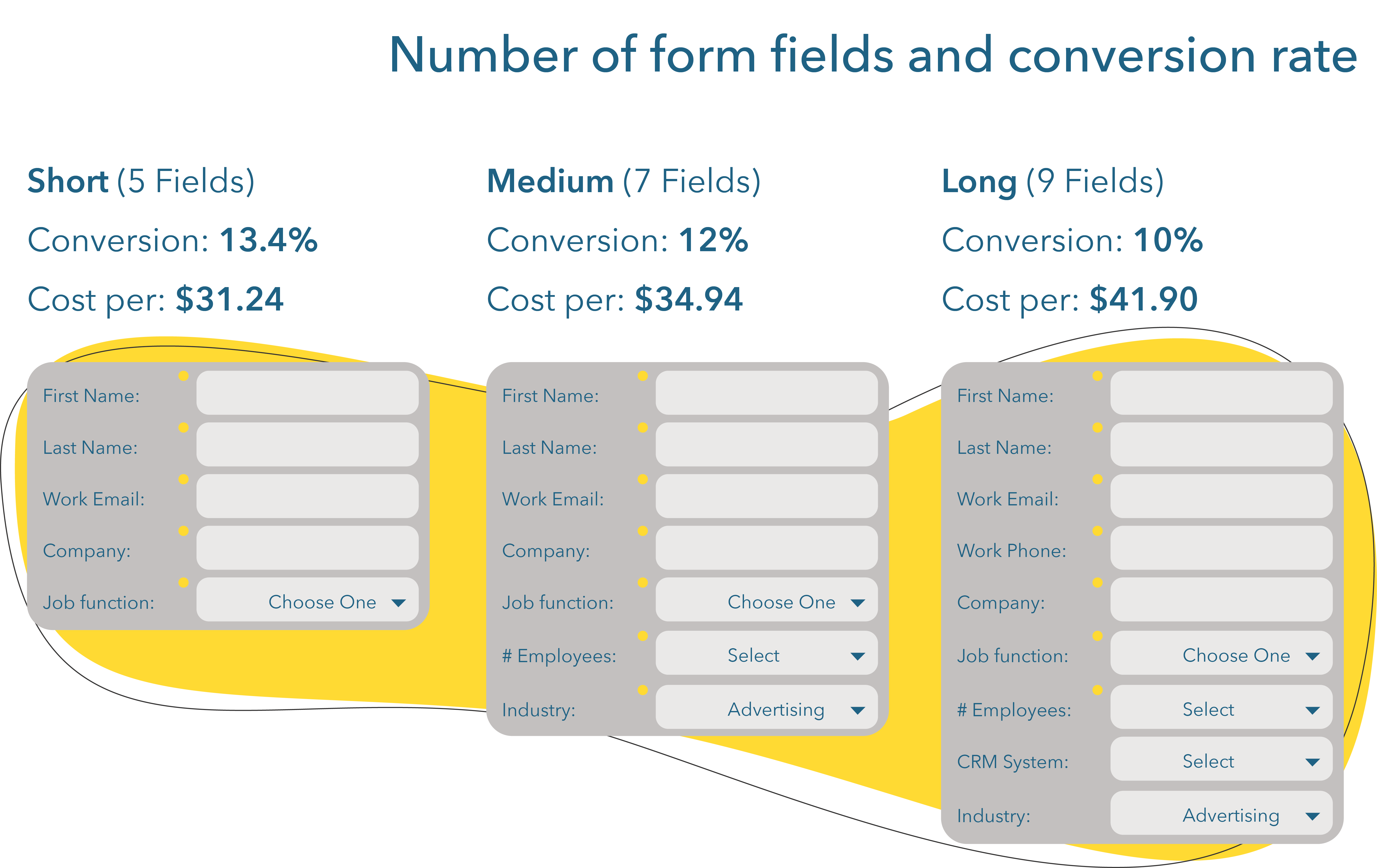
Now, if asked, “How many form fields should you use as a firm in a lead generation campaign?” it might be tempting to answer, “One.” Clearly, the fewer form fields, the more leads! Yet using fewer form fields also precludes us from getting important information about our potential customers. In the case above, the form with five fields did not get the number of employees of the firm, the industry they’re in, the type of CRM system they use, or their job function. These pieces of information are important because not all email addresses are equal. If, for example, a firm specializes in a specific industry and in companies of a specific size (e.g., SMEs in the fashion industry), then collecting these pieces of information might be worth the additional $3.70 that the lead costs. This is because collecting this information will help qualify leads and will save money in the long run when running a lead nurturing campaign. We discuss this idea in greater detail when we look at lead scoring later in this chapter.
Apart from longer lead generation forms, leads are also often obtained when short opt-in forms are used in concert with ungated content marketing efforts. We see this very often on blogs, for example (Figure 7.3 and Figure 7.4).


Lead opt-ins exist in many forms. They can be found in the footer of webpages, in the middle of a blog post, or at the bottom of a content page. They might appear as a welcome gate, a pop-up that appears at the start of your web browsing experience on a specific site, such as when you arrive on Neil Patel’s website for the first time. They might take the form of a lightbox (overlay box) pop-up that appears when a visitor performs certain actions, such as spending a specific amount of time on a site, scrolling to a specific section of a page (for example, scrolling all the way down on Zoella’s blog posts), entering a specific page, or viewing a specific number of pages on a website).
Opt-ins can be characterized based on two dimensions: whether consumers explicitly know that providing their email address will enter them in a lead nurturing campaign and whether the opt-in in confirmed by the firm, as follows (from Marketo’s Definitive Guide to Email Marketing):
Increasingly, transparency has become the name of the game when practicing online marketing, and an explicit double opt-in is often seen as a best practice. This is because consumers are more likely to open emails that they receive when they clearly know that they had signed up to receive them. Additionally, double opt-ins ensure that consumers want to receive an email and that the email address they gave was valid.
Lead scoring is an approach to ranking leads based on their value to a firm, which supports marketing and sales activities. It helps qualify leads and indicate whether efforts should be devoted to market to a lead, as well as the movement of the lead throughout their journey and, potentially, if and when they reach the purchase stage.
Many approaches exist to score leads, such as the following:
Lead scoring approaches use data collected by the firm (e.g., using forms) as well as behavioral data collected during the interactions of leads with the firm (e.g., whether or not the lead opens an email, requests a call, or views a product). We will group these types of data under “observable or explicit characteristics” and “behaviors or implicit characteristics.” Either type of data helps the firm know whether a consumer is interested in them and whether it should devote efforts marketing to them.
Observable or explicit characteristics represent data that a firm can readily collect by asking consumers or observing them (e.g., on their LinkedIn profile). This data is typically collected by simply asking consumers for it (for example, by using a form or during a phone call) or by looking them up online. Examples of such characteristics include the following:
Marketo offers more than 50 observable/explicit characteristics in their lead scoring guide (p. 18).
Behavioral or implicit characteristics represent data acquired through the tracking of online activities to measure the interest of a lead in a firm’s product or service. This data is typically collected when a lead visits the firm’s website, interacts with its emails, and responds to offers. Examples of such data points include the following:
Marketo offers more than 200 behavioral/implicit characteristics in their lead scoring guide (pp. 19–20).
Lead scoring entails first identifying the data that a firm believes is relevant to scoring leads. This process will greatly vary depending on the firm. Questions such as “Who is responsible for making purchases?”, “Does my consumer need to have a certain revenue to buy my product?” or “What kind of actions can I make consumers take that show that they have an interest in my product?” can help identify how to score leads. Once the right characteristics have been identified, firms will typically assign a weight to them. For example, having the right job title might be worth less than viewing a product demo or requesting a sales call. By assigning points to each characteristic, a firm can establish whether a lead is qualified and how a lead is moving through their journey. Leads with a certain score can be identified as marketing-qualified, while leads that later reach a higher score can be identified as sales-qualified.
An example of a lead scoring framework that has historically been heavily used by firms throughout the world is the BANT (budget-authority-need-timeline) framework. We use this framework here to exemplify how to perform lead scoring when focusing on observable or explicit characteristics. For example, to create a lead score, a firm could create forms or collect data during calls with potential customers and ask questions such as the following:
Last, it is important to emphasize the role of progressive profiling, the idea that you should collect information from potential customers throughout their interactions with your firm. As we saw earlier, you can’t ask a lot from visitors when they fill out a form without hindering the conversion of visitors to leads. How, then, do you collect this information? By slowly collecting bits and pieces over time. This can be done, for example, through the use of progressive profiling technology and dynamic forms, where a firm sets up ahead of time many forms that iteratively collect information based on what a consumer will have provided on a previous form. Put differently, if consumers give their name and email in the first form, the second form will move to asking for pieces of information that have yet to be obtained. Another approach is to combine explicit and implicit scoring and score a lead over time as they interact with a firm’s website.
Once a firm has acquired leads and qualified them (i.e., as MQLs), it enters a process of lead nurturing. Lead nurturing represents the “purposeful process of engaging a defined target group by providing relevant information at each stage of the buyer’s journey, positioning your company as the best (and safest) choice to enable them to achieve their objectives” (Hubspot).
Let’s examine some of the key aspects of this definition.
First, lead nurturing is a purposeful process. In this chapter and the next, we are going to emphasize how this intent translates to always having a clear idea of what comes next for the consumer. What happens when you receive an email address from a consumer? What comes next? What email should you send them? What should be in this email? What action should they be asked to perform then? What should the lead be achieving there? This ties closely to the idea of having clearly defined conversion paths. When doing lead nurturing, the firm is interacting with the lead, but it has a clear script in mind. It knows the steps the lead should go through to convert them to customers.
Second, lead nurturing looks at engaging a defined target group. That has a few implications. First, a firm should have clearly defined personas that they want to engage. Second, lead nurturing campaigns are persona-specific. They are persona-specific because what makes a persona tick will probably vary between personas. They are also at specific stages of the buyer’s journey, which brings us to the third aspect of the definition.
Third, lead nurturing aims to provide relevant information at each stage of the buyer’s journey. The only way to achieve this, i.e., to create relevant content for leads that varies depending on which stage of their journey they’re at, is to have in mind a clear persona and a clear understanding of their journey.
Last, firms practice lead nurturing in order to sell products. Yet as we have seen over the course of the preceding chapters, this should ideally come at the end of the lead nurturing process, i.e., when the firm believes that the lead has reached the purchase stage.
The following four main activities relate to lead nurturing:
On average, consumers who provided you with their email addresses receive ten marketing touches from the time they enter the top of the sales funnel until they become a customer.
To facilitate segmentation for lead nurturing activities, firms typically create extensive email marketing lists. These lists should provide the information necessary to create campaigns that correctly address the needs, challenges, and motivations of consumers and the stage of the journey they’re in. Useful information to for email marketing lists includes the following:
Similarly to persona, this last point is helpful for continuing the conversation a firm started with a consumer. For example, let’s assume that a consumer signed up to an email list from a blog post or a pillar page on the topic of ‘“back pain” from the website of a shoe manufacturer specializing in back pain. Ideally, this consumer should receive information that is different from another consumer who signed up after clicking a search ad that offered “comfortable shoes.” The better the information a firm provides caters to a lead’s needs, motivations, and challenges, the more likely they are to engage in a conversation and ultimately buy a product.
The main idea here is that one size does not fit all. Lead nurturing campaigns should be clearly tailored to personas and the stages they are in.
The metrics used to analyze marketing campaigns include the following:
These metrics should help gauge the level of engagement of leads with our email marketing campaigns and where there might be issues. For example, if our open rate is great but our clickthrough rate is abysmal, this probably indicates that there is something wrong with the way the email is crafted, or that the content does not align with the subject line of the email.
Ideally, acquiring a lead’s email address should start a sequence of planned emails and other marketing activities (such as ad retargeting, which we will cover in the next chapter). This sequence of planned emails should aim at transforming a marketing-qualified lead to a sales-qualified lead (MQL to SQL), using targeted content to move the lead from informing them about their problem to helping them evaluate their solution to explaining why a firm’s product is the best solution.
The first email in an email marketing campaign should be an onboarding email. An onboarding email should guide leads and educate them about what is about to come. This email should help make a lead take the next step in the series of planned activities a firm has sequenced. Often, onboarding emails will tell leads what to expect, such as the content of future emails and how often they will be sent.
Let’s take a look at Instagram’s onboarding email.
First, Instagram asks whether we indeed create an account with them, i.e., they practice double opt-in (Figure 7.5).

Second, they push you to take the next step in order to maximize your engagement on their platform. In the case of social media networks, a threshold effect has been found to maximize engagement, where following a minimum number of people greatly boosts the chance that a user will come back. It thus makes sense that this is first action that Instagram proposes users to engage in (Figure 7.6).

Last, Instagram tells users to start using the product (Figure 7.7), which is also quite well aligned with what we would expect people to want to do once they have signed up for an Instagram account.
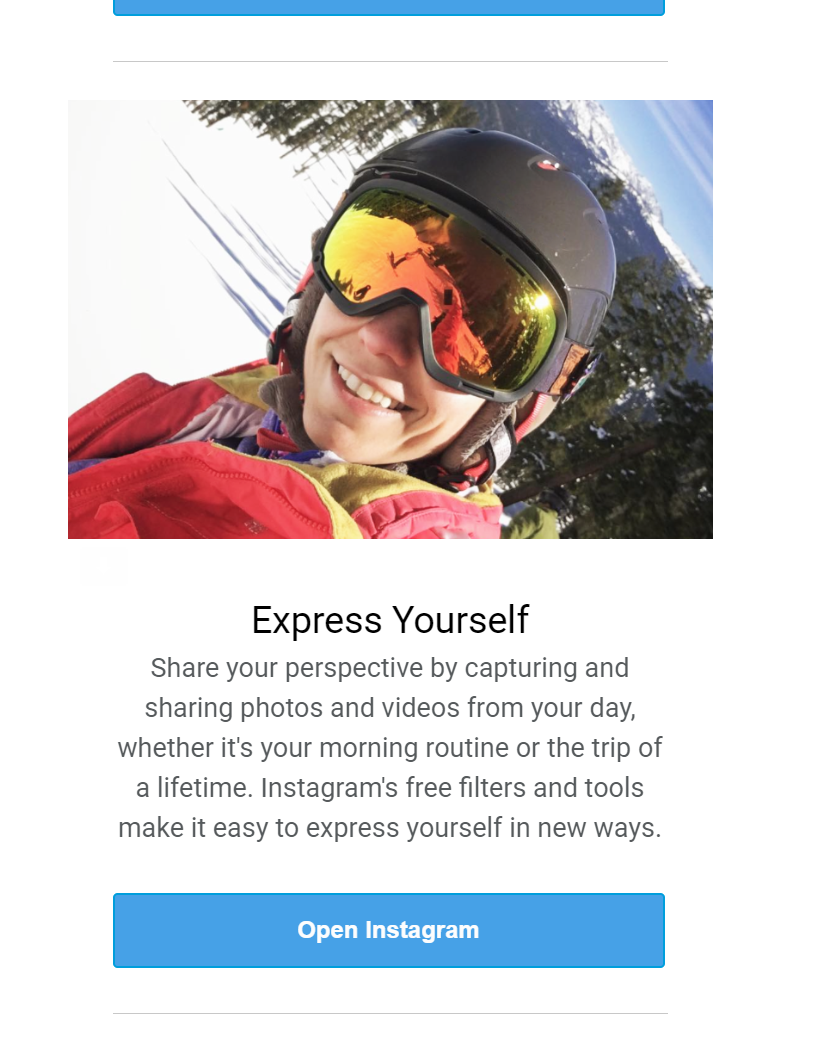
Here is another example, this time from a lead obtained from a content opt-in newsletter subscriber who was reading a blog article on Christmas decorations on the Crate & Barrel blog. Importantly, we can see how Crate & Barrel continues the conversation that started on a Christmas-related blog post by offering more information on Christmas decorations (Figure 7.8).
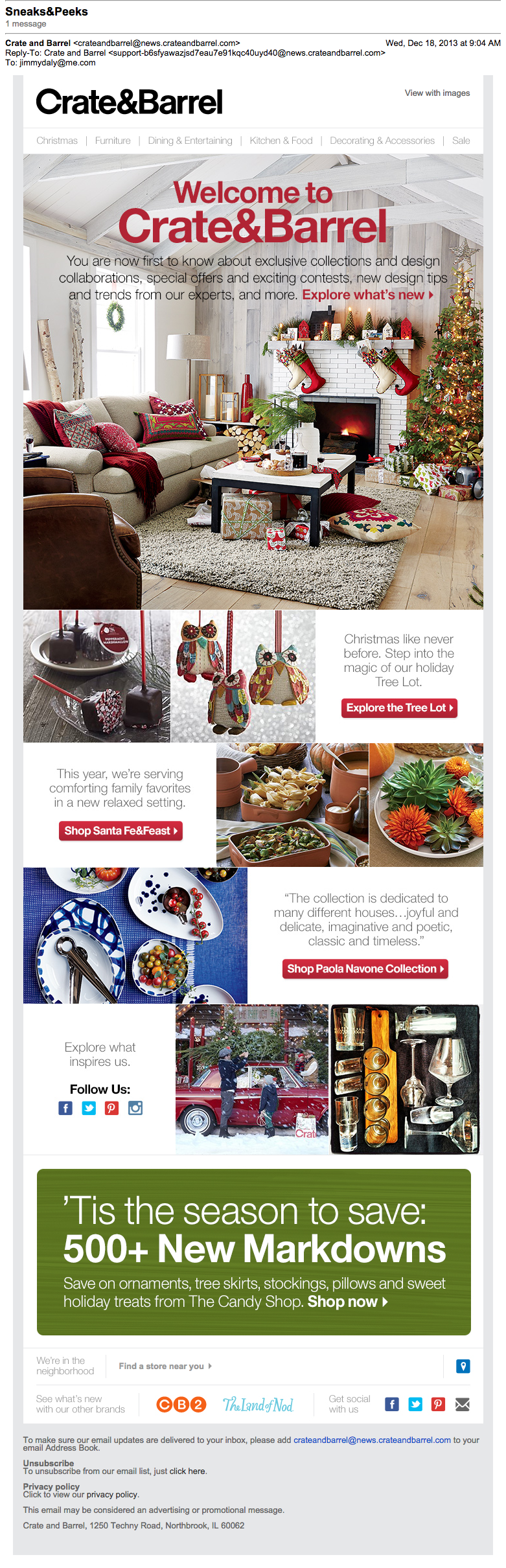
First, the onboarding email congratulates the lead for signing up for the newsletter and explains what the lead will be receiving in the future. Then, the first action offered to consumers is to explore new articles relating to Christmas decorations. The email then breaks down product categories that a user might be interested in.
The onboarding email should be the first email in a sequence of emails meant to convert leads to customers, which should ideally follow consumers in their journey (i.e., moving from problem to solution to product). This email sequence is often referred to as a drip email sequence or drip email campaign. Here is how Hubspot explains an email drip campaign:
An email drip campaign is a form of automated sales outreach. It’s comprised of a series of emails automatically sent to a specific audience after they take a specific action. For example, if a lead downloads a whitepaper on recruiting best practices, they might be placed in a drip campaign sharing relevant recruiting content. The final email might include a CTA to request a demo for your recruiting software.
This is (very simply) represented in Figure 7.9 (text here). The exact steps and content would depend on the stage at which a consumer signed up. For example, were they reading an awareness post or reading about potential solutions for their problem?
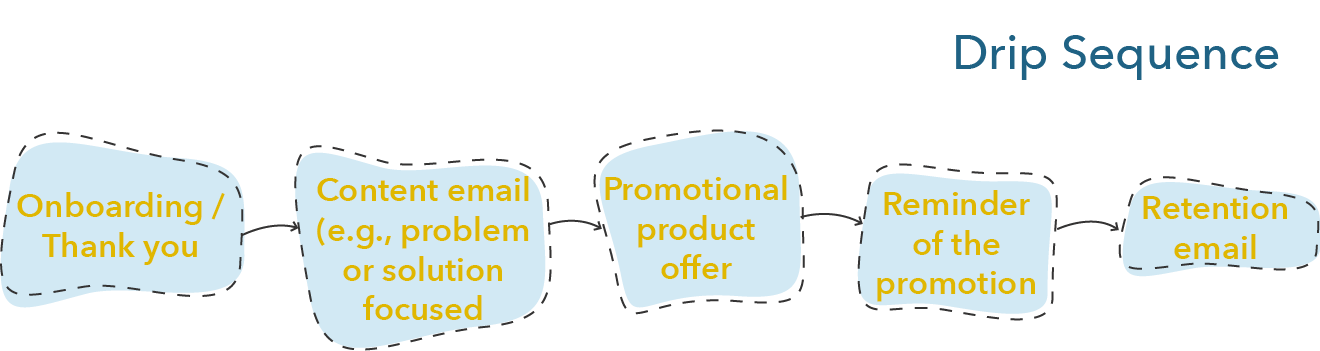
We can see how each email serves a dedicated function. The first email is an onboarding email explaining the value of signing up for the newsletter. The email that follows might be a problem- or solution-focused email depending on where the consumer is in their journey (since we’re at the lead generation stage, generally the consumer should be further down the funnel, e.g., weighing their options). The third email is a promotional product email to conclude a sale, the fourth email is a reminder (if the sale hasn’t been concluded), and the last email makes sure that the consumer still wants to receive emails (since the sale still hasn’t been concluded).
A simplified application of this sequence as provided by dripscripts is as follows:
Real life, though, is not as straightforward. Based on what we learned in lead scoring, we could also leverage here the idea of behavioral scoring and create decision trees to help strengthen our chances of converting leads. Did they open the email? Click on the link we provided? Read the blog post? Emails and other marketing activities should be informed by what the consumer has done with the last activity they interacted with. Marketing automation has helped create more complex marketing campaigns based on how a user will have interacted with a previous marketing activity. Figure 7.10 (text here) shows a flow chart for a simple example from Jacobs Levenger/Smart Insights.

The information should be well hierarchized, with the main message and the call to action associated with the goal you want consumers to accomplish located above the fold (i.e., before any scrolling happens). Emails should be short, with little to no scrolling. The subject line should include a call to action and be transparent about the content of the email. Emails aiming at conversion with a clear goal for consumers after the click can benefit from being associated with a landing page (i.e., the click leads the user to a landing page), and other landing pages tips, such as maintaining a low attention ratio, can be useful to create highly converting emails. Mailchimp provides its top tips and advice as well as design ideas in their email design guide here.
You are Paperlike, a company that specializes in an iPad screen protector that replicates the paper experience.
One of the personas you are targeting is Alister and Alice.
A&As are illustrators eagerly awaiting their new iPad Air 2020 with the Pencil 2. They intend to use the Procreate app to start doing digital drawings and designs. They are new to illustrating in a digital environment and they have never used a device like this to draw before. They are reluctant to move away from pen and paper but believe that this might help move their work online more easily.
Think of a series of five emails.
In this chapter, we cover what conversion is and how to optimize webpages to convert better. To that end, we discuss conversion rate optimization, how to identify what to optimize when people move from one webpage to another, some conversion-centered principles, A/B testing, and retargeting.
Learning Objectives
Understand what conversion rate optimization is and some approaches to optimizing webpages and websites.
The convert stage is focused on increasing conversions to maximize sales. It emphasizes both maximizing conversions across the journey of consumers and improving conversion from lead to customer. Since our main objective is to increase conversions, any indicator associated with measuring and improving conversion can serve as a KPI here, depending on what exactly we are trying to achieve. Examples of KPIs include sales, percent conversion of lead to sale, average order, cost per conversion (per channel), average conversion time, abandoned carts, and sales per source.
Conversion rate optimization is the process of improving webpages and websites to increase conversions. A conversion refers to a user achieving a goal by taking a desired action. Conversions can therefore happen on any webpage of a website that has a goal that a firm wants users to achieve.
Conversion rate is the percentage of people that visit a page and achieve a desired goal or action (conversion rate = conversions/number of visitors × 100).
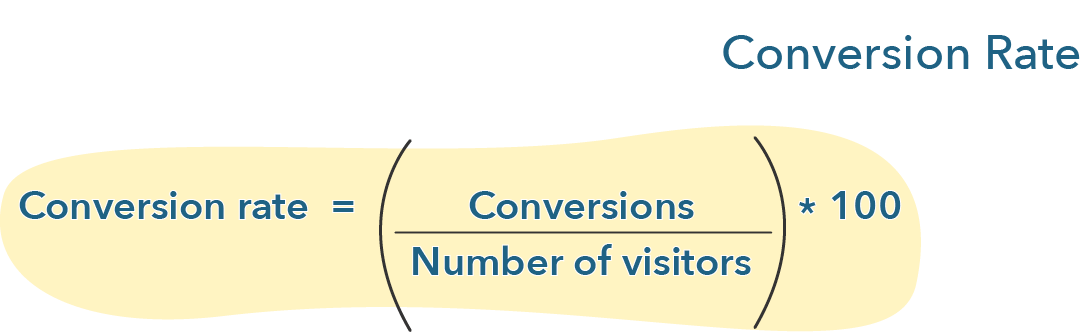
Although we might tend to think of conversion as a consumer completing a purchase, many other goals can be set up for them, such as submitting a form, clicking on a link, reaching a particular page, or spending a certain amount of time or viewing a certain number of pages on a website. A distinction tends to be made between goals that lead consumers to achieve certain critical actions set up by a firm and goals that consumers complete in their journey to achieving those critical actions. Optimizely talks about common and ultimate goals. Google discusses micro and macro conversions.
Conversion rate optimization is important because it helps firms improve the number of users who might achieve specific goals. It can lead to a higher number of leads, lower acquisition costs, and increased revenue, for example. It is also usually cheaper to convert more visitors than to attract more visitors, making conversion rate optimization the more cost-effective way to improve a business.
A useful way to think about micro and macro goals or conversions is to ask the question, “What are the little actions along their journey that consumers need to take (micro goal/conversion) in order for them to achieve what I ultimately want them to do (macro goal/conversion)?”
These can vary depending on the type of website that a firm is running. For e-commerce websites, purchases are the main indicator of whether the site is performing well. Because social media websites mostly make revenue based on ads and by making sure that users are participating and returning, time spent on site and engagement-related goals might be more important. News websites might have a mix of both. Thus, goals for visitors vary depending on the type of website and the business model of a firm.
Since conversions are calculated based on whether users achieve a goal, the first questions to ask to practice conversion rate optimization are “What are the goals I want users to achieve on my website?” and “What are the goals users should achieve on specific webpages in service of achieving the larger goal?” Many such goals can be achieved, and as a result, conversion rate optimization might touch many elements of websites, such as forms, carts, and content on webpages. Other types of online properties, such as apps and emails, can also be optimized. Last, conversion paths can be optimized by identifying whether there are movements between parts of a path (e.g., moving from an ad to a landing page or from a landing page to a cart) that seem to be hindered.
To manage optimization, firms should first examine the general path of a specific persona as they move from visitor to lead to customer. This gives an overview of the strategic picture of our overall conversion efforts. Trew Marketing provides us with an abstract funnel as shown in Figure 8.2 (text here).
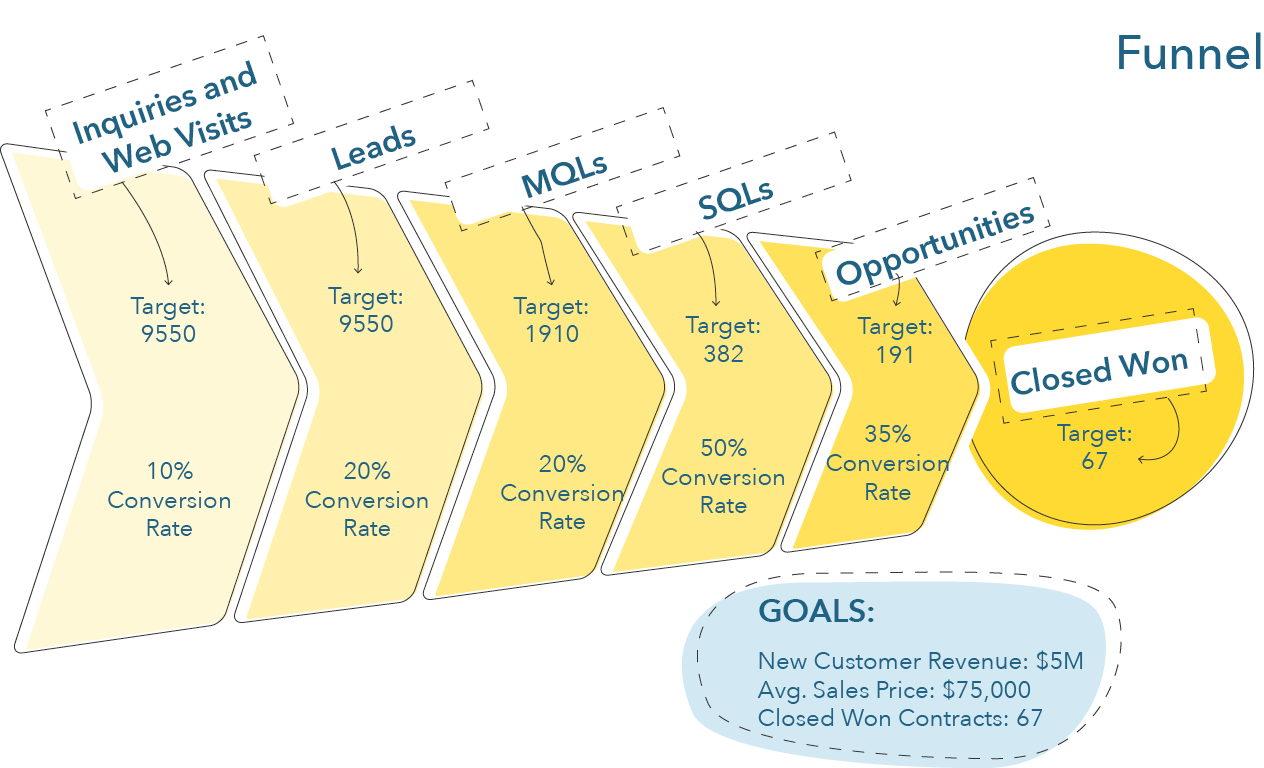
When we look at the journey of consumers this way, we see how, out of all of the visits that we receive on our website, we convert only a fraction to leads. Then, out of all of these leads, only a fraction will be marketing qualified. We then market to these leads and engage in lead nurturing, and only a fraction will move forward in their journey and become sales qualified. Lastly, from these SQLs, only a fraction will become our customers. Each of these moments, where a person moves from one stage to another, might need our attention. Is our conversion rate from visitor to lead good? What about our conversion rate from SQL to customer?
Looking at the performance of a firm throughout its efforts associated with the consumer journey and what happens between the different that stages a consumer goes through (i.e., visitor, lead, customer, and engaged customer) is a good first step to identify exactly where a firm should deploy optimization efforts.
Once a firm understands which steps in the journey seem to be a bottleneck to acquiring customers, it can concentrate on optimizing the specific elements of that step (e.g., a landing page, a shopping cart, or a product page). Using software such as Google Analytics, firms can set up steps for users to achieve on specific pages and measure whether users are going through these steps. For each goal, firms can link a series of steps to create conversion funnels (here is an example for cart abandonment). An example of a funnel for the goal of buying a product could be the following:
Homepage > [Step: Click on shop now] > Product categories page > [Step: Click on a category] > Specific product category > [Step: Click on a product] > Product page > [Step: Click “buy now”] > Checkout page > [Step: Fill out form] > [Step: Buy product]
Analytics solutions then give output that shows the percentage of people that achieve each step. For example, an example of Google’s conversion funnel is shown in Figure 8.3.
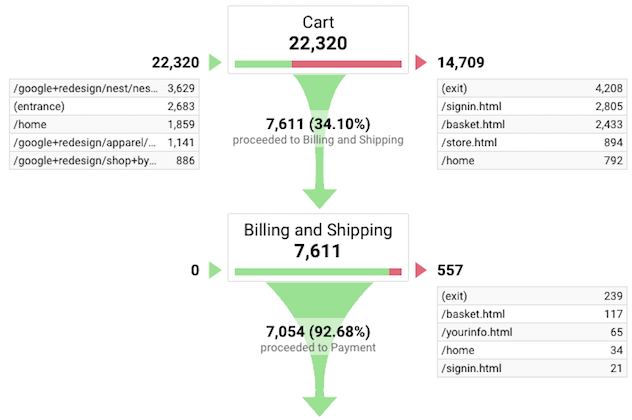
This figure provides a few key pieces of information. On the top left, we see that 22 320 people reached the cart and that 14 709 exited the funnel at this stage. 7 611 entered the funnel and move to the billing and shipping page, or about 34% of the people who reached the funnel. The bar in the ‘cart’ box represents this percentage visually. On the top right, we see that, out of the 14 709 who exited the funnel, 4 208 visitors left the website, 2 805 moved to the sign-in page, 2 433 moved to the basket page, 894 went to the store page, and 792 went back to the home page. We can infer from this that many users wanted to sign in, perhaps to benefit from a loyalty program (e.g., they will accumulate points on their purchase) or some promotion (e.g., free shipping for members). Consumers who return to the basket or the store might be undecided about their overall order and want to add or remove items. Consumers who exited the website, though, might be seen as worrisome, and there might be activities to deploy here (e.g., retargeting ads, abandoned cart email). It also serves to identify an area for conversion improvement to minimize consumers who exit the website after having put items in their cart. Next, we see that, out of the 7 611 users who reached the billing and shipping page, almost all (93%) completed their transactions. This points to a well-optimized billing and shipping page.
One of the main tools in the arsenal of conversion optimization is A/B testing.
A/B tests “consist of a randomized experiment with two variants, A and B. It includes the application of statistical hypothesis testing or ‛two-sample hypothesis testing’ as used in the field of statistics. A/B testing is a way to compare two versions of a single variable, typically by testing a subject’s response to variant A against variant B, and determining which of the two variants is more effective” (Wikipedia).
In plain language, an A/B test compares two versions of the same webpage where one element differs (e.g., a different call to action, background image, or heading). Using software solutions, half the traffic to this webpage over a specific period of time is sent to version A and the other half is sent to version B. Then the performance of both pages on whatever goal consumers were supposed to achieve on this page is compared.
Let’s take the following landing page (Figure 8.4), for example. The signup rate is lower than expected, and the firm wants to test different elements of the page. Their first hypothesis is that the headline is not convincing enough. They thus decide to test a different headline with a clearer call to action: “Transform yourself with Fit for Life” instead of “It has just become easier to develop your fitness potential.”
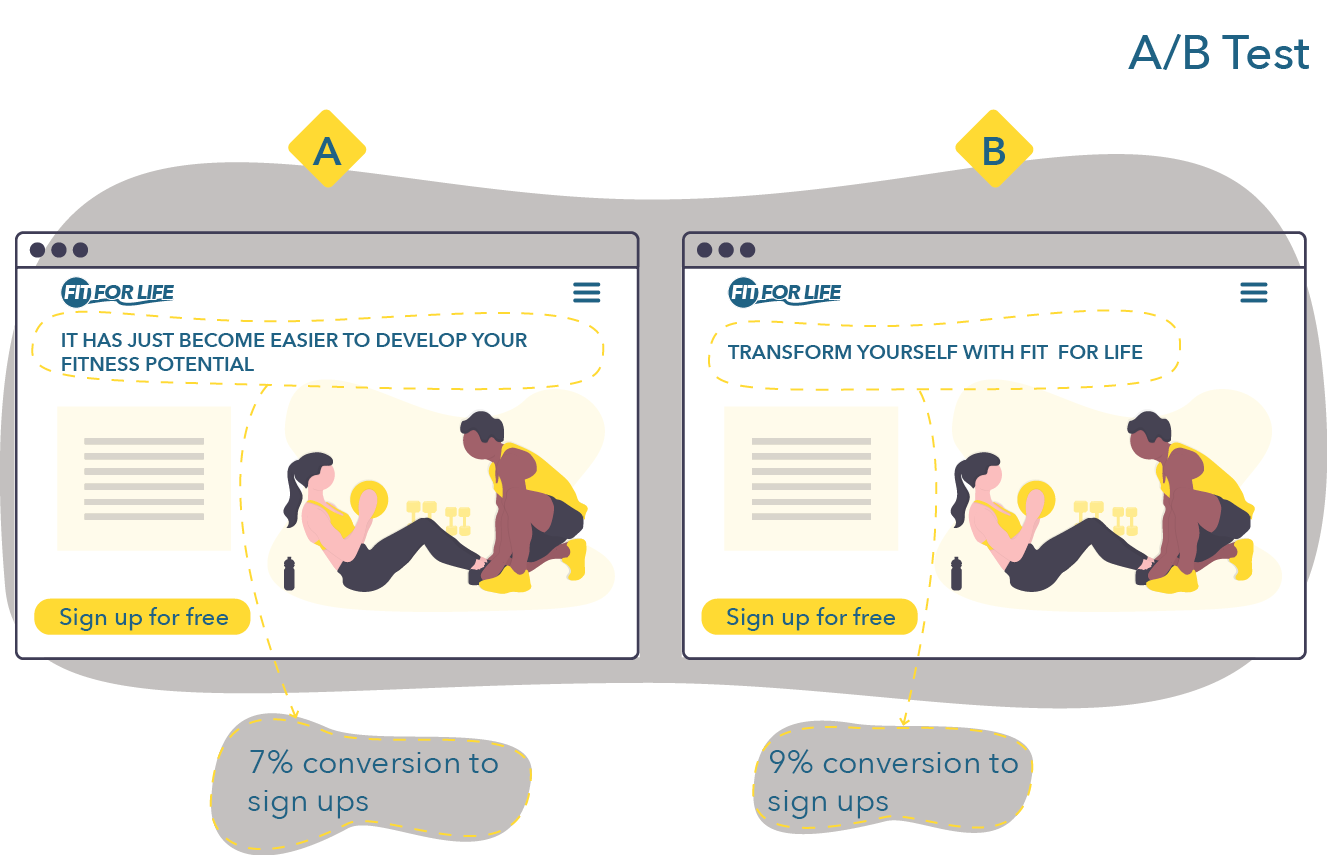
They test both pages over a period of a week. After the week ends, they compare version A and version B and find out that version B performed better. They thus keep version B and move on to testing other elements of the landing page.
Optimizing through A/B testing typically leads to marginal gains, meaning that it is rare to see a massive difference between two versions. But, over time, these marginal gains can add up to important differences. For example, let’s compare a website that does not do any A/B testing on a landing page to one that does A/B testing every week and makes small gains, improving their conversion rate by a factor of one percent a week (e.g., moving from 8% to 8.08% in the first week). The second website, at the end of the year, will have a page that performs 1.39% better. At the end of the second year, 2.97% better. At the end of the third year, 4.76% better. While the first landing page still converts, let’s say, 10% of visitors, the second landing page now converts 14.76%. If the improvements are by a factor of 2% per week, this difference moves to 21.77%. Like compound interests, small differences add up to large differences over time (Figure 8.5).
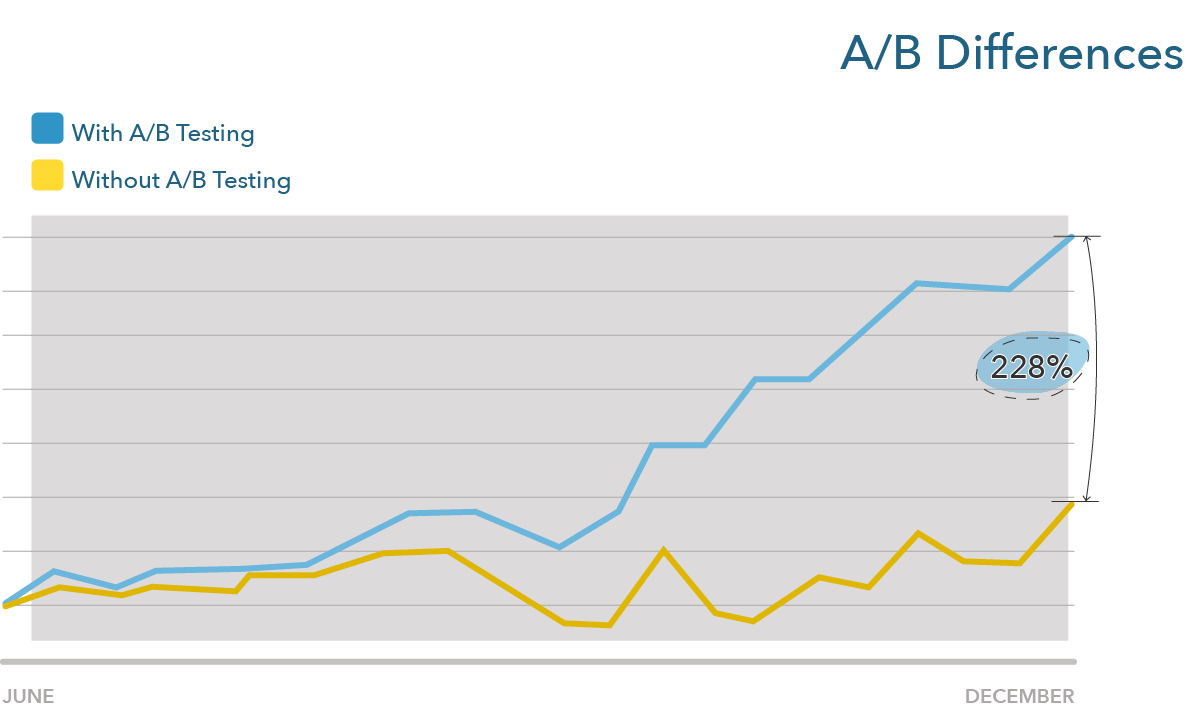
Anything can be A/B tested. If you want more information on how A/B tests can be used in practice, I highly encourage you to read one of the following three case studies from Optimizely:
We will next cover principles for conversion-centered design proposed by Unbounce. The main idea behind these principles is to help create highly converting webpages by concentrating on key design ideas that have less to do with creating aesthetically pleasing websites and more to do with creating websites that help marketers achieve their objectives.
The principles are as follows:
For example, applied to the optimization of a landing page, these principles suggest the following questions:
Now let’s examine each principle in depth.
Although we think of choice as a great thing, more options are associated with a breadth of negative consequences. According to leading psychologist Barry Schwartz, offering more choices makes people less likely to pick an option and more likely to be dissatisfied with the option they picked (TED Talk). Think of the last time you tried to pick a Netflix movie, for example. How long did it take you to choose a movie? How long would it have taken you if you only had two options? On webpages, more choices also mean more options offered to visitors and more chances that they will not do what they should be doing on a certain page.
For this reason, the first principle asks you to create focus on your webpages. On landing pages, we saw that the lower the attention ratio (the ratio between goals and links on a page), the higher the conversion rate. In 2013, Unbounce analyzed more than 20,000 lead generation landing pages and found a negative relationship between conversion rate and number of links (related to attention ratio, Figure 8.6). Clearly, the more links on a lead generation landing page, the less likely a firm is to create a lead. Thus, to create focus on landing pages, firms should focus on a 1:1 attention ratio. To accomplish this, landing pages should aim to make visitors accomplish one goal and one goal only.

How does focus translate on other pages? Often, focus is achieved by drawing people’s attention to the goal they are the most likely to be wanting to accomplish by positioning this goal above the fold on a firm’s page. Concretely, this often translates on having only one call to action above the fold, where the call to action is associated with the goal that consumers should be achieving.
Let’s see a few examples of top websites: Optimizely, Mint and Discord, and fashion retailers.
Optimizely offers visitors personalized options depending on their roles. Engineers are asked to create a free account, product managers are invited to watch a demo, marketers can try a visual editor, data scientists are offered a white paper, and team leaders are directed to a guide to experimentation. In short, what Optimizely has done is (1) identify the main goal that each persona is likely to want to accomplish when visiting the firm’s website and (2) put this goal front and center.
Discord and Mint employ the same tactic: They offer visitors one option above the fold, that is, to use or sign up for their product. Below the fold, the strategy of both websites is also the same. They expand on the benefits of their products, what users should expect when they sign up, provide social proofing, and conclude this sales pitch with, again, an option to sign up or use the product. This is a typical homepage design strategy for firms that sell one or a few products, such as Paperlike, which we discussed in our exercise for the last chapter.
Altitude-sports.com, an online retailer, employs a strategy typical for this type of website: They offer one or more links that will move the visitor to a section of the website where they can shop (see also FARFETCH). There are different approaches to doing this. MR PORTER invites consumers to visit different product categories that align with the season, such as rain jackets for Fall, as well as a link to new items. END., a clothing retailer, pursues a strategy typical of the niche menswear market and invites consumers to register for drops. An alternative for retailers that have content-heavy websites is to drive visitors to content articles (SSENSE follows this strategy), probably in a bid to become a privileged source of information for high fashion and turn readers into customers.
Importantly, for retailers and other types of websites, the number of links that visitors can click above the fold is limited. In all of these examples, visitors are offered a maximum of three options above the fold (not including the menu).
Once a firm has identified what goal visitors are supposed to achieve, it can use visual elements to draw the attention of visitors to elements of the website that should lead them to achieve this goal. A few visual principles can help us here (images from Unbounce).
Practice encapsulation by bounding an element you want to draw attention to in a box or a figure. A typical example of encapsulation is the introduction sequence of old James Bond movies, where the gun barrel draws our focus to James Bond (Figure 8.7). On a webpage, this can be done, for example, by putting an element that visitors should focus on in a box (see for example Figure 8.8).

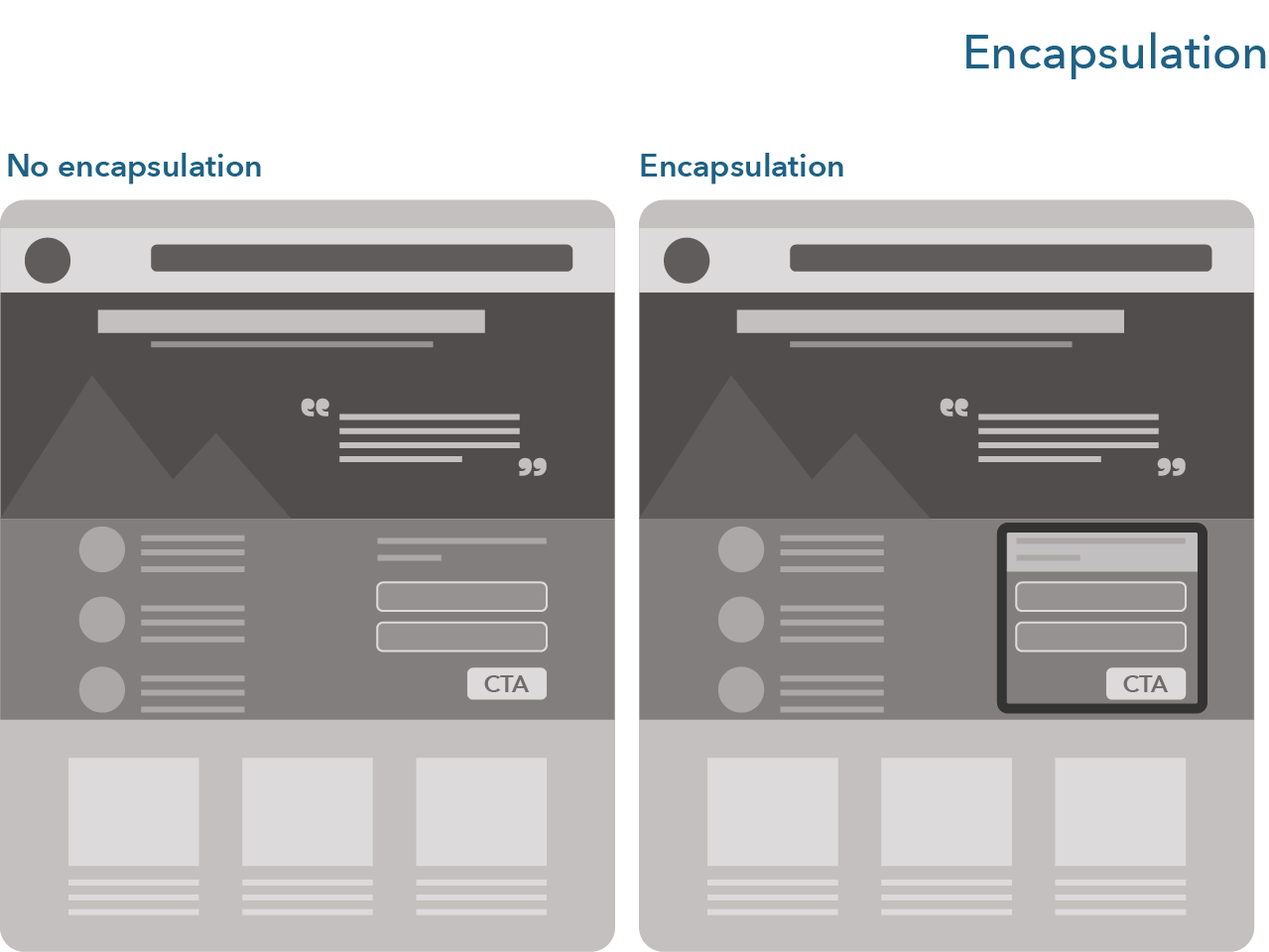
Similarly, contrast and color draw the attention of the visitors to the contrasting and colorful design elements, like a button, a specific sentence, a title, or a form (Figure 8.9). Many websites now exist to help with color theory and finding the best contrasting colors (Coolors, for example).
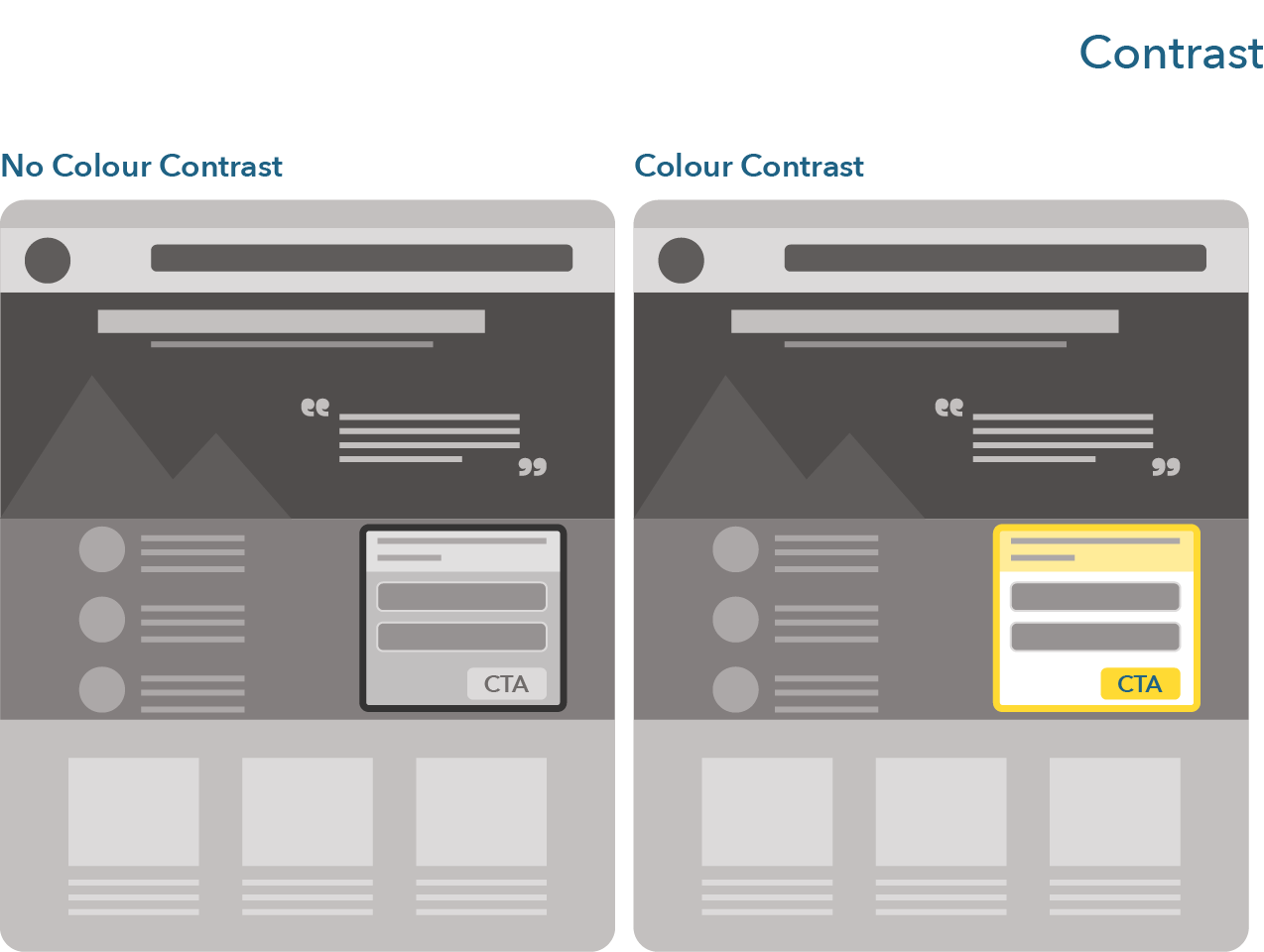
Directional cues serve two purposes. First, they help direct visitors’ attention to the elements that are pointed to. Second, they help create a reading pattern for your users to follow (Figure 8.10). Keep in mind that reading patterns should also be supported by the rest of your website structure, i.e., how your images and text are positioned (Figure 8.11), but that is beyond the scope of this course.


Lastly, white space is also a design tool that is useful to draw the attention of visitors to specific webpage elements, as shown in Figure 8.12.
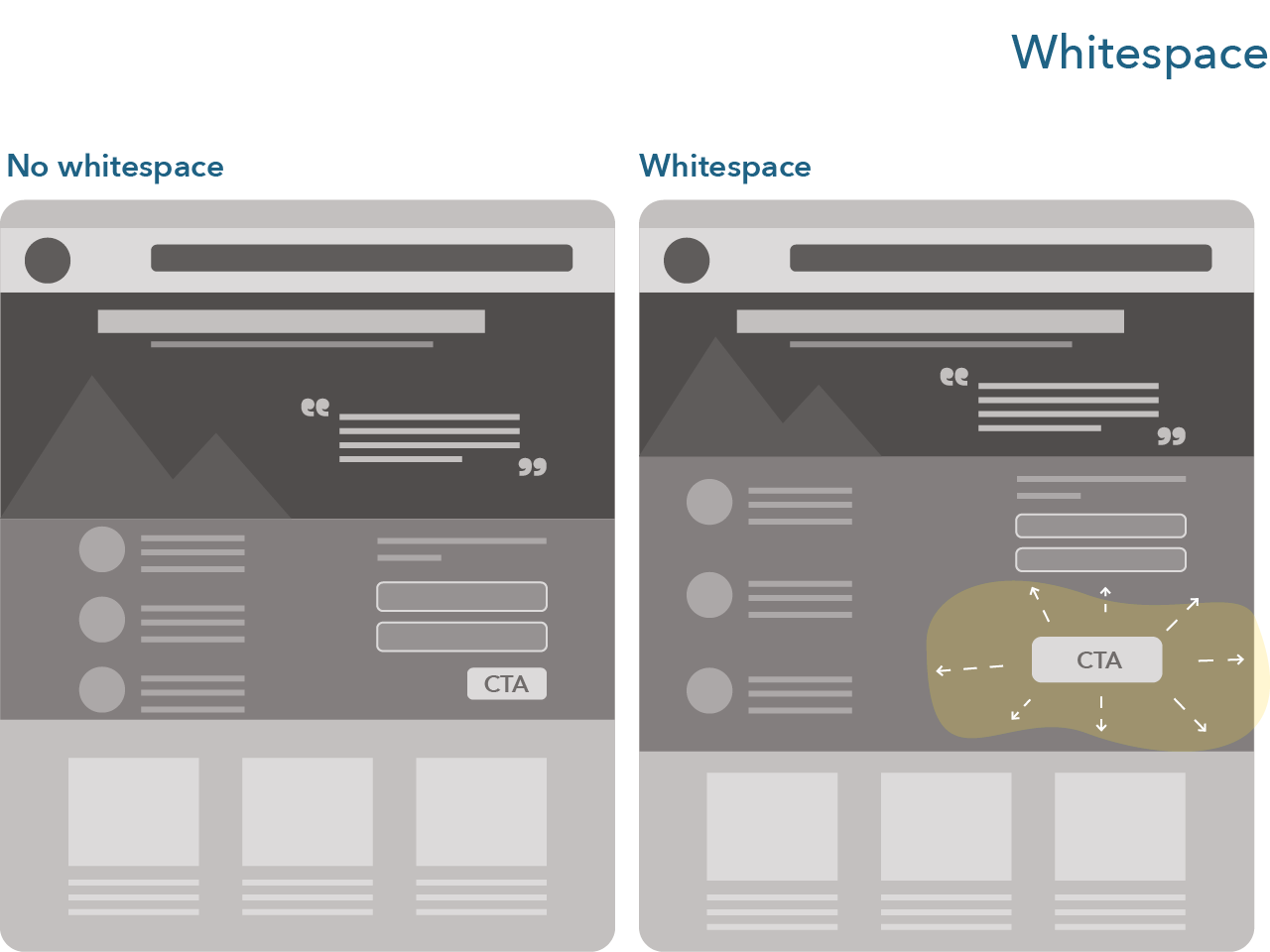
Building structure for clarity is all about making sure the message of a page gets across clearly and quickly. To do so, it is useful to follow basic principles of information and visual hierarchy, where the more important the information, the better positioned, bigger, brighter, and/or more colorful it is on the page (Figure 8.13).
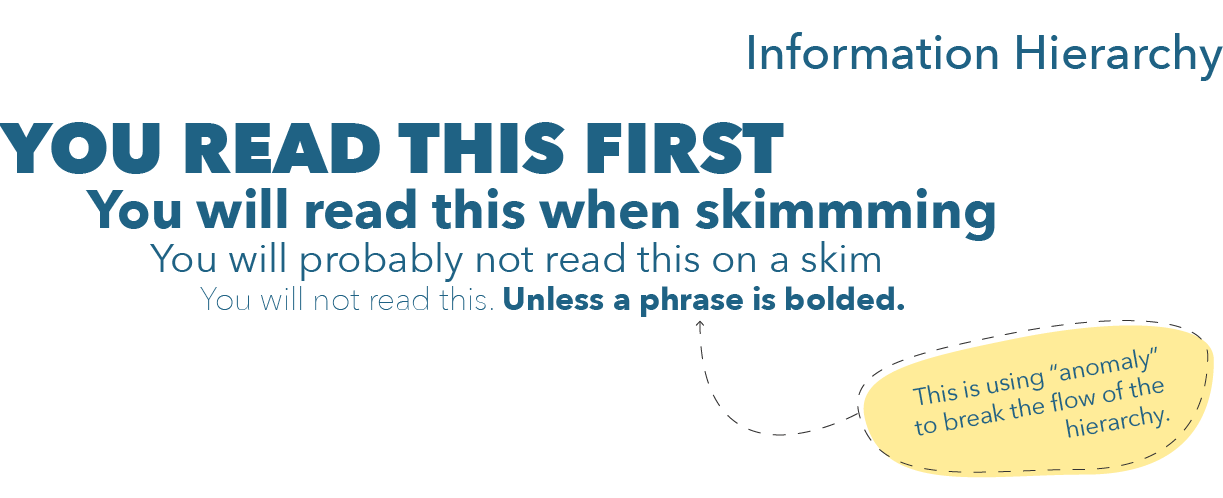
Follow the principle of Sullivan (the “father of skyscrapers”): Form follows function. Gone are the days when we designed webpages for purely aesthetic reasons. Webpages now have clear goals for visitors to achieve. Our objective as digital marketers is to make sure consumers achieve these goals. Design should support the achievement of goals rather than serve solely aesthetic purposes (i.e., designing a pretty website is not something we should solely strive for).
A useful, quick test to see if a page achieves a clear structure is the five second test. According to fivesecondtest.com,
Five second tests are a method of user research that helps you measure what information users take away and what impression they get within the first five seconds of viewing a design. They’re commonly used to test whether webpages are effectively communicating their intended message.
By consistency, we mean how all the elements of a campaign work together. Ideally, these elements should match. Answering the following questions can help us stay consistent:
These ideas are expressed in Figure 8.14.
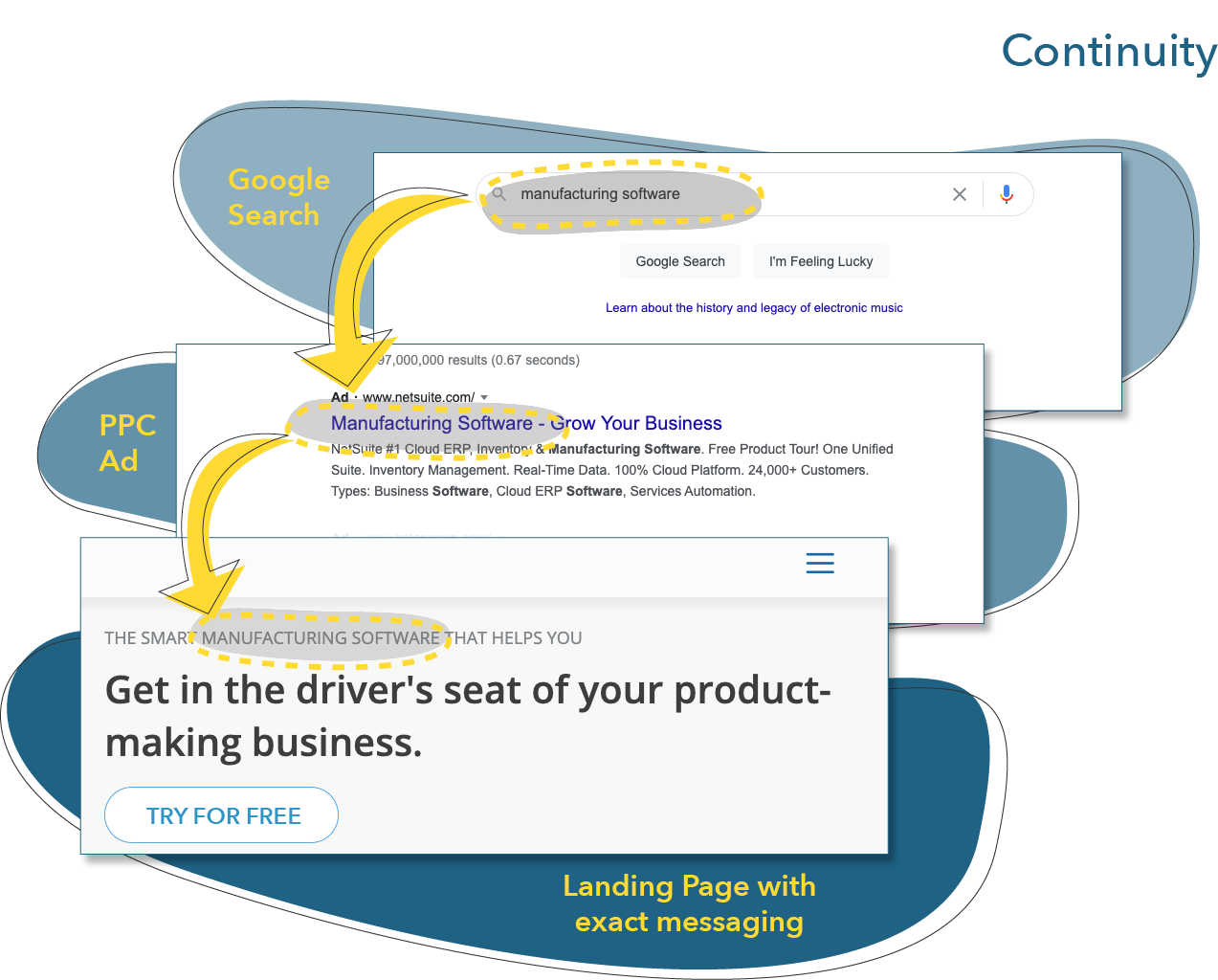
Ensuring consistency can be supported by practicing message and design matching.
Message matching entails repeating the copy or phrasing of your ad or search page result in the webpage where users land. This ensures that the user knows that the page they’ve ended up on will answer their query. We are all kind of lazy when it comes to navigating and looking for information online. The easier we can make the lives of consumers, the more likely they are to convert.
Take the example in Figure 8.15, where the first image doesn’t practice message matching, where the message changes from “Get a dozen roses for $29” for the search ad headline to “Great deals on beautiful bouquets” for the landing page headline. In contrast, in the example in Figure 8.16, the message the ad and landing page here are clearly aligned; in fact, in this example they are identical.
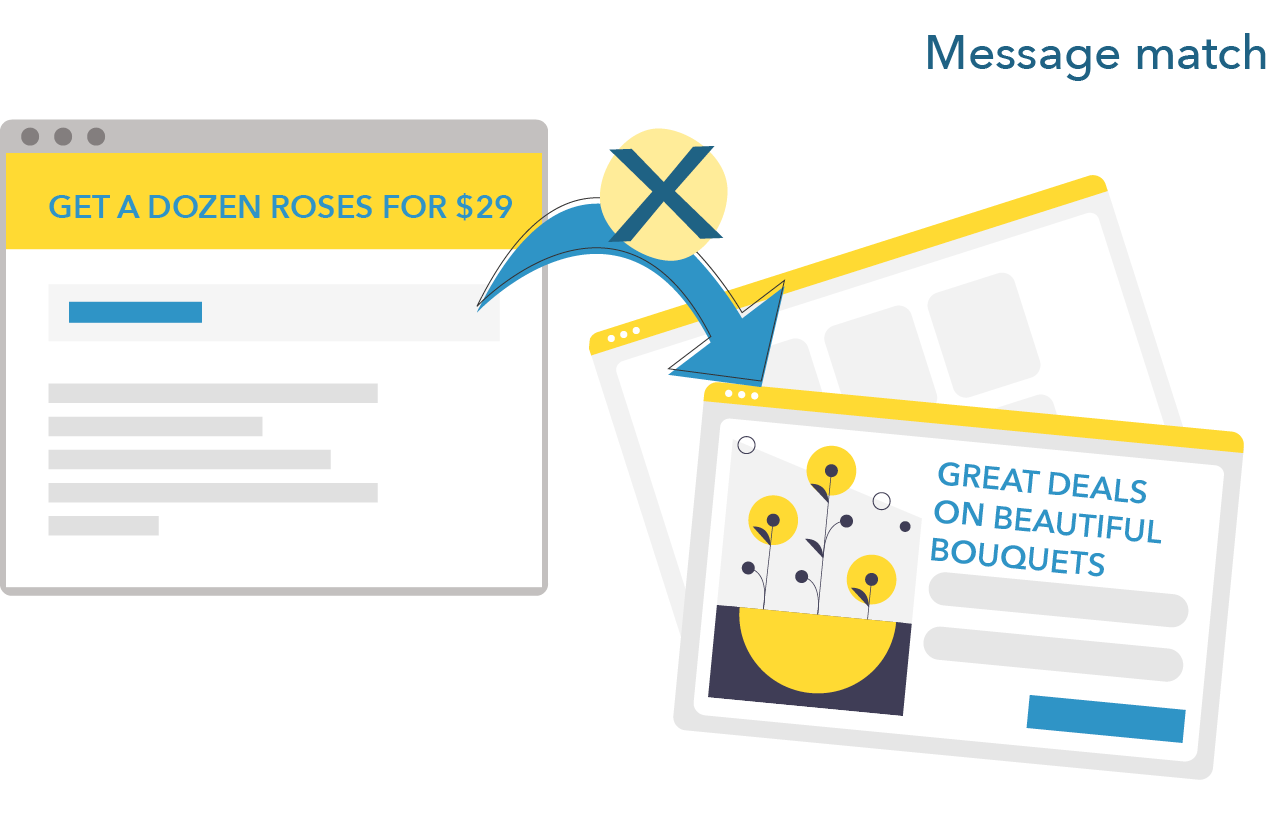
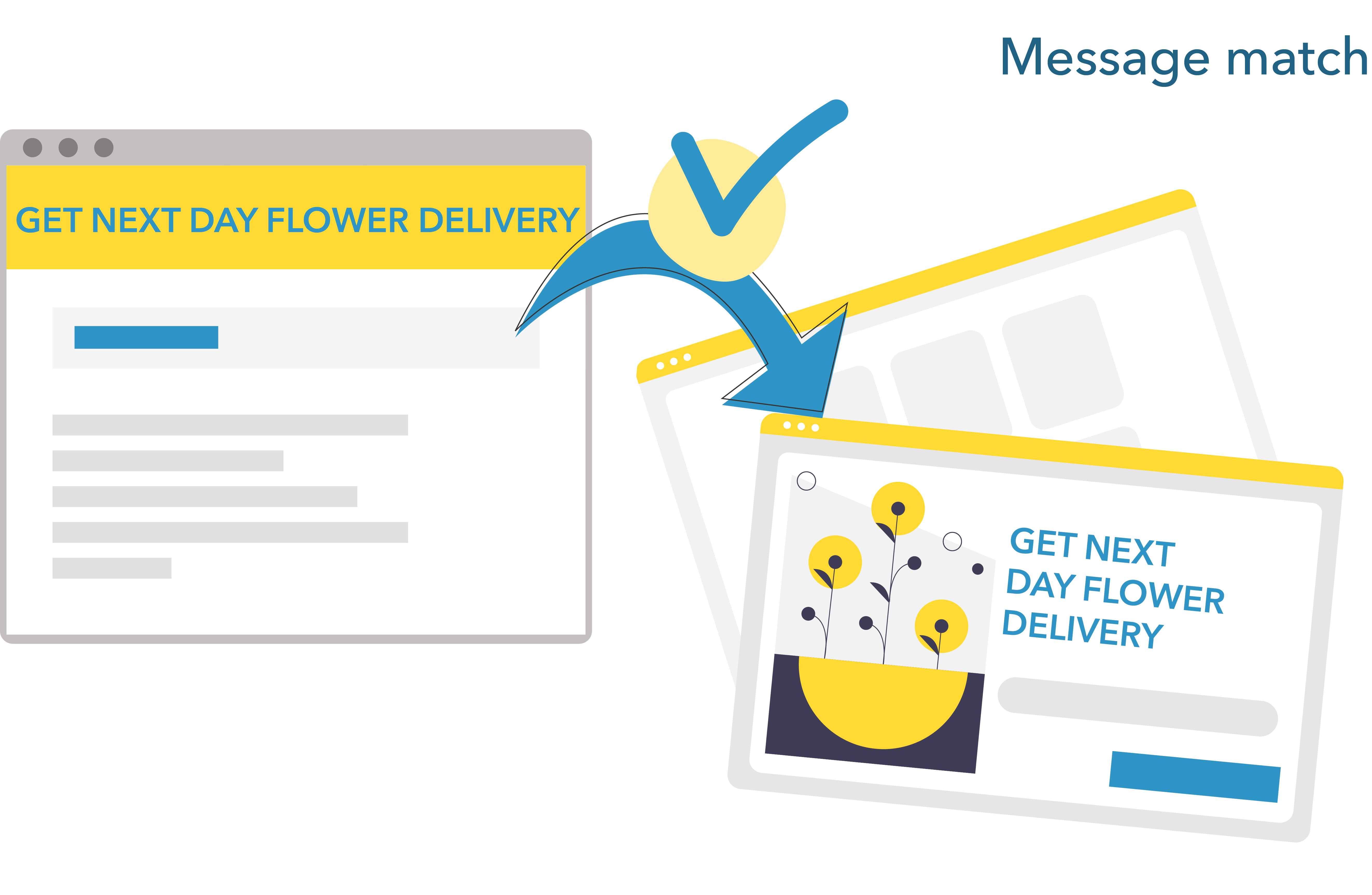
A similar idea has to do with matching the design of an ad and the page on which users land, or design matching. Here, we want to repeat the visual elements of the ad on the page. This can be done by, for example, repeating the visuals, colors, and structure of the ad.
Figure 8.17 shows an example where the webpage doesn’t repeat the elements of the ad (or, in this case, the copy!), while Figure 8.18 shows an example of the design of the ad and landing page being clearly aligned. The first image doesn’t practice design match and the second does.

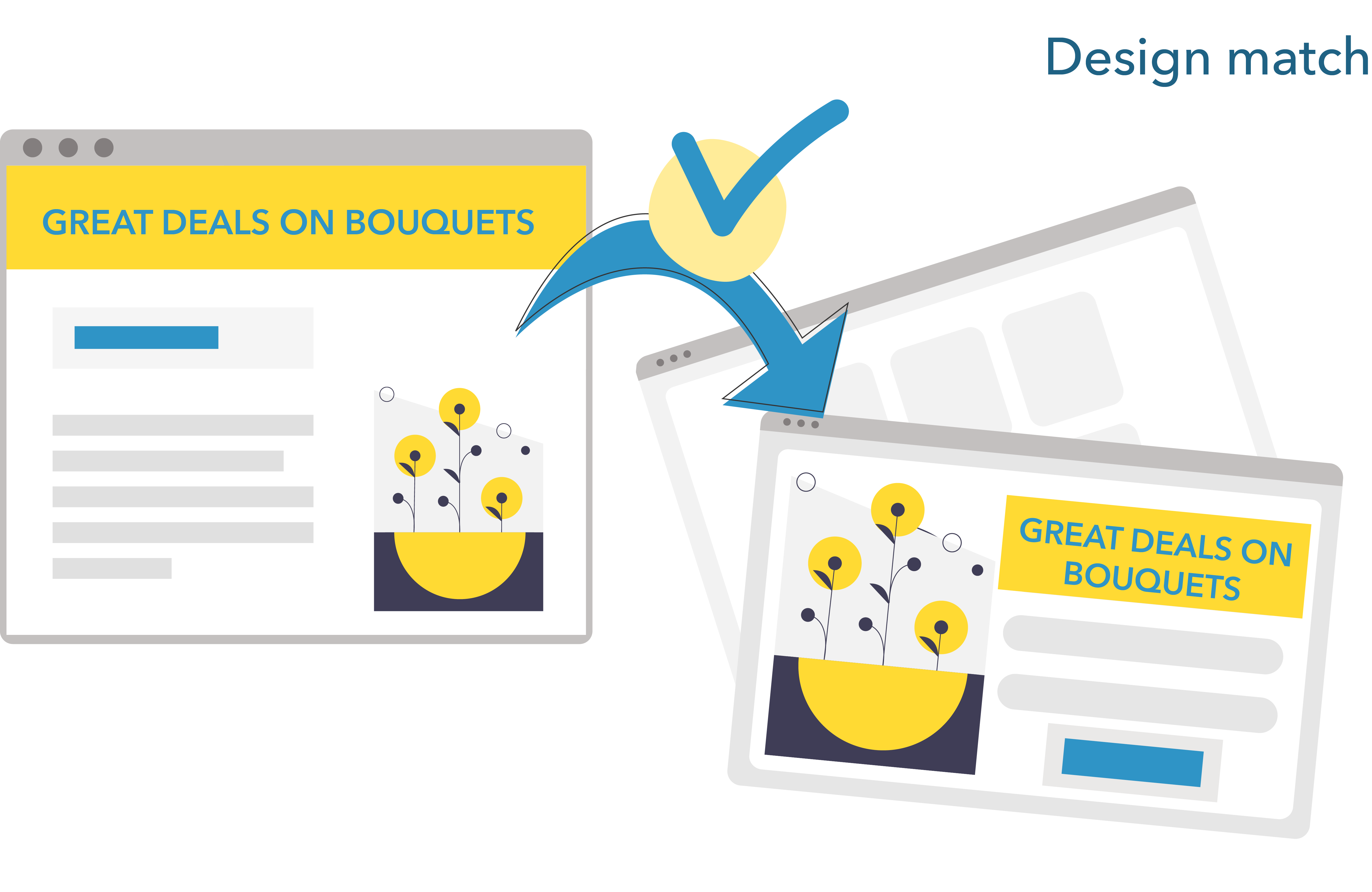
In an age where fake news is rampant, almost half of Amazon reviews are unreliable (AdAge), and when anybody, anywhere can create an online shop, instilling trust is a key component to making sales. This is especially true for smaller brands that consumers might not have heard of. Some website elements can help us build trust include
Most of these elements are considered social proofs. Originally, social proof related to the idea that we copy others, especially in situations of uncertainty (fun fact: organizations do the same thing, a concept called mimetic isomorphism). Online, this translates into proving to visitors that something is noteworthy or trustworthy because it has been adopted by others.
Here are a couple of tricks provided by Unbounce when creating testimonials:
And, importantly, use some of the principles we just covered to have social proofing stand out so that it is easier for visitors to quickly grasp that other people already believe in the brand.
Congruence is particularly relevant when designing landing pages, but its driving principles can be used when designing pages throughout a website. According to Unbounce, Congruence refers to
The alignment of every landing page element with your single campaign goal. Congruence is a high-level conversion-centered design principle. If a piece of copy or image on your page isn’t aligned with your campaign, it’s going to cause friction and hurt your conversion rate.
When designing landing pages, Unbounce proposes scoring a page based on the congruence of its individual elements with the goal that consumers should achieve. We saw that landing pages typically possess some core elements—a unique selling proposition, a hero shot, a benefit statement, social proofing, and a link, which is typically a call to action. These core elements are usually implemented in page elements, such as headlines, subheadlines, pictures, introduction paragraphs, bullet points, and links. An easy way to evaluate the congruence of a webpage with its goal is to build a scoring sheet for each of these elements. Take the landing page shown in Figure 8.19 as an example.

Now let’s see how each element of the landing page is performing. The first question to ask is, What is the goal that consumers need to achieve on that page? In this case, it is to download the white paper. Hence, all elements of this page should be talking about the white paper. The headline and subheadline should offer some unique selling proposition associated with the white paper. The hero shot should be white-paper related. The benefits, in this case explained in a short paragraph and bullet points, should explain what the consumer will get by downloading the white paper. The call to action should be white-paper related. And so on. Figure 8.20 shows an analysis of the webpage (text version here). How are each of these elements performing?
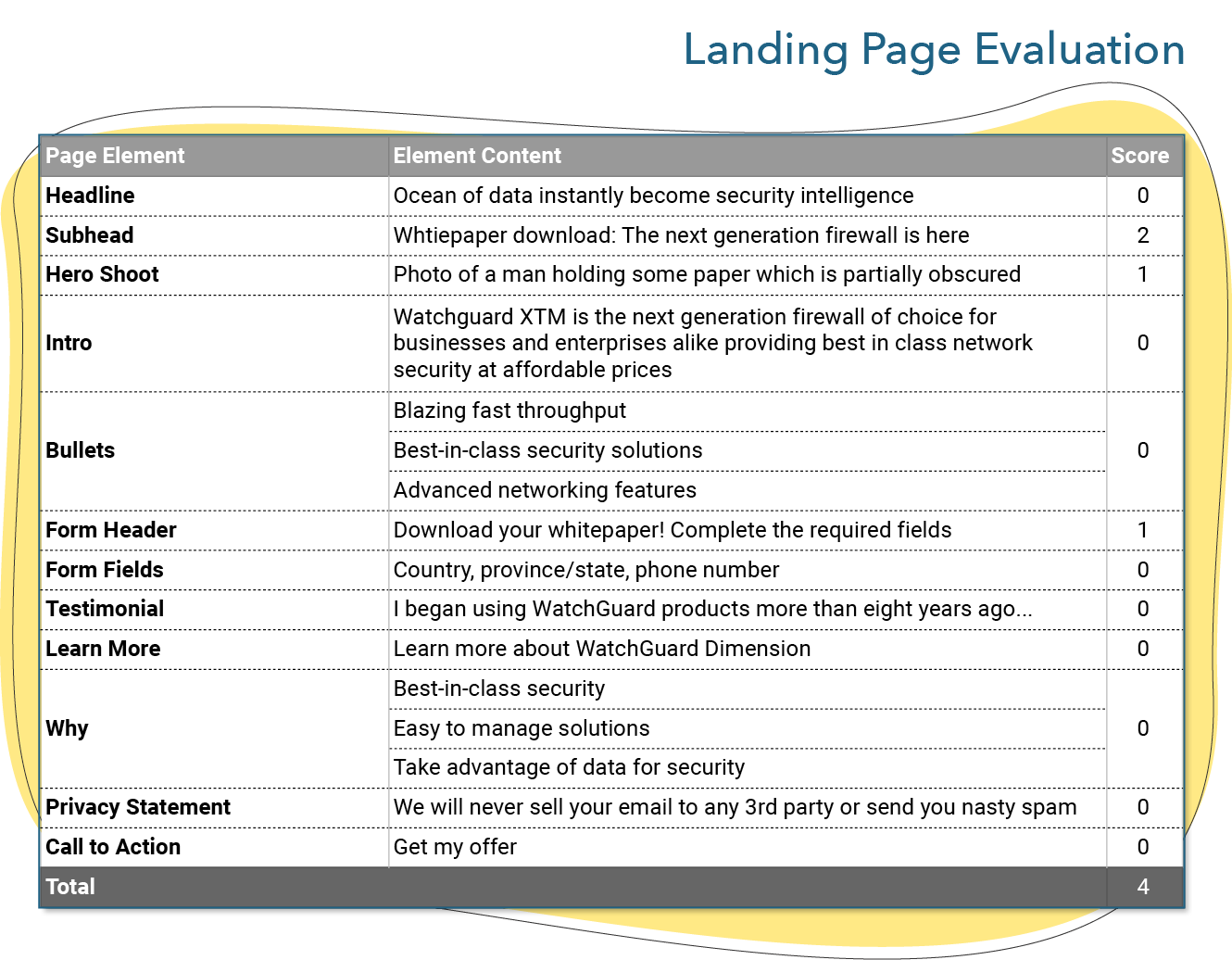
Generally, pretty badly: The headline is not aligned with the white paper, the intro and benefits are not white-paper related, the testimonial relates to the product rather than the white
paper, and so on.
To optimize this page, the firm should transform each individual element to better represent the goal of this page.
Ensuring that a persona achieves its macro conversion (e.g., making a sale) entails having well defined, planned paths through which it will go. This idea can be broken down into two main components.
First, every conversion is an opportunity for another conversion. This is the principle of continuance, as defined by Unbounce:
A conversion centered design technique that uses the momentum of one conversion to drive a secondary conversion request, like a social share or a newsletter signup. Confirmation pages and thank you emails are prime channels for continuance.
Second, this emphasizes the importance of clearly defined conversion paths. In order to know what to optimize in a sequence of steps, such as those we covered at the start of this chapter, we need to know in advance what series of steps consumers should take to complete an overarching goal or macro conversion such as making a purchase.
To do so, it is important to ask, What comes next? If I have consumers sign up for a newsletter, it should be because I know exactly what I will be doing next and what the consumer who signed up will be asked to do. Optimizing conversion is about creating these clearly defined paths so that we can analyze each step, and the relationship between these steps, to boost our conversion rate over time, both for specific steps and for the path as a whole.
Remarketing (sometimes called list-based retargeting) and retargeting (also called pixel or behavioral retargeting) are forms of targeting that serve ads to specific consumers, albeit differently. Online, you might find varying terms for these two activities. For example, Google places both under their remarketing tools.
Both strategies help during lead nurturing to maximize opportunities for conversion by serving ads to the right lead at the right stage of their journey. Remarketing and retargeting typically target qualified leads (MQL or SQL).
Although we discuss these two practices at the conversion stage, they can be used to convert for any goal (e.g., having consumers sign up for a webinar or visit a blog post, as well as making a purchase). In short, these approaches can be used to generate leads, qualify leads, or convert to purchase.
The main difference between the two approaches is how targeting is put into action. Remarketing uses emails collected during lead generation activities to target leads, while retargeting targets consumers based on previous behaviors. In both cases, ads are displayed to consumers.
To practice remarketing, a firm first needs to create an email list. Then, using targeting options on advertising platforms such as Facebook Custom Audience or Google Customer Match, a firm can create an ad campaign that will be seen only by consumers with these email addresses.
While remarketing can be useful for many strategic purposes, it is often used during retention strategies (i.e., when customers have already been acquired). This is, however, not the only use of remarketing. Remarketing can be used as part of a greater lead nurturing campaign to engage leads at any stage of their journey. For example, as long as a firm is properly keeping track of the stage at which the lead is located, it can use the emails associated with a large number of leads at a specific stage to personalize an ad campaign.
An advantage of remarketing is that it is highly customizable to specific customers, since you are targeting based on their email addresses. Two downsides, though, are that mismatch of email addresses happens (e.g., a lead might have given you an email address they do not use for their Facebook or Google accounts) and that it is not automatic (as compared to retargeting).
Instead of targeting ads based on an email list, retargeting uses previous behaviors, such as clicking a link, putting a product in a cart, or liking or commenting on a post. This is why, sometimes, after putting an item in a cart and abandoning your purchase, you might see the same article in the ads shown to you in numerous websites, over and over again (Figure 8.21).
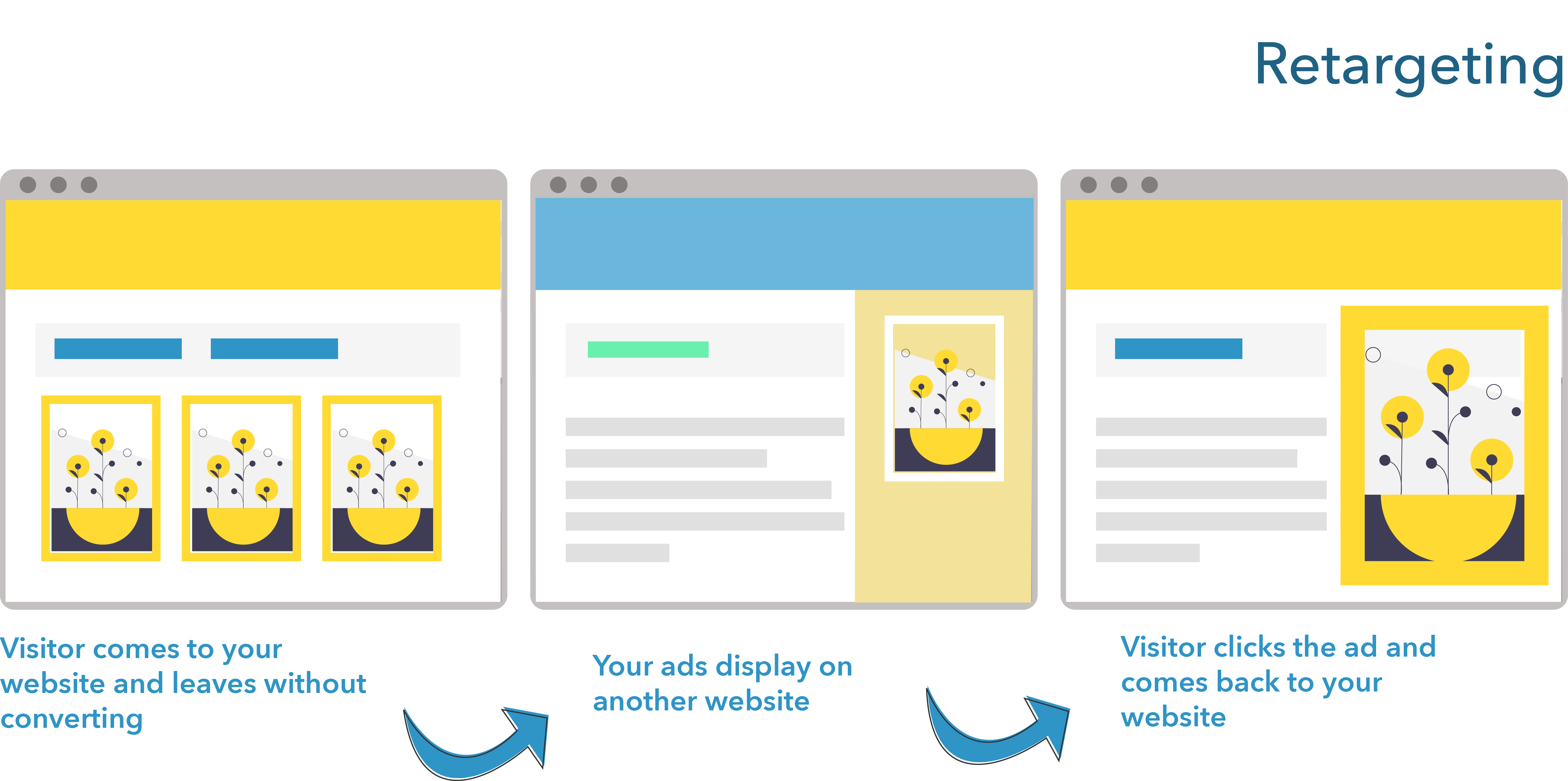
Because retargeting is automatic, and because it works on any predefined goal that has been accomplished by a visitor or a lead (e.g., viewing a specific page, clicking a link, spending time on a site, or commenting on a Facebook post), it is a great tool to master to perfect lead nurturing campaigns. Although retargeting is often used to push consumers to complete purchases, its uses are much more wide-ranging. Retargeting is a great tool to engage leads to perform the next action in a planned path. For example, a firm could create a blog post or a piece of gated content to generate leads and retarget anybody who gave their email address on either in order for them to accomplish the next goal the path set up for that specific persona.
Retargeting can also be used for lead generation, where a company could target people interested in a specific product category. For example, car companies do retargeting campaigns by advertising product reviews of their cars and those of their competitors on social media and by retargeting anybody who clicks on the ads to read the reviews. Such campaigns help generate leads by identifying consumers who seem to be looking to make a purchase in a specific product category and then targeting them to engage in lead generation activities.
Because it is highly customizable and automatic, the options when using retargeting are almost limitless. A firm simply needs to identify behavior that they deem interesting for scoring leads or identifying their stage in the journey and use retargeting to serve ads to the specific consumers who will have performed that behavior. Retargeting campaigns work best when firms have a clear idea of the path their persona should take to make a purchase, because the campaigns can then be used to maximize the chances that a persona at a specific step in that path will continue on and perform the next step.
Lastly, it is important, though, to ensure you identify the right actions! To finish this chapter on some laughs (or at least a smile):
Based on this week’s chapter, optimize the landing page located at bit.ly/34muGIR.
Explain your reasoning.

This last chapter covers activities associated with the Engage stage: how to evaluate and encourage customer engagement and loyalty and foster co-creation by engaged customers. We discuss the importance of customer engagement, customer lifetime value, ways to measure engagement, consumption communities, and co-creation activities.
Learning Objectives
Understand the concepts of engagement and loyalty, how to calculate customer lifetime value and its importance in marketing strategy, how to measure engagement, and how to create value with consumers.
A widespread definition of engagement attributed to Forrester is “creating deep connections with customers that drive purchase decisions, interaction, and participation, over time.” Accordingly, the two objectives of the Engage stage are to (1) foster loyalty and (2) co-create value with customers.
Key performance indicators at this stage help measure a firm’s success in attaining these objectives and the achievement by consumers of associated goals. KPIs include the number of shares, brand mentions, referrals, repurchases, and reviews as well as the ratio of comments to posts, comments to likes, and reviews to sales.
The Engage stage is central for many reasons. Perhaps most importantly, recent research shows that loyalty leaders “grow revenues roughly 2.5 times as fast as their industry peers and deliver two to five times the shareholder returns over the next 10 years” (HBR). Working on increasing engagement is thus profitable. There are a few factors that explain this.
Acquiring customers is much more costly than retaining and selling to existing ones, and repeat consumers tend to spend more than new ones (Forbes). Engaged consumers are also more willing to interact with you, facilitating market research and leading to groundbreaking insights. This is particularly true since you can develop winning engagement strategies by identifying what makes your loyal customers loyal. Last, engaged customers work on your behalf, co-creating content that, as we’ve seen, is used by other consumers throughout their journey.
To better understand the value of customers over their lifetime with a company, we turn our attention to the concept of customer lifetime value. We then look at two tools that can help us better understand and measure customer loyalty. We conclude the chapter by examining value co-creation.
Customer lifetime value (CLV) represents a customer’s profitability over their entire relationship with the business. A straightforward way of thinking about CLV is as follows:
CLV = average profit per sale (AP) × number of repeat transactions in a period (RTP) × retention time (RT)
Please note, however, that this is a simplistic approach used to illustrate this concept and not something we would recommend using in a real-life setting.
Let’s use the example of a subscription business (i.e., period = 1 month). The business has a churn rate of 2%. Churn rate represents the rate of customers leaving a company per period (Wikipedia). In this case, the company is losing 2% of its customer base every month. Churn rate is useful to calculate the average retention time of customers: By dividing 1 by the churn rate, we obtain the retention time. In this case, customers stay with the business for an average of 50 months (or 1 divided by 0.02).
The average profit per sale is $30.
The number of repeat transactions per period is one, because customers are making one transaction per month and the period we are looking at here is one month.
The CLV is thus
CLV = AP × RTP × RT.
Since AP = $30, RTP = 50, and RT = 1,
CLV = 30 × 50 × 1 = $1,500.
Over their lifetime, each customer brings the business $1,500.
CLV draws our attention to the importance of catering to the lifetime of a customer with a business. The first sale to a customer is not what typically brings revenue to a firm. Acquisition costs for a customer are generally much higher than the revenue a firm will make on its first sale. Thus, the objective of firms is to engage customers to increase their lifetime value.
More concretely, CLV can play many roles for a firm. For example, it helps firms price their customer acquisition strategies and calculate their return on investment. This is important because it helps evaluate whether acquisition strategies are profitable and manage marketing efforts more generally.
Continuing with the example above, let’s assume the firm is running a PPC search ad campaign to acquire customers. In this simple example, let’s further assume that people search for something, click on an ad which leads them to a landing page, and convert to customers from this landing page.
The total campaign cost is $20,000, including all campaign elements (i.e., developing the landing page, all costs related to ads, etc.).
The campaign gets 2,500 visitors on their landing page.
The conversion rate is 5%, meaning that the firm converted 5% of the 2,500 visitors to their landing page. That works out to 125 customers (2500 × 5% = 125).
The cost per acquisition is thus $160, or $20,000/125.
At this stage, firms will be asking themselves, “Is this profitable? What is my return on investment? Should I continue running this acquisition strategy campaign?” CLV becomes useful at this stage.
As a reminder, this firm earns $1,500 per customer on average throughout their lifetime with the company. Even if the company only makes $30 on the first sale (meaning that they just “lost” $95, since it cost them $160 to acquire the customer), two rules of thumb help us see that this is a profitable customer acquisition strategy over time.
The two rules of thumb to quickly gauge whether a customer acquisition strategy is profitable are:
Among many other uses that CLV serves, it can also support retention and customer support strategies central to the Engage stage. By knowing the lifetime value of customers, firms can more easily price retention and support strategies, i.e., how much to put into trying to retain customers.
CLV varies per persona, where some personas will be worth more over their lifetimes than others. This helps firms to decide where to spend extra resources and which personas to pamper a bit more. It can also help a firm see whether it should “fire” a persona, i.e., minimize the efforts dedicated to customers already acquired and stop acquisition strategies for a specific persona if their CLV is drastically lower than that of other personas.
Lastly, it is important to keep in mind that, apart from subscription businesses such as the example above, customers rarely bring in the same amount to a firm throughout their lifetime. The relationship between a customer and a firm evolves over time, and it is important to recognize that the journey of customers expands beyond their first purchase with a firm. Not only does this vary between personas, but it might also vary between markets. In some markets, such as videogame consoles or eyewear, products are seldom sold, with an extended period between purchases that might encourage churn. In other markets, like groceries, consumers are continuously making purchases over their lifetime. As is the case in the market for diapers, other markets might see a significant uptick at the start of the customer’s life with a company and then declining sales over time as, in the case of diapers, the baby ages into a child. Although the new approach is predictive analysis, some earlier analytical tools, such as RFM analysis (discussed in the next section), provide information regarding some of these aspects. They also help us understand the basics of analyzing customer behavior to make strategic decisions.
RFM, which stands for recency, frequency, and monetary value, is a long-standing analytical method that helps analyze and segment customer behavior based on the recency of their last purchase, the frequency of their purchases, and their monetary value, i.e., how much they spend with the firm.
By helping firms understand the purchasing behavior of acquired customers, RFM analysis can help increase retention and purchase per customer, identify which customers are not so great, better, and best, whether we are experiencing issues with a specific persona in terms of repurchase behavior, and so on.
To conduct an RFM analysis, a firm starts with its customer database. The first step is to assign value to customers associated with their recency, frequency, and monetary value. Since RFM analyses can be done by operationalizing these variables differently, let’s assume here that recency refers to the recency of the last purchase in days, frequency to the frequency of purchases over three months (or a quarter), and monetary value to the total amount spent during this period.
Firms will often start by indicating the exact number associated with each variable and move to create categories for each. For example:
| Recency | Frequency | Monetary value | |
| 1 | Very recent | Very frequent | High value |
| 2 | Recent | Frequent | Medium value |
| 3 | Not recent | Infrequent | Low value |
They will perform their analysis with these categories.
We can then create segments by combining these together. The following table shows examples of such segments, where “x” stands for any number (i.e., its value is not important for defining that segment).
| Segment | Recency | Frequency | Monetary value |
| Best customers | 1 | 1 | 1 |
| Loyal customers | x | 1 | x |
| Big spenders | x | x | 1 |
| Lost or almost lost customers | 3 | 1 | 1 |
| Thrifters | 3 | 3 | 1 |
Then, each customer will be coded based on the categories created above, as shown in the following table.
| Customer | Recency | Frequency | Monetary value |
| Jack | 3 | 3 | 1 |
| Jill | 1 | 1 | 1 |
| Bill | 3 | 1 | 2 |
| Sean | 3 | 1 | 3 |
| Raymond | 2 | 2 | 2 |
| Tom | 1 | 1 | 1 |
| Tina | 3 | 3 | 1 |
| Mariah | 2 | 3 | 2 |
| Sanjit | 1 | 3 | 3 |
| Todd | 1 | 2 | 3 |
| Becky | 1 | 1 | 1 |
| Seth | 2 | 3 | 2 |
| Caroline | 3 | 2 | 1 |
This allows firms to categorize customers into the categories just created (e.g., best customers, loyal customers, etc.). These categories of customers can help decide which segments to concentrate on and what kind of strategy to use to engage customers. Examples could include performing retention campaigns with big spenders, recuperating almost lost customers, or moving loyal customers to increase their monetary value over time. A firm could also target its best customer segment: send an appreciation letter, analyze their personal preferences for more personalized offers, or generally develop strategies to keep this segment highly satisfied.
Although simple, RFM analysis is a useful tool to foster engagement. A more thorough analysis could combine RFM with personas and evaluate whether personas also share commonalities or differences in their purchasing behaviors, leading to the creation of even more personalized campaigns.
Another approach to measuring customer satisfaction and engagement that is widely used is the net promoter score (NPS). Described by the Harvard Business Review as “the one number you need to grow,” NPS is associated with a single, one question survey based on customer engagement that has shown over time to be a great predictor of firm success.
To calculate the NPS, a firm first asks the following question to its customers: “How likely is it that you would recommend our company/product/service to a friend or colleague?” (Note: NPS has also been used in the past with other types of respondents, such as employees or resellers, depending on which population a company wants to measure). Respondents are asked to answer using a 0 to 10 scale, with 10 being “extremely likely” and 0 being “not at all likely.” The NPS is then calculated by subtracting the percentage of detractors from the percentage of promoters. The result ranges from −100% (all detractors) to 100% (all promoters) (Figure 9.1).
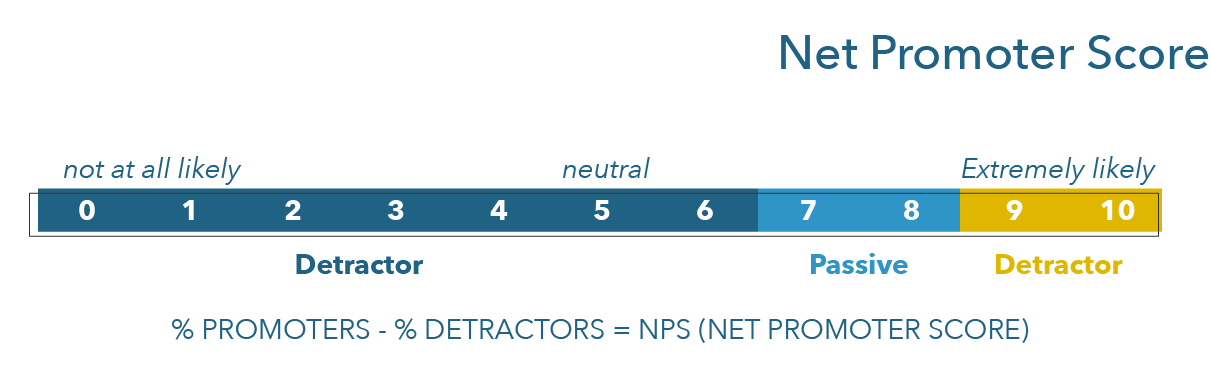
Promoters are those who answer 9 and 10. They are satisfied, loyal customers that will definitely recommend a brand to others. They are considered to exhibit value-creating behaviors, such as repeat buying, higher average basket, and longer retention time. They account for most referrals for a brand. Firms are advised to learn from promoters: What makes them so satisfied and engaged? Do they belong to a specific persona? How were they acquired? Promoters can be used to identify a winning formula that can potentially be replicated with other customers.
Passives are those who answer 7 and 8. They are satisfied customers who mostly neutral about their experience with a brand. Firms are advised to work toward converting passives to promoters.
Detractors are those who answer 6 or less. They are generally unhappy customers that will not recommend a brand to others. They might engage in value destructive behaviors, such as negative word of mouth. They have a high churn rate. Firms are advised to recover detractors. They can also ask themselves questions similar to those for promoters: What makes them unsatisfied with the brand? Do they belong to a specific persona? How were they acquired? For example, if a firm learned that specific a persona was responsible for most detractors, that should affect its future strategy in terms of where to dedicate customer acquisition efforts.
Co-creation refers to the joint creation of value by a company and its customers (Prahalad and Ramaswany 2004). Nowadays, most marketing activities can be co-created with consumers, whether those activities be market research, product innovation, advertising campaigns, or customer support.
We can categorize consumers into two broad categories of co-creators. The first category is composed of user innovators or lead users, highly involved and highly competent consumers who participate in co-creation activities to answer their own needs or desires. This is the kind of co-creator that MIT professor Eric Von Hippel has been studying since the mid-1980s. Lead users have been found to co-create value with firms in diverse markets, such as 3M and surgeons in the medical industry, amateur and professional athletes in sports as varied as windsurfing, rollerblading, snowboarding, and rodeo kayaking (e.g., Shah 2003), or computer geeks and open source software in IT (Von Hippel 2005).
The second category of co-creators is everyday consumers. These co-creators are people who are not particularly involved in a product category or particularly competent. They will probably not benefit from their co-creation activities. They participate in co-creation activities because it serves their needs (e.g., taking on the role of a clerk when using an ATM or self-checkout), because it is part of their activities with a company (e.g., co-creating content when we post social media content), or because it is fun (e.g., participating in a contest where we can choose the name of a product or redesign an ad).
A useful tool for thinking about how consumers can participate in co-creation activities is the value chain. The value chain is a tool that helps conceptualize where value is created in firm activities. For example, the marketing function can be thought of as the set of activities shown in Figure 9.2 (text version here), through which a firm creates value for itself and its customers.

Each of these activities can create value. For example, market research creates value by leading to a better understanding of consumers and their needs. Innovation helps create products that address those needs. Production creates value by turning a concept into reality. Marketing creates value by attracting sales and customers, and sales create value by making these sales happen and distributing products to consumers. Customer support creates value by maximizing retention and satisfaction.
The value chain helps us understand how to co-create value with consumers by emphasizing where they can create value. Let’s see how value can be co-created during each of these activities.
For market research, one of the most obvious ways that consumers co-create value is by sharing their opinions with firms. For some companies, this mechanism has been formalized outside of ad hoc research efforts. For example, DeWalt set up an “Insight Community,” which they use to send several surveys per week to interact with consumers. By using this community rather than traditional market research firms, they estimate they saved about $5 million in market research costs in 2016 alone. Another example of value co-creation in market research is crowdsourced market research firms such as Trendwatching. Trendwatching publishes regular reports on emerging trends in different markets. To create these reports, they rely on an international community of trend watchers that are part of its TrendWatching Global Insight Network (tw:in) who are tasked with spotting emerging trends and sharing them with the company.
For design and innovation, there are many examples of companies who have tasked consumers with coming up with innovative ideas. Examples include initiatives where everyday consumers discuss new product ideas with firms, such as Lego Ideas and BMW Co-Creation Lab. Other initiatives pitch lead users in competition against one another, such as the Heineken Open Design and the Anheuser-Busch “King of Beers.”
At the production stage, examples vary. In our everyday lives, we all contribute to co-producing social media content, which we then consume from one another. Social media is mostly a co-created activity. Although we all follow celebrities with audiences of varying sizes, content producers are often other consumers like you and me. The business model of social media firms aims to provide a platform for co-creation (and monetize this platform with ads), but users are those who produce what is consumed. For material products, there is some hope that the rise of 3D printing will lead to consumers being able to co-produce products at home. Even today, designs can be downloaded online, and consumers are responsible for manufacturing the product at home. This echoes other “maker” activities, such as sewing or knitting, where making something is the consumption activity (e.g., making a shirt from a pattern). Product customization, such as NikeID, is also an example of the co-production of products since consumers are tasked with making design decisions.
For marketing, any marketing campaign based on word of mouth, such as viral marketing, is a co-created marketing activity. In such campaigns, consumers become co-creators of the campaign by participating in its diffusion. Shareable content, such as Spotify yearly “Wrapped” or more traditional entertaining advertisements such as Dietz & Watson Dietz Nuts recruit consumers who become channels through which ads are diffused. In other campaigns, such as hashtag campaigns, consumers’ role as co-creator is heightened as they also co-produce content.
Similarly, sales can co-created by consumers when they share product links or promo codes or when they contribute to companies’ sales pitches by writing testimonials or positive reviews.
Lastly, consumers regularly co-create customer support. Forums where consumers answer each other questions, such as Apple Support Communities or Tesla Forums, co-create customer support. Consumers similarly answer one another’s questions in different ways, such as in communities not directly owned by brands. They also create content on blogs and social media channels such as YouTube to explain how they address some issues they might have faced.
You are Spikeball (see the following video):
A video element has been excluded from this version of the text. You can watch it online here: https://opentextbooks.concordia.ca/digitalmarketing/?p=406
We want to create co-creation activities along the value chain.
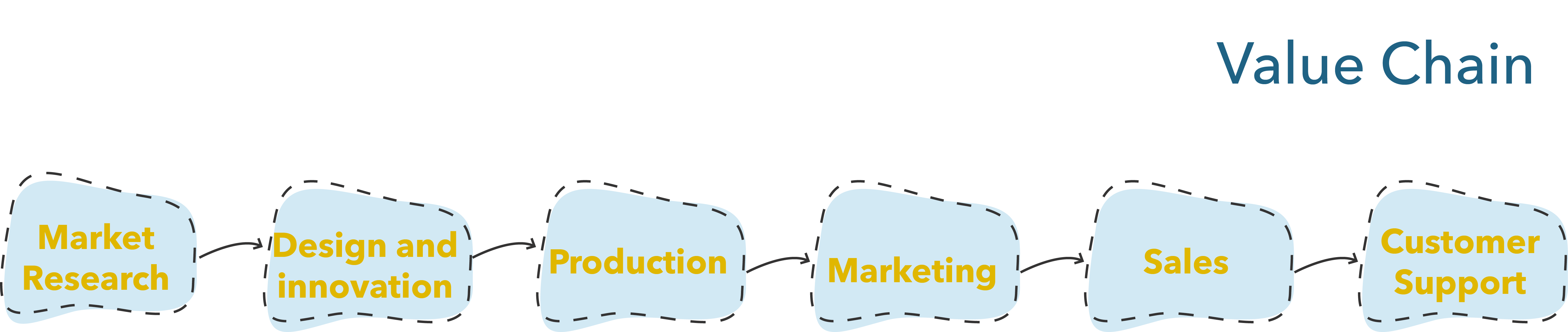
Note: These six activities (two for lead users and four for everyday consumers) should target the six marketing activities of the value chain independently, i.e., one activity for market research, one for design and innovation, and so on.
Pierre-Yann Dolbec is an assistant professor of marketing and Concordia University Research Chair in Complexity and Markets at the John Molson School of Business, Concordia University. His research tackles big questions to understand the complexity of markets and how people and organizations manage complexity. It has been published in the Journal of Retailing, the Journal of Consumer Research, the Journal of Marketing Research, and Marketing Theory, where it has received distinctions such as most cited and most downloaded articles. Recent media coverage includes the National Post, Channel News Asia, CTV News, Global News, CBC, Journal de Montreal, Les Affaires, and Le Devoir.
He has received more than $700,000 in funding from varied funding sources, such as the Social Science and Humanities Research Council and the Fonds Société et Culture, is an editorial review board member of the Journal of Consumer Research and an instructor at the John Molson School of Business, where he is responsible for the digital marketing undergraduate course.
This page provides a record of changes made to this open textbook since its initial publication. If the change is minor, the version number increases by 0.1. If the change involves substantial updates, the version number increases to the next full number.
| Version | Date | Detail |
| 1.0 | Fall 2020 | Pilot version released |
| 2.0 | Sep 2021 |
|
Betty lives in the suburb of a large Canadian city. She and her husband have both recently retired. One of their life dreams is to travel across North America during their retirement. While she doesn’t consider herself wealthy, she and her husband have saved enough during their lifetime to make their dream a reality and enjoy their retirement.
Betty is worried about how to travel in an RV: how to find utility hookups, where to stay when you have an RV, what happens if you blow a tire, how to plan her routes… She wants an RV with certain characteristics. Since she is retiring (and older), it has to be comfortable. She plans to spend most of her time in it! She also has a great network of friends, and she would like her friends to spend time with her in the RV, so she is looking at additional sleeping space and plenty of room. Maybe she’d like to host dinner time! All in all, she’d like an RV that makes her experience easy when traveling.
The objective is product awareness, which leads to the goals: to have users subscribe to updates and to have users engage with product types and features. Each of these goals is associated with two KPIs. For the goal of having users subscribe to updates, the KPIs are having contact forms be submitted and having email subscribe forms be submitted. For the user engagement goal, the KPIs are virtual mirror use and product content popularity.
Acquisition: How do your customers find you?
Activation: How quickly can you get to your customer’s “Aha moment”?
Retention: How many of your customers are you retaining, and why are you losing the others?
Referral: How can you turn your customers into advocates?
Revenue: How can you increase revenue?
Re-automate: Continue to cycle through the stages.
A graph showing search volume vs. conversion rate. In the upper left, the search “tomato plant,” with an average of 22,000 monthly searches, has a very high search volume and a very low conversion rate. “When to plant tomatoes,” with 3,600 monthly searches on average, falls more toward the middle of the graph. The long tail, where conversion rate is high and search volume is low, is formed by the search “why are my tomato plants turning yellow,” which has only 390 average monthly searches.
| Awareness | Consideration | Conversion |
|---|---|---|
| Brand awareness | Traffic | Conversions |
| Reach | Engagement | Catalog sales |
| App installs | ||
| Video views | ||
| Lead generation | ||
| Messages |
| week | network | time | content type | topic | copy | link |
|---|---|---|---|---|---|---|
| week 1 | week 1: Monday, date xx/xx/xx | |||||
| 07:00 | New blog post | silent video | Are you optimizing your video for viewing without sound? You should be. | http://ow.ly.NuSC30c577V | ||
| 10:00 | Curated content | new features | Infinite snaps, loops, and a magic eraser? Woah | http://ow.ly.HEv30c577V | ||
| 12:00 | Video | music resources | Don’t risk your video being removed or your account killed. Here’s the full list of free resources: http://ow.ly.tNx530bKlqN | (insert video file) | ||
| 15:00 | Promotion | product launch | Liftmetrix – Hotsuite impact – New name and offerings to help you measure and maximize ROI: http://ow.ly/zkjS530bKlqN | http://ow.ly/tNx530bKlqN | ||
| 17:00 | Live news | news update | A lot of social media updates happened this month. Let us know your reaction to these ones. | (include CTA link) | ||
Week 1: Send email. Possible actions and their consequences:
Week 2: Email 2 (extra incentive)
Week 3: Email 3 (extra incentive offer ending)
Goals:
| Inquiries and Web Visits | Leads | MQLs | SQLs | Opportunities | Closed Won | |
|---|---|---|---|---|---|---|
| Target | 9550 | 9550 | 1910 | 382 | 191 | 67 |
| Conversion Rate | 10% | 20% | 20% | 50% | 35% |
| Page Element | Element Content | Score |
|---|---|---|
| Headline | “Ocean of data instantly becomes security intelligence” | 0 |
| Subhead | Whitepaper download (“The next generation firewall is here”) | 2 |
| Hero shoot | Photo of a man holding some paper which is partially obscured | 1 |
| Intro | “WatchGuard XTM is the Next Generation Firewall of choice for businesses and enterprises alike, providing best-in-class network security at affordable prices” | 0 |
| Bullets | “Blazing fast throughput” “Best-in-class security solutions” “Advanced networking features” | 0 |
| Form header | “Download your whitepaper! Complete the required fields” | 1 |
| Form fields | Country, province/state, phone number | 0 |
| Testimonial | “I began using WatchGuard products more than eight years ago…” | 0 |
| Learn more | “Learn more about WatchGuard Dimension” | 0 |
| Why | “Best-in-class security” “Easy-to-manage solutions” “Take advantage of data for security” | 0 |
| Privacy statement | “We will never sell your email to any 3rd party or send you nasty spam.” | 0 |
| Call to action | Get my offer | 0 |
| Total | 4 |
| Activity | Co-created value |
|---|---|
| Market search | Online communities |
| Design and innovation | Lead user innovation |
| Production | User-generated content and funding |
| Marketing | Seeding on blogs |
| Sales | eWOM |
| Customer support | User tech support |
| Stage of Journey | ||||
|---|---|---|---|---|
| Awareness | Active Evaluation | Purchase | Loyalty | |
| Concrete actions |
|
|
|
|
| Touchpoints |
|
|
| |
| Opportunities |
| |||